
If you follow financial news in Europe, you’ve probably noticed something confusing. On one hand, there is a lot of talk about euro stablecoins — crypto-based euros already being used for trading, payments, and fintech applications. On the other hand, the digital euro keeps coming up in speeches by policymakers and the European Central Bank.
They sound similar. They both promise “digital money.”
But in reality, they are very different tools designed for very different purposes.
This article is written for normal people — not lawyers, not crypto maximalists, and not central bankers. The goal is simple: to explain, in clear and human language, what euro stablecoins are, what the digital euro is, how regulation like MiCA fits in, and which one Europeans are actually likely to use in daily life and business.
Why Everyone Is Suddenly Talking About “Digital Euros”
Europe is at a turning point when it comes to money.
Cash usage is declining. Online payments are dominant. Crypto has shown that money can move 24/7 without banks. At the same time, governments and central banks are worried about losing control over the monetary system.
That tension is exactly why we now have two parallel developments:
- Private euro stablecoins, created by companies and running on blockchains
- The digital euro, proposed by the central bank as public digital money
They are often discussed in the same sentence, but lumping them together creates more confusion than clarity.
What Is a Euro Stablecoin?
A euro stablecoin is a digital token designed to maintain a stable value of €1 per token. Unlike Bitcoin or Ethereum, its price is not meant to fluctuate.
The idea is straightforward:
one token represents one euro held somewhere as backing.
Most euro stablecoins are issued by private companies that promise to hold real euro reserves (cash or short-term government instruments) for every token in circulation.
Well-known examples include EURC, issued by Circle, and EURT, issued by Tether.
Euro stablecoins are not a theoretical experiment. They are already used for crypto trading without currency risk, cross-border transfers inside and outside the EU, treasury management for fintechs, decentralized finance (DeFi), and on-chain payments where banks are slow or unavailable. For many companies, they function like programmable euros — money that can move instantly and integrate directly into software.
What Is the Digital Euro?
The digital euro is something entirely different.
It is a proposal by the European Central Bank to create a central bank digital currency (CBDC) for the eurozone.
In simple terms, the digital euro would be a digital form of cash issued directly by the central bank. It is not crypto, not decentralized, and not live yet.
According to ECB publications, the digital euro is intended to ensure access to public money in a digital world, reduce reliance on private payment providers, support financial inclusion, and preserve monetary sovereignty. It is designed primarily as a retail payment instrument, not as a trading or investment tool.
A Simple Comparison: Stablecoins vs the Digital Euro
To really understand the difference, it helps to compare them directly.
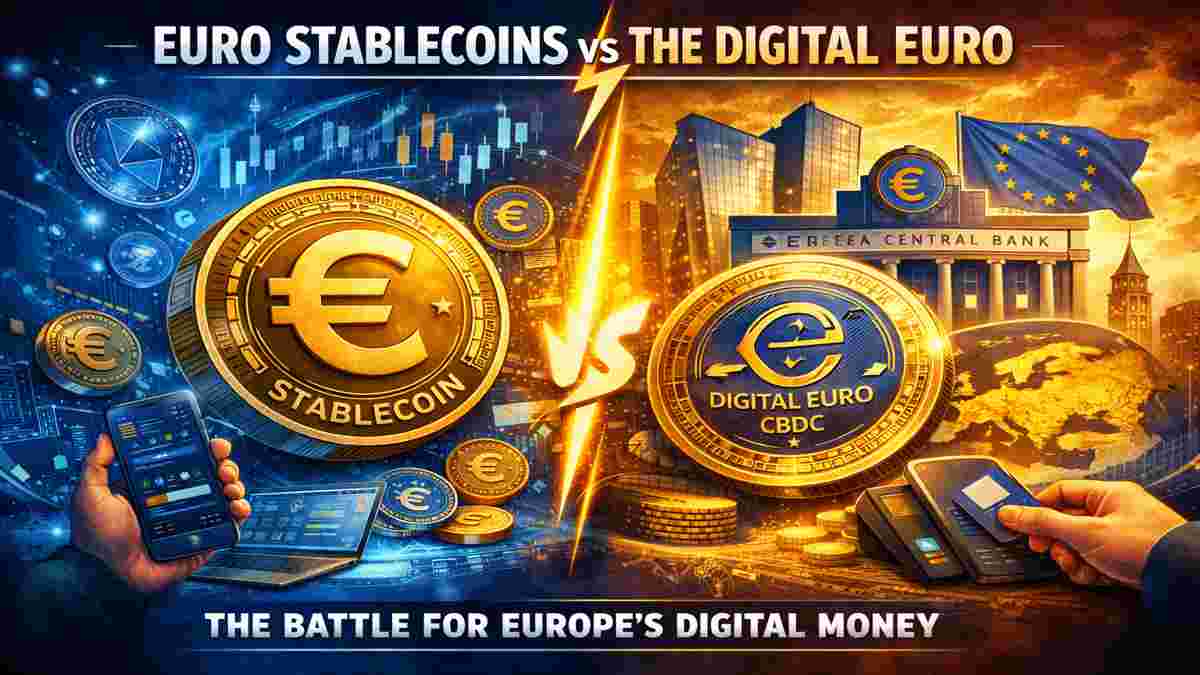
Euro stablecoins are issued by private companies, already live, blockchain-based, highly programmable, and deeply integrated into fintech and crypto ecosystems. The digital euro, by contrast, would be issued by the ECB, run on centralized infrastructure, innovate slowly by design, and prioritize stability, accessibility, and regulatory control.
This highlights an important truth:
these systems are not competitors in the traditional sense. They solve different problems.
Regulation: Where MiCA Changes the Game
One of the biggest reasons euro stablecoins are gaining legitimacy in Europe is regulation.
The EU’s MiCA (Markets in Crypto-Assets Regulation) introduces a clear legal framework for crypto assets, including stablecoins.
Under MiCA, euro stablecoin issuers must provide transparency about reserves, guarantee redemption rights, maintain strong governance, and submit to regulatory supervision within the EU.
This point is often misunderstood:
MiCA does not ban stablecoins. It institutionalizes them.
By setting rules, the EU is effectively saying that stablecoins are allowed — but only if they behave responsibly.
Will the Digital Euro Replace Stablecoins?
The short answer is no.
The digital euro is meant to act like cash in digital form. It is about public trust, accessibility, and sovereignty. Euro stablecoins behave more like financial infrastructure — tools for automation, software integration, global interoperability, and 24/7 settlement.
A useful way to think about it is this:
the digital euro is a public road, while stablecoins are high-speed logistics networks built on top of it.
Europe can — and likely will — have both.
Who Will Actually Use What?
This is where theory meets reality.
Consumers will mostly interact with the digital euro only if it is seamlessly integrated into existing banking apps, feels as easy as contactless payments, and offers strong privacy protections.
Businesses and fintechs care about speed, automation, cross-border efficiency, and cost. For them, euro stablecoins are already attractive, and MiCA makes them safer to adopt.
For crypto users and DeFi participants, the answer is simple: the digital euro is not designed for that world. Euro stablecoins are.
Risks and Trade-Offs
No system is perfect.
Euro stablecoins depend on issuer solvency, reserve management, and regulatory continuity. The digital euro raises concerns about privacy, limited innovation, and the potential crowding out of private payment systems.
These trade-offs explain why a single winner is unlikely to emerge.
Why Europe Is Heading Toward a Dual System
Europe has always balanced public and private finance. Banks are private, money is public, and payments sit somewhere in between.
The future of the euro will likely reflect that same balance: public digital money for trust and stability, and private digital money for innovation and efficiency. It may not be elegant, but it is pragmatic.
Final Thoughts: What Will Europe Actually Use?
The most realistic outcome is not “either-or,” but both.
The digital euro will exist because public institutions believe it must.
Euro stablecoins will grow because businesses and developers find them useful.
The real story is not competition — it is coexistence.
References & Further Reading
European Central Bank – Digital Euro Overview
https://www.ecb.europa.eu/paym/digital_euro/html/index.en.html
European Commission – Markets in Crypto-Assets Regulation (MiCA)
https://finance.ec.europa.eu/regulation-and-supervision/financial-services-legislation/crypto-assets_en
Circle – EURC Transparency & Reserves
https://www.circle.com/en/eurc
Tether – Euro Token (EURT) Information
https://tether.to/en/eurt/
Bank for International Settlements – Central Bank Digital Currencies
https://www.bis.org/about/bisih/topics/cbdc.htm
If you want next steps, I can lightly edit this to perfectly match Hitechies.com’s house style, add internal-link placeholders for future articles, or prepare a short executive summary for readers who skim.