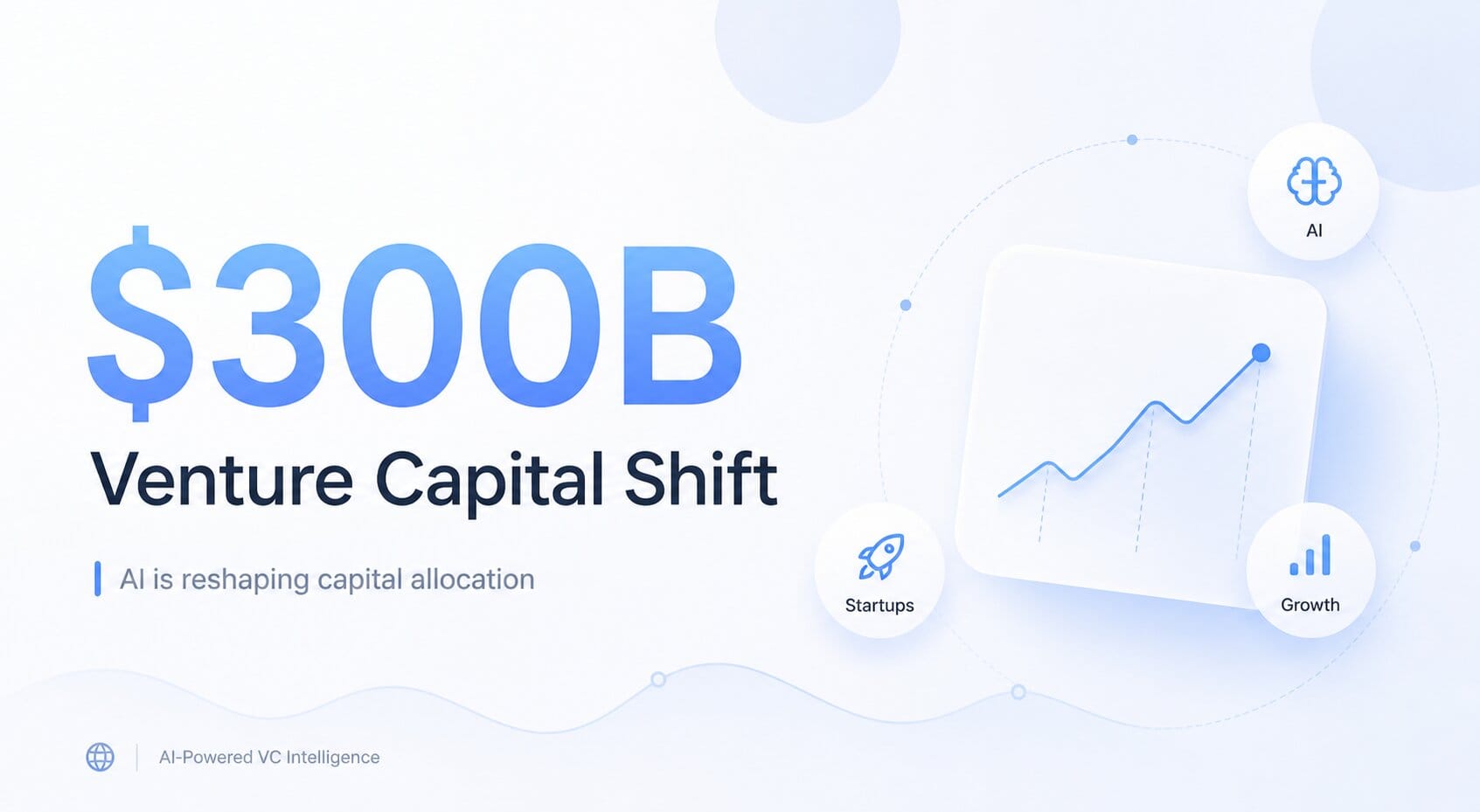
Crunchbase data shows investors poured $300 billion into 6,000 startups globally in Q1 2026, up over 150% quarter over quarter and year over year. That marks an all-time high for global venture investment that no previous quarter has approached. In fact, startup investment in the first quarter of 2026 alone totalled close to 70% of all venture capital spending in 2025, and also tops all full-year investment totals prior to 2018.
Read that number in isolation and you could reasonably conclude that Q1 2026 was the best time in history to be raising venture capital.
Now read the sentence underneath it.
Four of the five largest venture rounds ever recorded were closed in Q1 2026, with OpenAI ($122 billion), Anthropic ($30 billion), xAI ($20 billion) and Waymo ($16 billion) collectively raising $188 billion — 65% of global venture investment in the quarter.
Strip those four companies out. The remaining 5,996 startups split $112 billion between them. That would still be a strong quarter by historical standards. It would not be a record. It would be a number consistent with late 2024 — a market in recovery, not a market at its historic peak.
Both things are true simultaneously. Q1 2026 was the best quarter for venture capital in recorded history. For most founders, it was a normal quarter that happened to occur in the shadow of four companies raising at sovereign-wealth scale.
What the Deal Count Says
The most revealing number in the Q1 data is not the $300 billion total. It is the direction of deal count.
While last quarter set an all-time record for venture dollars invested, more money went to fewer companies, continuing an overall downward trend for deal count since the beginning of 2021. In North America, dollars invested surged 190% year over year even as deal count dropped 26%.
Seed-stage deal count fell 31% year over year to 3,700 deals, even as total seed dollars climbed 30% to $12 billion — meaning fewer startups are getting funded at larger cheque sizes.
This pattern is not noise. It is a structural shift in how venture capital is being deployed. Investors are writing bigger cheques to companies they already know and trust, at stages where those companies have already demonstrated traction. The early-stage bet on an unproven team with a promising idea is happening less often, not more often, even as the total dollars in the system reach record levels.
For a first-time founder without pre-existing relationships in the venture community, Q1 2026 was not more accessible than Q1 2023. It was less accessible. The attention, partner bandwidth, and portfolio capacity of most venture firms is overwhelmingly committed to the AI infrastructure story. A founder building a great product in logistics, healthcare operations, climate tech, or any number of other sectors was competing for the residual attention of investors whose most recent LP meetings were entirely about AI.
The Megaround Illusion
It is worth pausing on what OpenAI's $122 billion round actually represents, because including it in "global venture capital" statistics requires some care about what those statistics mean.
OpenAI closed a $122 billion round at an $852 billion valuation, with participation from Amazon, Microsoft, NVIDIA, and SoftBank. Amazon committed $50 billion of that total. These are not venture capital firms deploying fund capital. They are strategic investors making commitments tied to cloud infrastructure contracts, chip supply agreements, and competitive positioning against each other. The $50 billion Amazon commitment came alongside an agreement making Amazon the exclusive third-party cloud provider for OpenAI's operations. That is not a venture investment in any meaningful sense of the term. It is a business deal dressed in equity language.
OpenAI is generating $2 billion in monthly revenue and approaching 1 billion weekly active users. The company is real. Its revenue is real. But the $122 billion round is infrastructure financing at the scale of sovereign transactions, not a signal about the availability of venture capital for companies raising their first or second institutional round.
Who Is Actually Getting the Money
Beyond the four megarounds, the Q1 data tells a more interesting story about where institutional capital is flowing into the broader tech ecosystem.
Another 10 companies raised funding rounds of $1 billion or more in Q1, in sectors spanning generative and physical AI, autonomous vehicles, semiconductors, data centres, robotics, defence, and prediction markets.
Notice what that list includes: semiconductors, data centres, robotics, autonomous vehicles, defence. This is not the cloud-software-SaaS funding cycle of the 2010s, where capital went primarily into software companies with low capital expenditure and high margins. Unlike the cloud and mobile era, this wave is funding physical infrastructure: chips, data centres, autonomous vehicle fleets, and robotics manufacturing. The compute costs required to train and run frontier AI models are pulling capital into hardware at a scale the venture industry has never seen.
The capital intensity of this cycle has implications for return profiles that investors are still working through. A software company that raises $10 million can theoretically scale to $1 billion in revenue on that capital with no further dilution. A data centre company needs $10 billion to build what it needs to build. The business models are different. The expected returns are different. The institutional investors participating are different — sovereign wealth funds and infrastructure capital sitting alongside traditional VC in ways that have not been typical before.
The Geographic Picture
U.S.-based companies raised $250 billion, or 83% of global venture capital in Q1, up significantly from 71% in Q1 2025. China placed second with $16.1 billion. The UK came third with $7.4 billion.
The widening US share is almost entirely a consequence of the megarounds. OpenAI, Anthropic, xAI, and Waymo are all US companies. Remove them and the US share drops toward historical norms. The geographic concentration of the headline numbers obscures a more balanced picture of where venture capital is flowing at non-megaround scale.
Europe is actually the fastest-growing venture market by year-over-year percentage. Early-stage funding across Europe grew 41% year over year, the strongest regional performance globally. Yann LeCun's World Model AI lab raised $1 billion in Europe's largest seed round ever. The European AI ecosystem in 2026 has more institutional depth, more government support through the EU AI Act framework, and more serious founders than the headline US dominance numbers suggest.
The Question the Data Doesn't Answer
There is a question about Q1 2026 that the funding data cannot resolve: whether the valuations attached to the megaround companies are justified.
OpenAI is generating $2 billion in monthly revenue but still burns cash and has not reached profitability, according to its most recent disclosures. Anthropic has serious enterprise traction. 95% of enterprise generative AI projects have not demonstrated measurable financial returns within six months of deployment, and more than 80% of organisations report no measurable impact on EBIT from their AI initiatives.
The gap between investment and demonstrated return is the defining tension of the current AI moment. The infrastructure being built is probably necessary — the compute, the data centres, the trained models. The question of whether the specific valuations attached to specific companies at this specific moment are justified by the path to profitability that investors will eventually need is not answered by the Q1 data. It will be answered, or not, by what happens over the next two years as private companies with unprecedented valuations face the question of public markets.
If the largest AI companies demonstrate a path to sustainable margins, the capital flood will accelerate. If they don't, the first cracks in the thesis will show, and investors may begin rotating back toward companies with clearer unit economics.
The record was real. The concentration was real. And the question of what happens when the companies holding 65% of global VC eventually need to account for it is the most important story in venture capital that nobody can yet write.
Related reading