In the summer of 2020, a peculiar kind of madness descended on crypto.
Protocols with names like Yam Finance and SushiSwap were offering annual yields north of 1,000%. Anonymous developers were forking competitors' code overnight. Money was moving so fast through so many chains of smart contracts that nobody — including the people who built the protocols — could fully track where it was or whether it was safe. Billions of dollars sat in contracts that had never been audited. Some of it disappeared. Most of it didn't. The whole thing was chaotic and dangerous and genuinely thrilling in a way that had nothing to do with the money.
That era is over.
What replaced it is more interesting and considerably less fun. DeFi in 2026 is not an experiment. It is infrastructure. And the process of becoming infrastructure has required DeFi to make peace with exactly the things it was built to circumvent.
The Fee Switch That Changed Everything
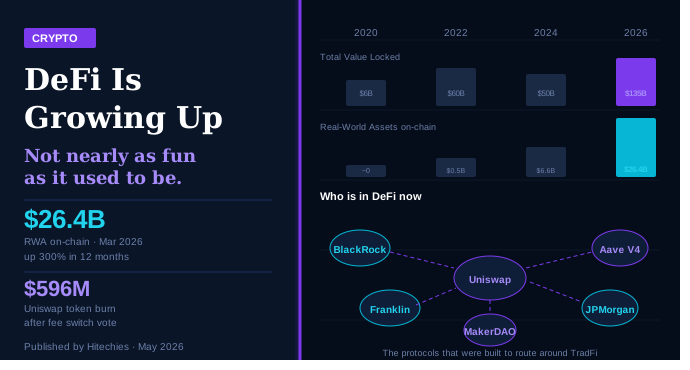
On the first day of 2026, Uniswap executed a token burn worth approximately $596 million — the direct consequence of a community vote that had passed with unanimous support in December 2025.
The decision to activate Uniswap's fee switch sounds technical. The implications are not. For most of its existence, Uniswap operated on a principle that had an almost idealistic purity to it: the protocol provided a service, liquidity providers earned fees for providing liquidity, and the protocol itself charged nothing. Uniswap was infrastructure for DeFi the way TCP/IP is infrastructure for the internet — foundational, permissionless, and deliberately indifferent to the value it created.
The fee switch vote changed that. Beginning in late 2025, a portion of Uniswap's trading fees now flows to the protocol treasury, to be distributed to token holders and used to fund development. The protocol that pioneered permissionless exchange has activated the same mechanism that every traditional financial exchange uses to sustain itself: taking a cut of the transaction.
This is not a betrayal of anything. It is a rational response to operating at scale — Uniswap processes approximately $4.8 billion in daily trading volume across all chains as of Q1 2026, larger by volume than the Nasdaq options market on most trading days. A protocol operating at that size with no revenue is a protocol that has found a way to make the question of sustainability someone else's problem. The fee switch is Uniswap deciding that's no longer a viable answer.
What it signals to the rest of DeFi is simpler: the era of protocols surviving on token emissions and pure community goodwill is ending. The ones that last will be the ones that generate real yield from real activity. The ones that don't will slowly become irrelevant as liquidity flows toward protocols that can offer something sustainable.
BlackRock Is Trading on Uniswap Now
In February 2026, Uniswap partnered with Securitize to integrate BlackRock's USD Institutional Digital Liquidity Fund — better known as BUIDL — into the UniswapX trading platform. Institutional investors can now trade BlackRock's tokenised money market fund directly on-chain.
Hold that thought for a second.
BlackRock manages more than ten trillion dollars in assets. BUIDL is a regulated, institutional-grade money market fund. UniswapX is a decentralised exchange protocol originally built by pseudonymous developers so that cryptocurrency traders could swap tokens without using a centralised exchange.
The fact that these two things have converged in 2026 is not incidental. It is the entire story of what DeFi has become. The infrastructure that was built to route around traditional finance has become attractive enough, stable enough, and compliant enough that traditional finance wants to use it.
The DeFi market size sits at approximately $238.5 billion in 2026, projected to reach $770.6 billion by 2031. Total value locked across all chains sits around $130–140 billion. The leading protocols — Lido at $27.5 billion TVL, Aave at $27 billion, Uniswap at $6.8 billion — are not experimental projects. They are financial infrastructure with more assets under management than many mid-sized banks.
$26.4 Billion and Counting
The most structurally significant number in DeFi right now has nothing to do with token prices or protocol yields. It is $26.4 billion — the value of real-world assets tokenised on-chain as of March 2026, up from roughly $6.6 billion a year prior.
That is 300% growth in twelve months. Not in a speculative token. In tokenised US Treasuries, private credit, corporate bonds, and real estate.
Private credit alone accounts for $14 billion — up 180% year-over-year and the largest single non-stablecoin RWA sector on-chain. Tokenised US Treasuries account for $5.8 to $7.3 billion. Six individual asset categories now each independently exceed $1 billion. BlackRock CEO Larry Fink wrote in his 2026 Chairman's Letter that tokenisation today may be roughly where the internet was in 1996. JPMorgan has launched its own on-chain money market fund. MakerDAO — now rebranded as Sky — holds over $2 billion in real-world assets and generates 60% of its protocol revenue from them.
The logic driving all of this is not ideological. It is operational. Traditional asset issuance costs 5 to 8% in fees. Tokenisation cuts this to 1 to 3%. A tokenised Treasury bond settles in seconds rather than two business days. It can serve as collateral 24 hours a day. It can be divided into any denomination. It can carry compliance logic in the contract itself, so only eligible investors can hold it without a compliance officer manually reviewing each transaction.
For a family office treasurer looking to earn yield on short-duration debt, or a hedge fund that wants to use Treasury exposure as collateral across multiple DeFi positions simultaneously, these are not marginal improvements. They are the difference between a product worth using and one that isn't.
Aave's Horizon platform — a permissioned lending infrastructure specifically built for institutions to borrow stablecoins against tokenised RWAs — already holds approximately $550 million in net deposits and is targeting $1 billion before the end of 2026, with Circle and Franklin Templeton as partners. This is Aave, the protocol that was built so anyone with a wallet could borrow without asking permission, now building a KYC'd, permissioned product for institutional counterparties.
What Got Left Behind
The transformation is real. It is also incomplete, and the incompleteness is worth sitting with.
Decentralised finance began as a specific kind of promise: a financial system that anyone in the world could access with an internet connection, that didn't require a bank account or a government ID or permission from any institution. That promise has not been entirely abandoned. Uniswap is still permissionless. Aave's core protocol still requires no KYC. The basic access story remains intact for anyone willing to navigate the complexity.
But the money has moved. The most significant capital in DeFi in 2026 is not anonymous early adopters running yield farming strategies. It is institutional capital flowing through permissioned products, regulated stablecoin infrastructure, and tokenised real-world assets that would be perfectly at home in any traditional asset manager's portfolio.
The people who got into DeFi in 2020 because they believed in stateless, sovereign-resistant finance now share protocols with Franklin Templeton, JPMorgan, and BlackRock. The infrastructure they built turned out to be efficient enough that the institutions it was designed to circumvent decided they wanted to use it.
That is either a vindication or a co-optation, depending on where you started.
The Boring Thesis
There is a cynical reading of all of this: that DeFi promised revolution and delivered a faster settlement layer for Wall Street. That the gains went to the early holders and the institutions who arrived with capital, and that the financial access story has been quietly shelved now that there are more profitable customers available.
That reading has something to it. But there is a less cynical one that also has something to it.
The protocols that survived — Uniswap, Aave, MakerDAO — survived because they were actually useful. Not useful in the sense that 1,000% yields are useful, which is to say not useful in any sustainable sense, but useful in the way that infrastructure is useful: reliably, at scale, doing something real. The fee switch, the RWA integration, the permissioned institutional products — these are what it looks like when experimental technology stops being experimental and starts being adopted.
The DeFi that looks like it's maturing into something boring is also the DeFi that is processing $4.8 billion a day on Uniswap, holding $27 billion in Aave, and settling BlackRock fund trades on-chain. Boring, in finance, is often another word for working.
The question for the people who cared about the original promise — access, sovereignty, financial inclusion for people without access to traditional banking — is whether the infrastructure that's now good enough for BlackRock is still committed to serving them too. The answer to that question is not yet settled.