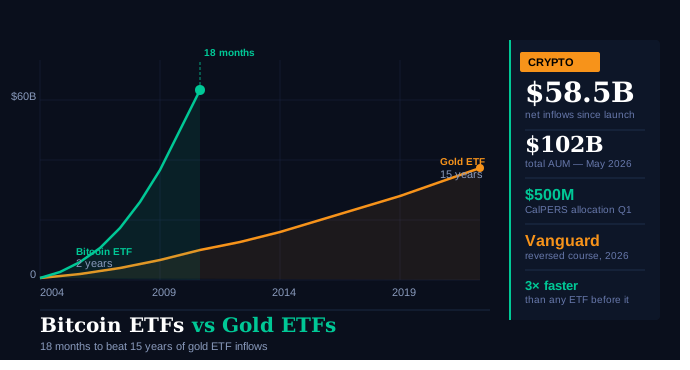
There is a chart that circulates among Bitcoin analysts whenever someone argues the institutional adoption story is overhyped. It compares two lines: the cumulative net inflows into gold ETFs from their 2004 launch, and the cumulative net inflows into Bitcoin ETFs from January 2024.
The gold line climbs steadily for fifteen years — through the 2008 financial crisis, through a decade of zero interest rates, through the longest bull market in the history of American equities — before it reaches what Bitcoin ETFs surpassed in under two years.
This is not a price chart. It does not tell you where Bitcoin is going or what it will be worth when you read this. It tells you something narrower and more verifiable: that the rate at which institutional capital has flowed into Bitcoin ETFs is historically unprecedented for any new financial product. Faster than gold. Faster than any commodity ETF before it. More than triple the $15 billion maximum that analysts predicted before the products launched.
Understanding why that happened — and what it means that it happened so fast — is worth more than any price target.
The Numbers Running Right Now
As of late April 2026, total spot Bitcoin ETF assets under management in the United States sit at approximately $102 billion, with cumulative net inflows of $58.5 billion since the January 2024 launch. April alone saw $2.44 billion in net inflows — reversing outflows from the first two months of the year and pushing total 2026 flows back into positive territory.
BlackRock's iShares Bitcoin Trust, known by its ticker IBIT, is the dominant instrument by a distance that tells you something important about how institutional capital actually moves. IBIT holds approximately $62 billion in assets — roughly 60% of the entire US spot Bitcoin ETF market by AUM. Fidelity's FBTC, the second-place fund, holds approximately $17-18 billion. Both products hold physical Bitcoin. Both charge similar fees. The gap between them is not explained by product quality. It is explained by distribution — by the advisor networks, the wirehouse platforms, the retirement account infrastructure that BlackRock has spent decades building.
On a single day in April, IBIT pulled in $214 million. Fidelity's FBTC added $45 million. ARK 21Shares contributed $113 million. Total daily inflows across the category: $411.5 million. This is not an exceptional day. It is a normal one.
The Conversion of the Skeptics
The most revealing data point in the entire Bitcoin ETF story is not BlackRock's cumulative inflow or IBIT's AUM. It is Vanguard.
For years, Vanguard occupied a specific and important position in the institutional debate about crypto. It was the most credible, most intellectually serious voice saying no. The company manages approximately nine trillion dollars in assets, almost entirely through low-cost index funds built on the efficient markets hypothesis. Its founder, Jack Bogle, was skeptical of any asset class that produced no earnings, no dividends, and no cash flows. Crypto, in Vanguard's telling, was not an investment. It was speculation.
In early 2026, Vanguard announced a pilot program exploring Bitcoin exposure in select funds. Shortly after, it added third-party Bitcoin ETFs to its platform, making them available to Vanguard clients for the first time.
This is not a small event. Vanguard's size means that even a modest allocation creates institutional-scale demand. A 0.5% crypto allocation across Vanguard's managed portfolios would represent approximately $45 billion in additional demand. That ceiling has barely been scratched. The significance is not the amount Vanguard has put in. The significance is that the most principled institutional opponent of crypto allocation — the company that was most visibly and vocally on the other side — has changed its position.
When Vanguard moves, it is not following a trend. It is making a judgment that the evidence has changed enough to warrant a change in stance. The evidence that changed it is the same evidence visible in the flow data: two years of institutional capital behaving differently than it has ever behaved around a new asset class.
Diamond Hands, Institutional Edition
Bitcoin peaked above $126,000 in late 2025. By early 2026, it had fallen to roughly $69,000 — a decline of more than 50% in a matter of months. This is the kind of move that, in previous cycles, triggered waves of ETF outflows as investors who bought near the top rushed to cut their losses.
It did not happen.
Bitwise CIO Matt Hougan documented this explicitly in March 2026. Bitcoin ETFs had accumulated roughly $60 billion in net inflows from their launch through October 2025. Since prices fell roughly 50% from that point, Hougan expected meaningful outflows. What he found instead was that less than $10 billion had left the funds. "Despite a punishing bear market," he wrote, "professional investors have proven to be diamond hands."
His explanation for why is more interesting than the data itself. Bitcoin remains, in Hougan's framing, a non-consensus asset. An institutional investor who allocates to Bitcoin has already run a gauntlet: the internal investment committee that needed convincing, the compliance team that needed to approve it, the client communication that needed to be written explaining why. By the time that capital is actually deployed, it belongs to investors with unusually high conviction. They bought because they had a view. A 50% price decline does not change the view.
This is a structural feature of early-stage institutional adoption, not a specific feature of Bitcoin. The early institutional investors in gold ETFs were similarly conviction-driven. What matters is what happens when the second and third wave arrives — the advisors and platforms that allocate not because they have a strong view but because their competitors have started allocating and the cost of being wrong has shifted.
Who Is Actually Buying
CalPERS — the California Public Employees' Retirement System, one of the largest public pension funds in the United States — allocated 1% of its assets to Bitcoin in Q1 2026. That is approximately $500 million from a single pension fund.
Millennium Management, the global hedge fund, has ramped crypto allocations to 8% of assets under management. Fidelity now offers 1% Bitcoin ETF allocation options in 401(k) plans — retirement accounts — and drew $800 million in new assets from that product in the first months after launch. Morgan Stanley launched its own Bitcoin ETF in April 2026; within 13 trading days, it had accumulated $163 million in net assets.
Sovereign wealth funds from Qatar, Norway, and Abu Dhabi have purchased Bitcoin directly or via stakes in Bitcoin-adjacent companies. Brazil and Kyrgyzstan have passed legislation enabling Bitcoin purchases for national reserves. The US Strategic Bitcoin Reserve — a policy that would have seemed inconceivable to most serious analysts five years ago — has fundamentally altered how sovereign entities think about the asset.
The universe of institutional buyers is no longer a handful of crypto-native funds and early-adopter hedge funds. It is pension systems, sovereign wealth vehicles, wirehouse platforms, and 401(k) providers. The distribution channels are mature. The products are regulated. The compliance frameworks exist. What remains is for more of the capital sitting on the sideline to make the decision to move.
What the Gold Comparison Actually Means
The comparison to gold ETFs is useful precisely because gold is well-understood. Gold has been a store of value for millennia. Gold ETFs made it easy for institutions to get exposure without holding physical metal. When GLD launched in 2004, it was immediately recognised as a legitimate financial product and attracted significant institutional interest.
It still took fifteen years to accumulate what Bitcoin ETFs accumulated in under two.
According to data from ARK Investment Management and 21Shares, Bitcoin ETFs accomplished in less than two years what took gold ETFs more than fifteen years. This comparison is based on cumulative net inflows normalised for launch date, not on price or total AUM. It is a measure of capital velocity — how fast institutional money moved into the product after it became available.
The most straightforward explanation is that Bitcoin launched into a financial ecosystem that gold ETFs did not have in 2004: a mature ETF industry, established institutional crypto desks that had been building internally for years before the products launched, and a regulatory environment that — while imperfect — had finally resolved enough uncertainty for compliance teams to say yes.
But there is another explanation that deserves equal weight. The demand was already there. Institutional investors had been watching Bitcoin for a decade. The ETFs did not create demand. They unlocked capital that was ready to move but had no appropriate vehicle to move through.
The Honest Version of Where This Goes
Total spot Bitcoin ETF assets under management are expected to reach $180–$220 billion by the end of 2026. If those projections hold, the product category will have grown from zero to roughly $200 billion in less than three years — a pace of adoption without precedent in the history of exchange-traded products.
Bitcoin is also changing in character as a result of this capital. The 50% decline from the 2025 highs was severe, but it was not accompanied by the kind of forced selling, exchange collapses, and retail panic that characterised the 2022 downturn. Institutional holders did not sell. Derivatives markets did not collapse. The market structure behaved more like a commodity with deep institutional ownership than like a speculative asset driven by retail sentiment.
That is either reassuring or disappointing depending on what you wanted Bitcoin to be. If you believed in it as an ungovernable, counter-cultural alternative to the financial system, the presence of BlackRock and pension funds and 401(k) allocation options is not obviously good news. If you believed in it as a legitimate asset class seeking institutional legitimacy, it is.
What is not in question is what has happened. The data is not ambiguous. Capital flowed in at a rate nobody predicted. The investors who were most visibly skeptical reversed course. The products are holding through a 50% decline. The distribution channels are expanding.
Whatever Bitcoin is, it is no longer something that serious investors can dismiss without having examined the evidence. The evidence is in the flows. And the flows are pointing in one direction.
Related reading