In April 2026, Figma shipped something that would have sounded like science fiction at its last major conference: AI agents that design directly on the canvas. Not suggestions. Not prompts that generate static mockups you then import. Actual agents, working inside your live design file, alongside your design system, applying your spacing rules, touching your real components.
Figma has been around since 2012. For most of that time it was, purely and simply, a design tool. Then in 2025 it shipped Figma Make — prompt-to-prototype, integrated with your component library. Then in 2026 it shipped agents in the canvas. The tool that taught designers to stop emailing PSDs to each other is now a product where AI participates in the design process as a collaborator, not a feature.
Nobody announced that Figma became an AI company. It just did.
The Transition That Didn't Come With a Memo
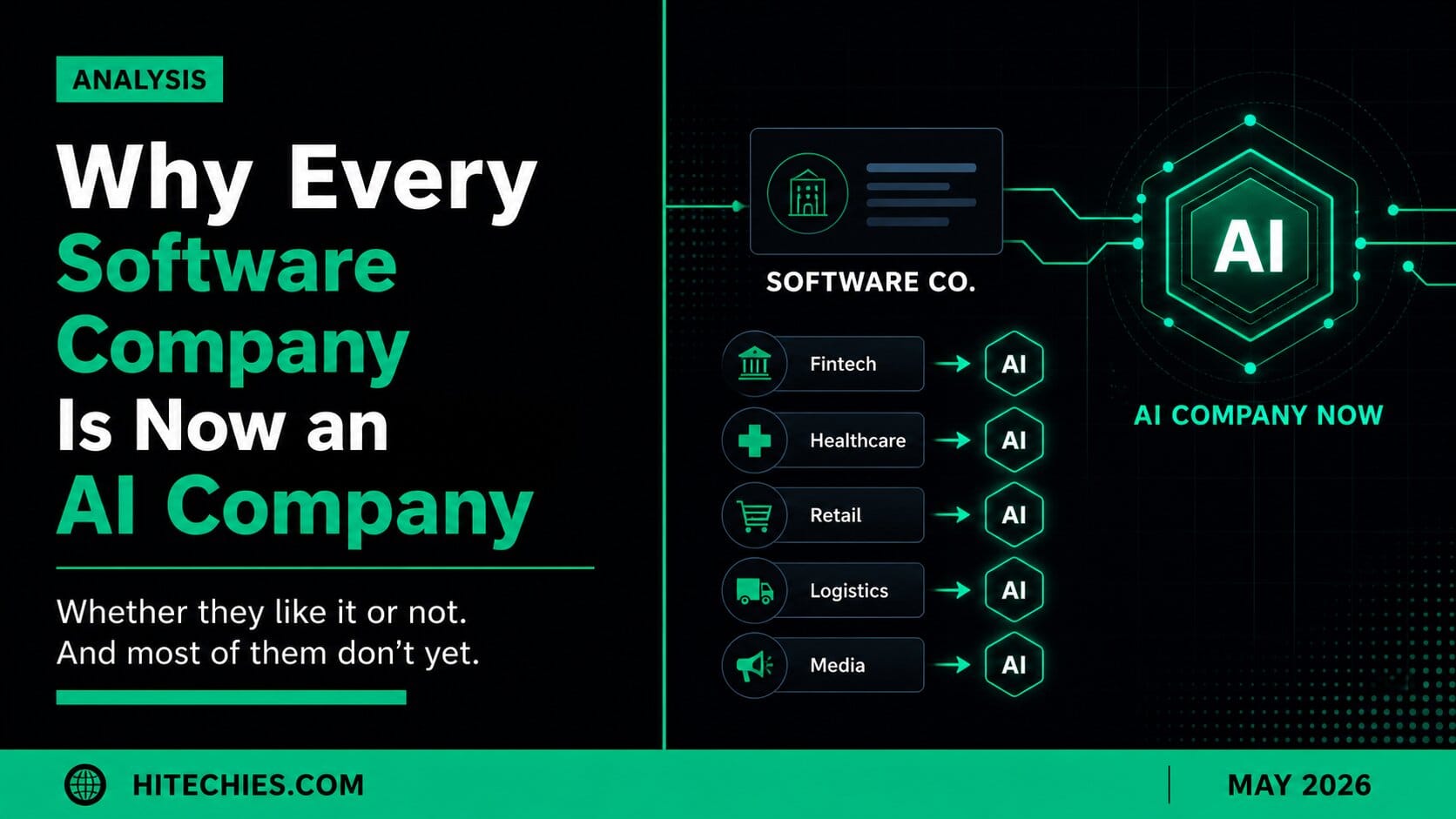
Here's what's strange about this moment: the most significant shift in how software companies build products happened without most of those companies deciding it was happening.
There was no industry conference where someone stood on a stage and said "the category is collapsing." There was no analyst report that landed in enough inboxes simultaneously to shift behaviour. There was just a gradual, relentless drop in the cost of integrating genuine intelligence into a product — and then, one day, not doing it started to look like a choice that required explanation.
The pattern is visible everywhere once you start looking.
Stripe, which has spent fifteen years positioning itself as financial infrastructure for developers, now offers what it calls an Agentic Commerce Suite — a set of APIs that let AI agents conduct transactions on behalf of users, with programmable checkout flows, shared risk signals, and outcome-based pricing built in. Think about what that means for a moment. Stripe isn't adding a chatbot. It's rebuilding its core primitives around the assumption that the entity making purchases might not be a human at all. That's not a feature. That's a fundamental architectural decision about what Stripe is for.
Figma, as described above, has gone further than almost anyone in collapsing the boundary between the tool and the intelligence operating inside it. The April 2026 canvas agent update isn't just impressive — it's a statement about what design software is. It's no longer a canvas. It's an environment where human designers and AI agents work on the same files, with the same access to the same design system, in real time. The LogRocket blog's coverage of it put it cleanly: Figma has evolved "from a design tool into an AI-assisted product design ecosystem."
And Stripe and Figma are not scrappy AI-first startups building on foundation models. They are decade-old companies with millions of users, mature engineering organisations, and real revenue. The transition is not coming. It arrived.
What "AI Company" Actually Means Now
Part of the confusion here is definitional. When people say "AI company," they often mean one of two things that are increasingly irrelevant: a company that trains models, or a company whose product is an AI assistant. Both of those things exist. Neither of them is the interesting category anymore.
The interesting category is the third thing: companies whose core product has been structurally reorganised around AI capability. Where the intelligence isn't a feature you turn on or off — it's load-bearing infrastructure.
To understand what that looks like in practice, think about what evals are.
An eval is an automated test for AI output quality. If your product makes a decision — writes a sentence, routes a ticket, prices a contract, triages a bug — and that decision is made by a model, you need a systematic way to know if the model is making that decision well. Evals are how you do that.
For most engineering teams, evals are completely outside their current tooling, culture, and mental model. Tests are for code. Monitoring is for infrastructure. The idea that you need an entirely separate quality assurance discipline for the outputs of the inference layer — that's a new muscle most companies haven't started building.
The companies that have started building it are moving differently than the companies that haven't. Not faster necessarily. More precisely. They've accepted that some parts of their product are going to behave probabilistically rather than deterministically, and they've built systems to manage that gap. Everyone else is either not using AI in any serious way, or using it without really knowing if it's working.
The Talent Signal Nobody Talks About
Here's a concrete way to see where a company actually is in this transition: look at what they're hiring for.
A company at the "we added a chatbot" stage is hiring prompt engineers — usually junior, usually on contract, usually sitting outside the core engineering organisation.
A company genuinely restructuring around AI is hiring for something harder to name. It's the combination of product intuition, systems thinking, and the specific judgment that comes from having shipped products where the output isn't fully predictable. They want engineers who understand that "it works in testing" has a different meaning when the component doing the work is a language model. They want product managers who can write a spec for a system that sometimes gives different answers to the same question.
That skillset is genuinely rare. It's rarer than most hiring managers currently understand, because they're still thinking about it as a technical role rather than a product role. The teams that figure this out first will pull ahead in ways that compound over years, not quarters.
The Incumbent's Specific Problem
There's a version of this argument that gets simplified into "startups will eat your lunch." That's true but not the most interesting part.
The more interesting part is that the threat incumbents face isn't a direct copy of their product with AI bolted on. It's a product that solves the same customer problem with a completely different architecture — one where the intelligence is at the centre and the interface is secondary.
Think about what a CRM is. At its core, it's a system that helps salespeople know what to do next with their pipeline. The incumbent CRM is a database with a very complicated UI. The AI-native challenger is a system that watches all your communication channels, understands your deals better than your CRM does, and tells you what to do — with the database as an implementation detail rather than the product.
These aren't better CRMs. They're different products that make CRMs look like what they actually are: complex filing systems with workflow automation glued on. You can't patch your way out of that architectural gap. You have to decide, at a company level, whether you're going to rebuild.
Most incumbents are not having that conversation. They're having a conversation about which AI features to add to the roadmap in Q3.
The Honest Version of Where This Goes
The argument here isn't that every software company will become an AI company smoothly or even successfully. Plenty won't. The transition involves real costs — technical debt, culture change, talent you don't have, product decisions that require conviction rather than data.
And the hype is real too. There are companies slapping "AI-powered" on products where the AI is doing approximately nothing, optimising for fundraising slides rather than product quality. Hallucinations are still a problem. Inference costs at scale still don't pencil out in some unit economics. The gap between what demos look like and what production systems feel like is still large enough to embarrass.
But here's the thing about transitions of this kind: they don't require universal adoption to be directionally correct. What matters is that enough companies — across enough categories — have crossed the threshold where AI is structurally important to their product rather than cosmetically attached to it.
That threshold has been crossed. Figma crossed it. Stripe crossed it. Dozens of companies you use every day have crossed it quietly, without press releases, without rebrandings.
The question for everyone else isn't whether this is happening. It's how much of a head start they're willing to give the companies that started moving eighteen months ago.
Related reading