Tools · May 22, 2026
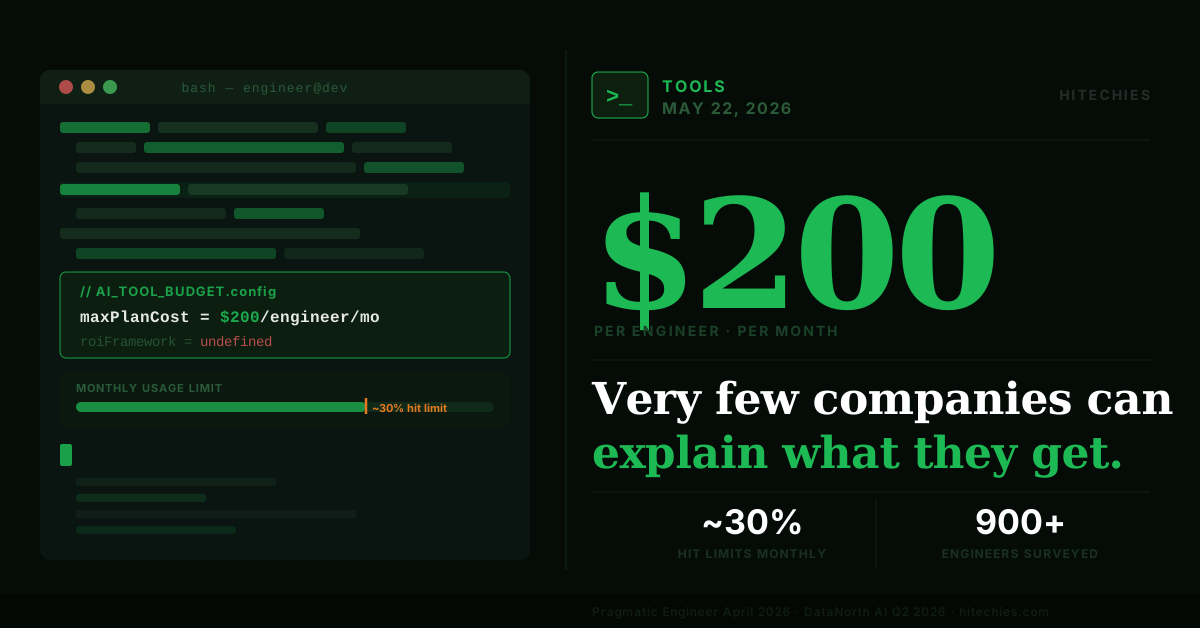
Companies are spending $200 a month per developer on AI tools. Very few can explain what they're getting for it.
A survey of 900+ engineers published in April 2026 found that around 30% have already hit usage limits monthly. The larger problem is that most teams never defined what success looks like — and the companies that did are getting results the others aren't.
The promise was clean. Developers use AI coding tools. They write code faster. Productivity rises. Costs stay predictable. That narrative has been the backbone of a tool category that has attracted billions in investment and reshaped how engineering teams think about their daily workflow. The reality, surfacing with increasing clarity in 2026, is considerably messier.
The Pragmatic Engineer's April 2026 survey of over 900 software engineers and engineering leaders is one of the most detailed examinations of how AI coding tools are actually being used at scale — not in marketing materials, but in day-to-day engineering work across companies of varying sizes, geographies, and technical sophistication. The findings are instructive, and they are not uniformly flattering to the tool vendors or the companies deploying them.
Approximately 30% of survey respondents had already hit usage limits on their paid AI coding tools within a given month. Around 15% cited AI tool cost as a serious and ongoing concern. Companies are commonly funding "Max" plans for Claude Code, Cursor, and Codex — costing $100 to $200 per engineer per month — while explicitly acknowledging, as several respondents did, that they are still in an "experimentation phase" with no defined framework for measuring what the investment is producing.
"Right now, we're not sweating the costs because we're trying to evolve best practices. But that has resulted in some devs really blowing through budget — so we may start instituting caps on spending."
— CTO, US-based company, Pragmatic Engineer survey, April 2026
That quote, from a CTO at a small US company, captures the dynamic precisely. The budget is open because no one wants to be the manager who slowed the team's AI adoption. The result is unconstrained spend with undefined outcomes — a combination that finance teams at these same companies will eventually find unacceptable, at which point the conversation will happen under pressure rather than from a position of clarity.
What the survey of 900+ engineers actually found — April 2026
~30%
of engineers hit monthly usage limits on paid AI coding tools — a recurring friction point
~15%
cited AI tool cost as a serious, ongoing concern rather than an accepted business cost
$100–200
per engineer/month on top-tier "Max" plans at companies — GitHub Copilot at $20 sits at the opposite end
The arithmetic problem that nobody is doing
The economic case for premium AI coding tools is built on an assumption that is almost never verified in practice: that the productivity gain from the tool, measured in engineering output per dollar, exceeds the cost of the tool by a sufficient margin to justify the investment relative to alternatives. That sounds obvious. The striking finding from the survey data is how rarely companies have actually done that calculation — or set up the measurement infrastructure to do it retroactively.
One European founder in the survey articulated the arithmetic problem clearly. A single small task executed using Kimi K2.5 through a third-party inference provider costs approximately $5 in input tokens at current pricing. The same task completed under a Claude Code Max plan at $100 per month per engineer is effectively free at the margin — but only if the engineer is using the tool at sufficient volume to amortize the flat rate meaningfully. For engineers who use AI tools heavily and continuously, the flat-rate pricing is favorable. For engineers who use them selectively on complex tasks, the per-task economics of a cheaper model may be significantly better.
The same founder noted what they described as a sustainability concern: "I cannot see how the spend on AI tools is fiscally sustainable in its current form. If we assume that third-party inference providers are doing so at a sustainable price, the much more expensive Opus model cannot be sustainable, never mind profitable at these plan costs." This is not a fringe view. The pricing structures of current AI tool plans appear to reflect customer acquisition strategy more than sustainable unit economics — which suggests that the pricing environment for these tools will look different in 18 to 24 months than it does today.
The incentive misalignment that compounds the problem
The survey reveals a structural misalignment in how AI tool costs are experienced at different levels of the engineering organization — and it runs in an unexpected direction. At small and mid-sized companies, leadership is more comfortable with budget overruns than engineers are with running out of usage credits mid-task. The incentive from the top is to experiment freely without cost pressure. The experience at the individual level is a hard stop when a limit is hit, often at a critical moment in a debugging session or a complex code generation task.
This creates a paradox. Engineers who use AI tools most heavily — who are getting the most value from them — are the most likely to hit limits. Engineers who use them more conservatively never encounter the constraint but also never develop the deep workflow integration that produces the largest productivity gains. The usage cap, wherever it is set, functions as a ceiling on the highest-value use cases.
The companies managing this most effectively have implemented a tiered approach: a small number of "power user" seats on maximum plans for engineers who use AI tools as a core part of their workflow, and lower-tier plans for engineers who use them as an occasional supplement. This sounds like obvious resource allocation. It is surprisingly uncommon. Most companies default to a uniform plan across the engineering team, optimizing for administrative simplicity at the cost of economic efficiency.
The model routing discipline that separates the leaders from the rest
The DataNorth AI Q2 2026 analysis — which tracks the AI tool landscape across frontier models and enterprise deployments — identifies what it calls a "routing discipline" as the single most important differentiator between teams extracting strong ROI from AI tools and teams paying for capability they are not using. The insight is straightforward but requires operational commitment to implement: not all tasks require the same model, and routing tasks to appropriately capable (and appropriately priced) models based on their actual requirements produces significantly better cost outcomes without meaningful quality degradation on the tasks that don't need frontier capability.
In practical terms, this means using GPT-5.4, Claude Opus 4.7, or Gemini 3.1 Pro for the tasks that genuinely benefit from the highest reasoning capability: complex architectural decisions, subtle bug diagnosis in systems with many interacting components, security review of generated code, and tasks requiring deep contextual understanding of a large codebase. It means routing boilerplate generation, simple refactoring, documentation drafting, and test generation to smaller, faster, and significantly cheaper models — Kimi K2.5, Gemma 4, or smaller Claude variants — where the quality difference is minimal and the cost difference is substantial.
"The underlying trends have not changed. Reasoning and agentic execution are still the two axes everyone is racing along. What has changed is that the frontier tier has shifted again, and the line between AI assistant and autonomous agent has effectively dissolved."
— DataNorth AI Q2 2026 Update
The April 2026 model landscape is itself worth understanding in the context of tool cost. OpenAI's GPT-5.4 Thinking, Claude Opus 4.7 with adaptive thinking, and Gemini 3.1 Pro have all eliminated the separate "reasoning mode" that characterized their predecessors — the o-series branding is gone. Reasoning is now the default behavior, not an add-on. This means that the performance gap between frontier models and mid-tier models for complex reasoning tasks has narrowed, because even the mid-tier models now reason by default rather than generating without reflection. The practical implication is that the cost-performance tradeoff for many common engineering tasks has shifted in favor of the cheaper options.
What the GPT-5.1 retirement means for teams that haven't acted
GPT-5.1 models were retired on March 11, 2026. GPT-5.4 became the default for the OpenAI platform. For engineering teams running automated pipelines that were integrated against the older model endpoints, this retirement triggered a forced upgrade that exposed a category of technical debt that had been accumulating quietly: API-driven workflows that were never tested against a model version change because nobody expected model versions to change on a quarterly cadence.
Claude's tokenizer change between 4.6 and 4.7 produced a similar challenge. Teams running autonomous agents on Claude 4.6 and upgrading to 4.7 discovered that the token count for identical inputs had shifted — meaning that cost models built against 4.6 pricing were no longer accurate, and that workflows calibrated to specific context window sizes were behaving differently than expected. These are not catastrophic failures. They are the kind of operational friction that compounds over time when AI model dependencies are managed with the same assumptions as stable software dependencies rather than as a continuously evolving external service.
The teams handling this most gracefully had built model abstraction layers into their AI integrations — wrappers that could be reconfigured to point at a new model version without changes to the business logic of the workflow. Teams without that abstraction were doing manual updates across their pipeline configurations, absorbing engineering time that was not budgeted against the AI tooling cost calculations.
Three changes high-performing engineering teams are making in H1 2026
- Model routing by task category: Frontier models for architecture and complex reasoning, cheaper models for generation and boilerplate. The cost difference can exceed 10× per task.
- Tiered seat allocation: Maximum plans only for engineers who demonstrably use AI tools as a core workflow component. Lower plans for selective users. A uniform plan for all engineers regardless of usage intensity is economically inefficient.
- Model abstraction in pipelines: Any AI-integrated workflow has a configuration layer that decouples the business logic from the specific model endpoint — enabling model version updates without pipeline rebuilds.
The honest productivity picture
Setting aside the cost question, the productivity picture for AI coding tools in 2026 is genuinely mixed — and the variance is wide enough that aggregate claims about productivity gains should be treated with significant skepticism. The engineers experiencing the largest productivity gains from AI coding tools share a consistent profile: they had strong existing skills before AI tools became available, they treat AI output with active skepticism rather than passive acceptance, and they have developed intuitions about which categories of task AI tools handle well and which they handle poorly.
The engineers experiencing the smallest gains — or, in some cases, negative net productivity due to debugging overhead — tend to have adopted AI tools without developing those intuitions. They trust output that looks syntactically correct. They deploy code that passes automated tests without reviewing for the subtler failure modes that AI tools consistently produce: incorrect assumptions about error handling, security vulnerabilities in generated authentication logic, race conditions in generated concurrency code, and edge cases that the training distribution did not adequately represent.
The practical implication is that the ROI on AI coding tools is not uniform across a team and cannot be meaningfully discussed as an average. It is a function of the individual engineer's ability to direct and review AI output — a skill that is distinct from raw coding ability and is not automatically acquired through tool exposure. Companies that invest in developing that skill, through deliberate training and code review practices specifically designed for AI-generated output, will extract systematically better returns than companies that deploy the tools and assume the gains will follow.
Sources: The Pragmatic Engineer, "The Impact of AI on Software Engineers in 2026," April 14 2026 · DataNorth AI, "Top 10 Best AI Tools for 2026 (Q2 Update)" · OpenAI GPT-5.1 retirement notice, March 2026 · Anthropic Claude 4.7 tokenizer documentation · Pragmatic Engineer survey raw findings, 900+ respondents