Startups · May 21, 2026
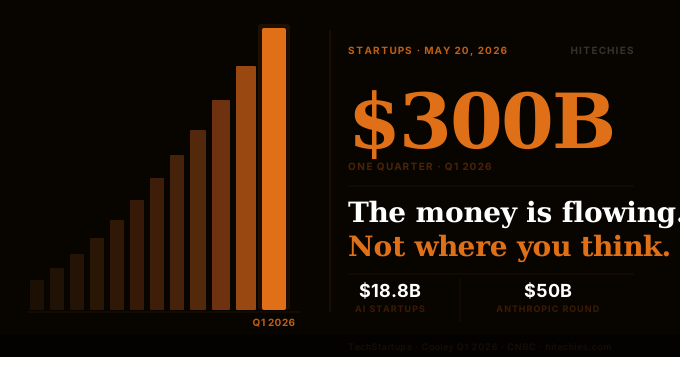
Venture capital deployed $300 billion in Q1 2026. The money is flowing. It is just not flowing where most founders think it is.
As global VC hits historic highs, the categories receiving capital have narrowed sharply into AI infrastructure, defense tech, and deeptech with genuine IP. For founders outside those categories, the market has become considerably less forgiving — and the gap between what they believe investors want and what investors are actually funding has never been wider.
The headline number is almost disorienting. Global venture investment hit $300 billion in the first quarter of 2026 alone — representing approximately 70% of all capital deployed across the entirety of 2025. The industry is describing the current moment variously as the "Agentic Infrastructure Super-Cycle" and the "AI infrastructure gold rush." Both framings are apt. Wall Street is writing billion-dollar checks at a pace that makes the 2021 peak look measured by comparison. Cooley, the VC law firm, facilitated nearly $40 billion in venture financing in Q1 2026 alone.
None of that headline abundance makes the average founder's fundraising easier. It may, in some ways, be making it harder. Capital concentrating at the top of the market — in mega-rounds for infrastructure companies and frontier AI labs — creates an impression of a wide-open funding environment that does not match the experience of companies outside the categories receiving the largest checks. The market is not uniformly hot. It is extremely hot in three specific categories, moderately active in a few adjacent ones, and significantly cooler than the aggregate numbers suggest everywhere else.
The funding landscape — Q1–Q2 2026
$300B
Global VC deployed in Q1 2026 — ~70% of all 2025 capital in a single quarter. Described as the "Agentic Infrastructure Super-Cycle."
$18.8B
Raised by AI startups founded since early 2025 — new entrants are capturing significant capital at compressed timelines from founding to raise
$100M
Parallel Web Systems raised from Sequoia at a $2B valuation — agentic infrastructure, not an AI application
$50B
Anthropic's reported next funding round — the frontier lab tier now operates at a scale that bends the market around it
What the largest rounds actually reveal about investor priorities
The May 19 funding roundup from TechStartups described the current moment as one defined by "an aggressive transition from model experimentation to industrial-scale deployment." That description is more analytically useful than most VC commentary, because it identifies the specific transition that is driving capital allocation decisions rather than simply noting that AI is popular.
The companies receiving the largest checks in Q2 2026 are not, for the most part, building AI applications that sit on top of existing infrastructure. They are building the infrastructure itself, or the physical systems that AI controls, or the governance and security layers that enterprise AI requires. Parallel Web Systems — $100 million, $2 billion valuation, Sequoia-led — is building agentic infrastructure: the layer beneath applications. Firestorm Labs — $82 million — is building shipping-container drone manufacturing: physical AI at scale, for defense and logistics applications. 137 Ventures — $700 million-plus across two growth-stage funds — is explicitly focused on startups with large market impact potential, language that in the current context means companies capable of displacing significant existing market value rather than creating new market niches.
Armada, another notable Q2 raise, is deploying mobile, megawatt-scale modular data centers — what they call "Leviathan" — that can operate beyond existing power grid infrastructure. The thesis is that the AI compute demand is outrunning fixed data center capacity, and that mobile, deployable compute infrastructure is a constraint that will determine which companies can actually run the AI systems they need at the scale required. This is an infrastructure bet, not an application bet — and it is receiving serious capital accordingly.
"The venture capital landscape on May 19 2026 is defined by an aggressive transition from model experimentation to industrial-scale deployment. The sheer scale of capital being deployed reflects a market betting on a permanent shift in how value is created."
— TechStartups, VC Funding Roundup, May 19 2026
The legal infrastructure that tells you where the money expects to go long-term
Cooley's position as the top VC law firm globally — which it has held consistently for multiple years — is a useful proxy for where institutional capital is structurally concentrated. The $40 billion in Q1 2026 financing that Cooley facilitated represents a meaningful fraction of the total venture deal flow, and the firm's client mix is a reliable indicator of where the highest-value transactions are happening. The concentration of that deal flow in AI infrastructure, enterprise software, and defense technology is consistent with the investment thesis that is dominating the current market: that the foundational layer of AI-enabled business is being built right now, and that the companies establishing durable positions in that layer will generate returns comparable to the cloud infrastructure buildout of the 2010s.
The legal and regulatory infrastructure around AI is also maturing in ways that create specific funding opportunities. The WEF Global Cybersecurity Outlook 2026 noted that governments are moving toward requiring earlier review of advanced AI systems before public release — a regulatory posture that, if implemented, will create significant demand for AI governance, audit, and compliance tooling. Companies building in this space have a regulatory tailwind that pure application companies do not. Investors who track regulatory development as a leading indicator of market creation are already positioned accordingly.
The Anthropic $50B round and what it means for the rest of the market
Anthropic's reported next funding round — at approximately $50 billion — operates at a scale that is effectively a different asset class than standard venture investing. At that valuation, Anthropic is not a startup seeking venture capital; it is a frontier AI lab securing the resources to compete at the level of nation-state infrastructure investment. The companies that Anthropic competes with — OpenAI, Google DeepMind, Meta AI — are similarly capitalized. The capital requirements to remain competitive at the frontier are compounding faster than any but the best-resourced organizations can sustain.
The practical implication for the broader startup ecosystem is that the frontier model layer is, for practical purposes, closed to new entrants. The capital, compute, and talent required to train competitive frontier models are beyond the reach of startups in any conventional sense. This is not universally true — there are well-funded new entrants doing interesting work on specialized architectures and domain-specific models — but as a general market orientation, the competitive dynamics at the frontier favor incumbents with extraordinary resources.
What this creates for the rest of the market is an opportunity structure that is specifically favorable for companies that build on top of frontier models rather than competing with them — vertical applications with deep workflow integration, governance and compliance tooling, domain-specific fine-tuning, and the physical and infrastructure layers that AI requires to operate at scale. IBM's assessment that the competition is shifting from model capability to orchestration capability is directly relevant here: the winners in the next phase of AI adoption will be determined by how well they combine, direct, and govern AI capabilities rather than by the underlying model performance.
What is not getting funded — the pattern behind the silence
The funding data for May 2026 is instructive not only for what it includes but for what it conspicuously does not. Multiple analysts and VCs tracking deal flow have described, with increasing consistency, the categories receiving least traction in the current market. The pattern is coherent enough to be diagnostic rather than anecdotal.
Thin AI wrappers — products that provide a user interface over a frontier model without proprietary data, workflow integration, or technical differentiation — are not finding institutional funding at meaningful valuations. The argument for these products was always that the user experience and go-to-market execution would create durable value even without technical moats. In the current environment, where multiple well-funded competitors are building in every vertical simultaneously and the underlying models are improving quarterly, the execution-only argument has not survived contact with investor due diligence at scale.
Consumer applications without demonstrable retention data are facing a harder market than the 2024 environment that saw consumer AI products raise significant rounds on relatively thin evidence. The consumer AI application layer has turned out to be less sticky than anticipated — users experiment with multiple tools, attention is fragmented, and the habit formation that produces the engagement metrics investors require for consumer applications at Series A and beyond has been more difficult to achieve than the initial adoption curves suggested.
The most consistent finding across current VC commentary is that "we use AI" as the primary pitch differentiator produces immediate skepticism rather than interest. Investors in 2026 assume AI capability as a baseline rather than treating it as a differentiator. The question that distinguishes a fundable pitch from an unfundable one is not whether AI is involved — it is what specific problem for which specific buyer at what unit economics, with what evidence that the problem is severe enough and the buyer willing to pay enough, and with what technical or data advantage that prevents a better-funded competitor from replicating the solution in six months.
What the funded startups in May 2026 have in common — and what the unfunded ones are missing
Getting funded
- Hard-to-copy technical layer (infrastructure, physical systems, proprietary data)
- Clear buyer with defined budget (enterprise, defense, regulated industry)
- Product that becomes part of daily work rather than an optional tool
- Demonstrable proof of demand — revenue, contracts, or waitlist with intent signals
- Improving unit economics, even if not yet positive
- Technical depth in a specific domain rather than broad AI application
Not getting funded
- GPT/Claude wrapper with no proprietary workflow or data advantage
- "We use AI" as the primary pitch differentiator
- Consumer application without retention metrics
- Horizontal tool competing against Microsoft, Google, or OpenAI's expanding product surface
- B2B pitch without defined buyer, budget owner, or procurement process
- Large addressable market claims without evidence of willingness to pay at target price
The European signal — and why it's different from the US market
The European funding landscape in May 2026 shows patterns that are instructive for founders building outside the US market, and for investors trying to understand where the next wave of valuable European companies is coming from. The categories attracting investor attention in Europe — AI, deeptech, anti-drone systems, photonics, industrial software — are more heavily weighted toward technical depth and, in several cases, defense applications than the US consumer and enterprise application market.
Earlybird's €360 million fund, announced in this period, is a signal that institutional capital for European deeptech is becoming available at a scale that was not present two years ago. The European startup ecosystem has historically been criticized for underinvestment relative to US comparables at growth stages — a structural challenge that limited the ability of European companies to scale to compete with US counterparts. The current cohort of large European VC funds suggests that dynamic is changing, at least for the categories of technical deeptech that European universities and research institutions have consistently produced.
The practical implication for European founders is one that several observers have articulated consistently: the playbook that works in Europe is not the US playbook with a different accent. It is a more disciplined, evidence-driven approach that leverages the genuine technical strengths of European R&D ecosystems — photonics, materials science, industrial automation, precision manufacturing — rather than competing on ground where US companies have structural advantages in capital, talent density, and go-to-market reach. The Legora and Performativ rounds cited in May 2026 funding coverage illustrate the point: legal tech and fintech tools with deep workflow integration and clear buyer budgets, not broad AI applications competing globally.
The infrastructure layer being built right now — and why timing matters
The framing that best captures the current venture capital moment comes from the observation that Q1 2026 deployed 70% of 2025's total capital in a single quarter. This is not just a data point about volume. It is a statement about the belief structure of the investors deploying that capital. They believe, with sufficient conviction to commit at an extraordinary pace, that the foundational infrastructure of AI-enabled business is being built right now — and that the window to secure positions in that infrastructure is compressing.
The companies establishing durable positions in agentic infrastructure, governance tooling, physical AI deployment, and domain-specific AI applications are, in the investors' view, analogous to the companies that built the cloud infrastructure layer in the 2012–2018 period. The cloud infrastructure buildout created companies worth trillions of dollars because every subsequent business that ran on the cloud paid rent to the infrastructure layer. The AI infrastructure buildout, in this thesis, will create analogous companies — infrastructure providers whose value is determined not by their own AI capabilities but by how much of the world's AI activity runs through their systems.
Whether this thesis proves correct depends on factors that no analysis can determine in advance: the regulatory environment for autonomous AI systems, the pace at which AI capability continues to improve, the concentration or distribution of AI value across the stack, and whether the current infrastructure companies establish the durable competitive advantages that the thesis requires. What is observable right now is that $300 billion of Q1 capital has bet on it. The founders who understand the thesis — and who are building in the categories the thesis rewards — are navigating a remarkably well-funded environment. The founders who are not are facing a market that has moved considerably faster than most startup advice anticipated.
Sources: TechStartups, "Top Tech News Today May 19 2026" · TechStartups, "Venture Capital Startup Funding Roundup May 19 2026" · Mean CEO, "Top Funded Startups News May 2026" · Mean CEO, "AI Startup Funding News May 2026" · CNBC AI startup funding data · Cooley LLP Q1 2026 VC Report · IBM Think, AI Competition and Orchestration analysis · AI Industry Trends May 2026, Mean CEO