
AI · May 20, 2026
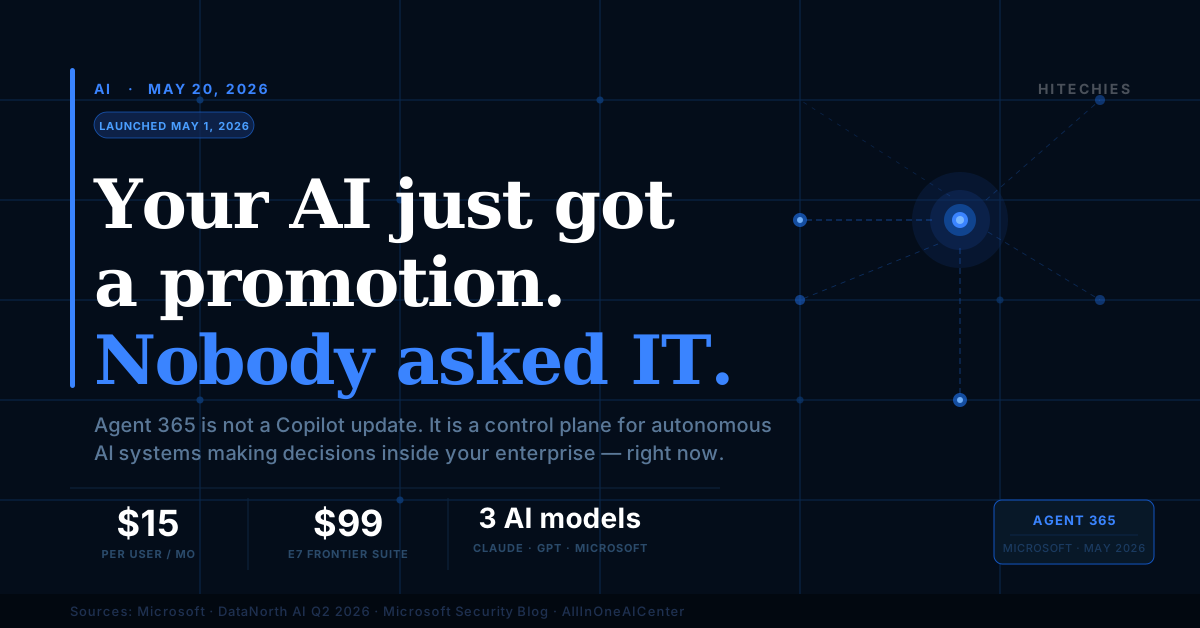
Microsoft just gave your company an autonomous AI employee. Nobody asked IT.
On May 1, Agent 365 went live — a dedicated governance layer for enterprise AI agents that take actions, access data, and make decisions inside your systems. Most IT teams are still reading the release notes.
There is a version of the Microsoft Agent 365 launch story that sounds routine. A new enterprise product. A new pricing tier. A new acronym to add to the stack. The press release, measured in tone, invited that reading. The product itself does not support it.
Agent 365 is not a feature update to Microsoft Copilot. It is not a rebranded productivity assistant. It is a control plane — software that governs other software that, in turn, governs operations inside your business. It manages autonomous AI agents built on Microsoft Foundry, Copilot Studio, and an expanding list of third-party platforms, giving IT teams visibility and security controls over systems that are, by design, already taking actions without waiting for human confirmation on each step.
The launch price is $15 per user per month, sitting inside the new E7 "Frontier Suite" at $99 per user per month total — a bundle that combines E5, Copilot, Agent 365, and Entra Suite. These are not small line items. For an enterprise with 10,000 employees, the Frontier Suite represents roughly $12 million annually in Microsoft licensing before a single agent has been built. The question of what that investment is actually buying, and what risks it carries, deserves more scrutiny than it has received.
"Every agent should have similar security protections as humans. Agents shouldn't turn into double agents carrying unchecked risk."
— Vasu Jakkal, Corporate VP, Microsoft Security, January 2026
That quote deserves attention independent of its source. Microsoft's own security leadership is using the language of insider threats — "double agents" — to describe AI systems that the company is simultaneously selling as productivity infrastructure. This is not a contradiction. It is a remarkably candid acknowledgment of a risk that most enterprise AI vendors have declined to name explicitly. When a company selling a product warns that the product could behave like an adversarial actor without proper controls, the warning is worth taking seriously.
Agent 365 — what actually shipped May 1, 2026
$15
per user/month standalone price for Agent 365 governance layer
$99
per user/month for E7 Frontier Suite bundling E5 + Copilot + Agent 365 + Entra Suite
3 models
Copilot Wave 3 routes tasks across Claude (Anthropic), GPT (OpenAI), and Microsoft's own models
What a control plane actually means — and why it's different from everything before it
The terminology matters here. A control plane, in computing, is the layer of a system that manages how other parts of the system behave. It is distinct from the data plane, which is where the actual work happens. In network infrastructure, the control plane decides how traffic should flow; the data plane moves the traffic. In Microsoft's framing, Agent 365 is the layer that decides what AI agents are allowed to do, what data they can access, what actions they can take, and who is accountable when something goes wrong.
This is categorically different from previous enterprise AI deployments. When a company integrated Copilot in 2024 or 2025, they were adding an AI assistant that answered questions and generated drafts. The human remained in the loop for every consequential decision. The agent might suggest an action; the person decided whether to take it. That model has worked reasonably well as a risk management framework, because human judgment functions as a brake on AI error.
Agent 365 is explicitly designed for a world where that brake is partially released. The product governs agents that are meant to complete multi-step tasks autonomously — not in a single generation, but across a sequence of actions that may span multiple systems, data sources, and time periods. An agent might read an email, look up a customer record in Dynamics, draft a response, schedule a follow-up meeting, and update the CRM record — without a human authorizing each individual step. The value proposition is efficiency. The risk profile is structurally different from anything the enterprise has managed before.
The multi-model architecture and what it introduces
Copilot Wave 3's multi-model architecture — routing tasks across Claude, GPT, and Microsoft's own models depending on the specific task — is technically sophisticated and commercially interesting. It is also the first time most enterprise IT teams will be managing infrastructure where the underlying AI model is selected dynamically and may change without explicit configuration by the administrator.
Consider what that means in practice. A compliance-sensitive workflow running through Copilot in Wave 3 may be processed by a different model than it was the previous week, depending on Microsoft's routing logic and model updates. The output, the data handling characteristics, the potential failure modes, and the compliance posture may all shift accordingly. Enterprise IT teams have spent decades managing software where version changes are controlled, documented, and tested before deployment. Multi-model dynamic routing introduces a fundamentally different paradigm: the model serving a workflow may evolve continuously, outside the enterprise's direct control.
Microsoft has built model governance into Agent 365 specifically to address this. Each agent is meant to have a documented identity, scoped access permissions, and auditable output logs. Whether enterprises will actually configure and maintain those controls rigorously — rather than deploying agents at speed to meet business demand and addressing governance retroactively — is the operational question that will determine whether Agent 365 becomes a security asset or a liability.
"The future isn't about replacing humans. It's about amplifying them. A three-person team will launch a global campaign in days, with AI handling data crunching, content generation, and personalization while humans steer strategy."
— Aparna Chennapragada, Chief Product Officer for AI Experiences, Microsoft
SharePoint agents, Excel Python, and where the access actually goes
The specific capabilities that shipped with Copilot Wave 3 are worth examining in detail, because they reveal the actual data access footprint that enterprise agents will carry. The Excel Python integration — now paired with cross-workbook analysis for consolidated financial reporting — means an agent can, with appropriate permissions, read across multiple financial workbooks simultaneously and generate consolidated reports autonomously. That is genuinely useful for finance teams. It also means an agent with misconfigured permissions has simultaneous access to every financial workbook it can reach.
SharePoint AI-powered agent creation — currently in public preview — allows organizations to build agents directly from SharePoint document libraries. The implication is that an agent built in SharePoint could, depending on permission configuration, have access to the documents stored there. For organizations that use SharePoint as a document repository for sensitive contracts, HR records, or proprietary research, the access footprint of a SharePoint-native agent is substantial.
Word, Excel, and PowerPoint agents are now generally available in chat. These are not preview features. They are production capabilities available to any organization on qualifying Microsoft licenses. The speed at which enterprise employees will deploy them — given the productivity incentives and the general enthusiasm for AI tooling among business units — will almost certainly outpace the speed at which IT and security teams can configure appropriate controls.
What enterprise IT teams should configure before deploying agents
- Assign each deployed agent a distinct identity in Entra ID with scoped, least-privilege permissions
- Audit SharePoint permission inheritance before enabling SharePoint agent creation — agents inherit document library permissions
- Configure Agent 365 audit logging before any agent goes to production, not after
- Define and document which workflows are approved for autonomous execution vs. which require human-in-the-loop confirmation
- Review the multi-model routing configuration — understand which models can process which categories of data in your environment
- Establish agent versioning and change management processes analogous to software deployment pipelines
The speed of adoption versus the speed of governance
The 2026 AI deployment pattern across enterprises is now reasonably well documented. Business units move fast because the productivity gains are real and competitive pressure is intense. IT and security teams move slower because they are responsible for what happens when something goes wrong. The gap between those two speeds is where most enterprise AI incidents originate.
Google Cloud's 2026 agentic AI trends report describes the current moment as the "agent leap" — a shift from one-off prompts to autonomous workflows that orchestrate complex, end-to-end business processes. Their framing of "digital assembly lines" is apt. But assembly lines require quality control, safety systems, and maintenance procedures. The organizations that are building agent workflows at speed without the corresponding governance infrastructure are building assembly lines without the safety equipment.
IBM's 2026 analysis makes a complementary point about where the competition is actually happening. "We're going to hit a commodity point," said Gabe Goodhart, IBM's Chief Architect for AI Open Innovation. "The model itself is not going to be the main differentiator. What matters now is orchestration: combining models, tools, and workflows." That observation reframes the competitive landscape in a way that has direct implications for security. If differentiation comes from orchestration — from how agents are combined and directed — then the attack surface is not just the model itself but the entire orchestration layer, including the instructions given to agents, the tools they can access, and the permissions they carry.
The breach nobody has a name for yet
Security researchers and enterprise risk professionals are beginning to describe a category of incident that does not map cleanly onto existing breach taxonomies. It is not a data exfiltration. It is not a ransomware attack. It is not a credential compromise in the traditional sense. It is an autonomous agent that executed a sequence of actions that each individually fell within its permitted scope — but whose combined effect was damaging in ways that no human reviewed before they occurred.
The scenario is not hypothetical. An agent with access to a company's email system, calendar, CRM, and document storage — the exact access footprint that Copilot agents are designed to carry — could, through a sequence of individually-permitted actions, forward confidential documents to an external address, accept a calendar invite that grants external access to internal meeting notes, or modify CRM records in ways that persist long after the agent's session ends. None of these actions requires the agent to be "hacked" in the conventional sense. They require only that the agent be given instructions it misinterprets, or that it encounter an edge case its configuration did not anticipate.
Agent 365, at its best, is the infrastructure to prevent exactly this category of incident. The identity management, access scoping, output logging, and human-in-the-loop controls that the product enables are precisely the right tools for the problem. The question is whether the organizations deploying it will use those tools with the rigor required — or whether the competitive pressure to ship fast and govern later will produce the first generation of autonomous agent incidents before the governance frameworks are in place.
The companies that treat Agent 365 as a line item in the Microsoft invoice, deploy agents without scoped permissions, and address governance after the first incident will be instructive case studies. The companies that build the governance infrastructure first, even at the cost of slower deployment, will be less interesting to read about — and considerably better positioned when the inevitable audit arrives.
The bottom line
Agent 365 is the right infrastructure for the autonomous AI moment. Whether it becomes an enterprise asset or a liability depends entirely on implementation discipline. The product ships the capability. The governance has to be built by the organization deploying it — and most of them are not yet equipped to do that at the speed the market is demanding.
Sources: Microsoft official announcement, Agent 365 general availability, May 1 2026 · Microsoft Security Blog, Vasu Jakkal · Microsoft AI Experiences, Aparna Chennapragada · DataNorth AI Q2 2026 Model and Tool Update · Google Cloud Agentic AI Trends Report 2026 · IBM Think, "AI Tech Trends 2026," Gabe Goodhart interview · AllInOneAICenter, New AI Tools May 2026 · Microsoft X-Force Threat Intelligence Index 2026