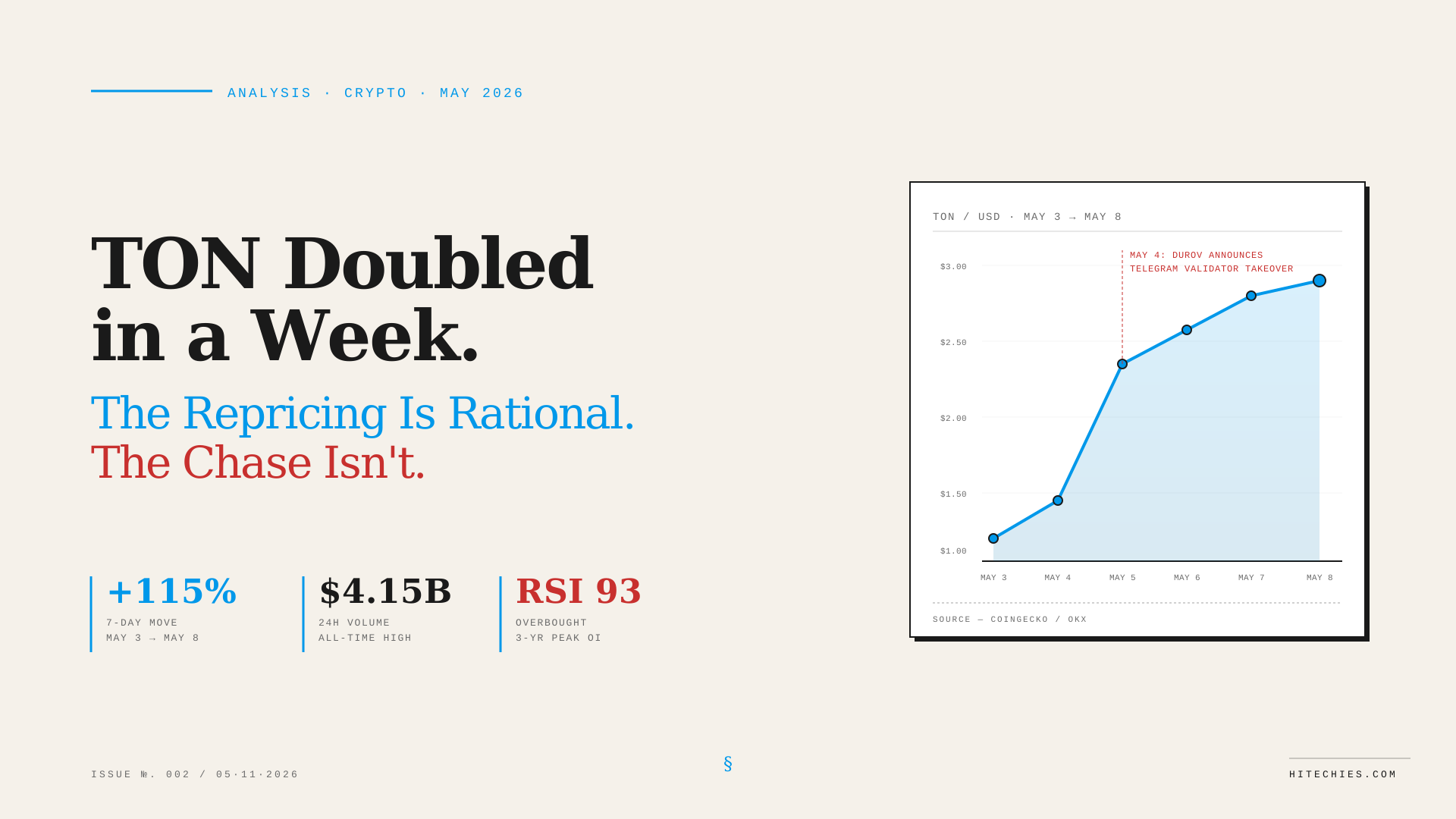
Toncoin traded at $1.30 on May 3. By May 8 it had touched $2.90. Volume printed $4.15 billion in a single 24-hour window, the highest in TON's history. Futures open interest reached $628 million, a three-year peak.
May 3 → May 8
All-time high
Deeply overbought
The proximate cause is well-reported: on May 4, Pavel Durov announced that Telegram itself would replace the TON Foundation as the network's primary driver and become its largest validator. Six years after the SEC forced Telegram out of its own blockchain — $18.5 million in penalties, $1.22 billion returned to investors — the messaging app walked back in.
The more interesting story is what the move says about a structural shift in how crypto networks acquire users, and why the market doesn't have a clean precedent for pricing it.
The Distribution Inversion
Every L1 since Ethereum has competed for the same scarce resource: users willing to install a wallet, fund it, and learn to transact on-chain. Solana spent years and billions in incentives to acquire a few million active addresses. Avalanche, Aptos, Sui — same playbook, similar economics, marginal results. Crypto's user-acquisition cost has been one of the most expensive in consumer technology, and the industry has been arguing for a decade about whether the unit economics ever resolve.
Telegram's 950 million monthly actives don't need to be convinced to download an app, set up a wallet, or migrate behavior. The wallet is already in the messaging app they open thirty times a day. The blockchain is the settlement layer for transactions they're already making. The acquisition cost isn't $30 per user. It is structurally zero.
What Durov did on May 4 was formalize the relationship that made this work. Telegram is no longer an adjacent partner. Telegram is the network's largest validator, sharing block production weight with the asset's distribution channel. That's not a typical decentralization story, but it's also not a typical crypto network. It is a vertically integrated consumer financial layer, and the market is starting to price it accordingly.
The bull case for TON over the next 18 months isn't fundamentally about price targets. It's about whether this distribution model — built once, replicable nowhere — gets revalued against the L1 cohort that has spent years trying and failing to build comparable reach.
What Actually Shipped
Three things landed in 30 days, all on-chain and verifiable.
Catchain 2.0 went live April 9, cutting block times from 2.5 seconds to 400 milliseconds. That puts TON in the top tier of L1 settlement speed and — critically — in viable range for consumer payments inside a messaging app. Fees were cut six-fold in late April, from $0.0023 to $0.0005 per transaction. Durov has publicly committed to moving most transactions to zero. Then on May 4, Telegram staked 2.2 million TON to claim the largest validator position.
April closed with 67 million transactions on the network, its strongest month of the year. Staking inflows after the announcement hit $191.83 million in a single day — the largest single-day staking inflow in nearly four months. USDT supply on TON crossed $500 million. TVL is at $1.2 billion. Revolut listed TON memecoins on April 30, exposing the asset to 70 million additional retail users.
The fundamentals at $2.70 are not the fundamentals at $1.30. The market is repricing because the asset is genuinely different. That part is rational.
What's Underpriced
Three risks are not being properly weighted.
Supply. TON's maximum supply is 5 billion tokens against Bitcoin's 21 million. Circulating supply is roughly 2.5 billion. The Believers Fund — an early investor unlock that began in late 2025 — releases approximately 37 million tokens monthly. At current prices, that's around $100 million in fresh supply hitting circulation every month. The fundamentals can keep improving and the chart can still grind if demand doesn't keep pace. This isn't a price call. It's an arithmetic constraint, and it explains why TON has historically failed to hold parabolic moves.
Leverage. Open interest at $628 million in futures is the highest in three years. RSI at 93 is the level at which short-term tops historically form. The combination of overheated retail positioning and crowded leveraged longs is the textbook setup for a sharp retrace that doesn't reflect any change in fundamentals. The same flow that drove the price from $1.30 to $2.90 can drive it back to $2.10 in two days on no specific catalyst.
Telegram itself. The validator takeover creates a single point of corporate failure that didn't exist when the TON Foundation was operationally independent. Durov was arrested in France in 2024 on charges that remain unresolved. Telegram's regulatory posture is now structurally fused with TON's risk profile. Any escalation — French proceedings, EU enforcement, US securities determination — flows directly into the asset. This risk wasn't priced in at $1.30 because the legal surface area was smaller. It isn't fully priced in at $2.70 because the market is celebrating the integration without acknowledging the symmetric exposure.
These aren't reasons to be bearish on TON long-term. They are reasons the current price has overshot what a rational reading of the setup justifies in the short term.
The Call
TON's fair value range, given the network changes of the last 30 days, is somewhere between $2.00 and $3.00 as a structural baseline. The repricing from $1.30 to that range is rational and probably mostly complete. The move above $2.70 is the market borrowing future returns against a 100% one-week move and crowded leverage.
The base case for the next four to six weeks is a 15-30% retracement to $2.00-$2.30. The interesting question is where it bottoms. A correction that holds above $2.20 confirms the structural re-rating; $4-$5 by Q4 2026 becomes a reasonable target if MTONGA continues to ship and broader crypto doesn't break. A correction that breaks $2.00 means the move was leverage-driven and the fundamentals were a narrative riding the flow.
The optimistic scenario — TON reclaiming $8.25 or pushing into double digits — requires every variable to cooperate. MTONGA ships on Durov's timeline. Believers Fund supply gets absorbed without slippage. Broader crypto rallies. Telegram avoids regulatory shock. None of these is individually unlikely. The probability of all four landing simultaneously is meaningfully lower than the chart enthusiasts pricing in $10 are admitting.
If you held before the move, take partial profits. If you don't currently hold, wait for the retracement. The fundamentals don't change in two weeks. The entry price will.
What Decides This
The next 60 days have three variables that matter more than the chart.
The remaining MTONGA roadmap is the first. AgenticKit, Rust Node v1, TON Factory, TON Pay 2.0, the full AppKit release, and the new consensus layer are all targeted for the first half of 2026. Durov has publicly tied his name to specific deliverables on a six-week timeline. On-time shipping compounds the narrative. Slippage compresses it.
Believers Fund absorption is the second. The 37-million-token monthly release needs buyers. The on-chain signal is movement from known fund addresses to centralized exchanges versus outflow rates from those exchanges. If unlocked tokens accumulate on exchange order books without absorption, supply is winning regardless of fundamentals.
Telegram's regulatory exposure is the third. Durov's French case is unresolved. The validator takeover means Telegram and TON now share legal surface area. Any material development in either direction will reprice the asset within hours, in a way the market is not currently prepared for.
Everything else is noise.
The deeper bet underneath the price call is whether TON's distribution model gets revalued against the L1 cohort over the next 18 months. If the answer is yes — if consumer crypto's user-acquisition problem turns out to be the constraint that defined the last cycle, and TON's solution to it turns out to be uncopyable — then current prices look cheap in retrospect and the bull case writes itself.
If the answer is no — if Telegram is a distribution channel like any other and the market eventually prices TON as an L1 with strong adoption rather than an L1 with structural escape velocity — then $2.70 is roughly the right number and the next move is sideways with volatility.
The market hasn't decided which one is true. The next two quarters will.