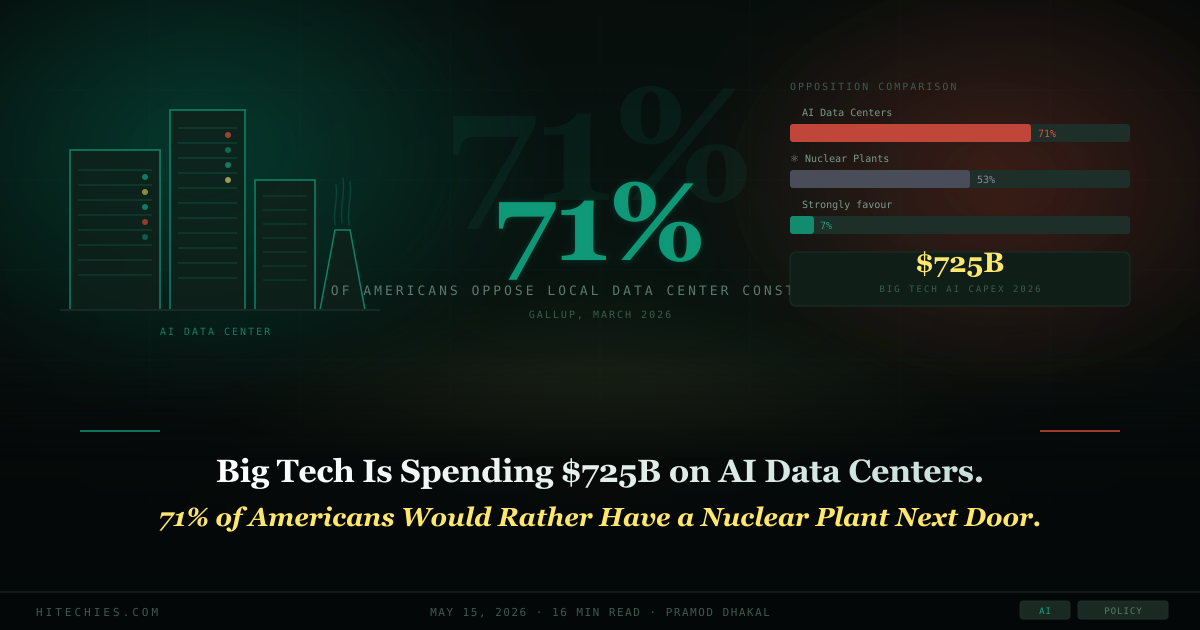
Nvidia is selling chips faster than it can make them. Amazon, Microsoft, Meta, and Google have committed a combined $725 billion in capital expenditures for 2026 — the majority earmarked for data centers and AI compute. The construction cranes are going up across the American midwest. And 71% of Americans want none of it near them.
That number comes from Gallup — not a tech-sceptic NGO, not a partisan think tank, but the oldest and most respected polling institution in the United States, whose surveys have tracked American public opinion since 1935. The result is unambiguous, and the implications for the industry are profound.
The Number Is Worse Than It Looks
Seventy-one percent opposition sounds bad. The breakdown makes it worse.
Gallup asked the same question about nuclear power plants in the same survey. In March 2026, 53% of Americans oppose nuclear plant construction locally. Nuclear power — the technology that gave us Three Mile Island and Chernobyl, the technology that has defined "not in my backyard" politics for half a century — is now more popular as local infrastructure than AI data centers. The AI industry has barely acknowledged this exists.
Why People Don't Want Them
Gallup didn't just ask whether people oppose data centers — it asked why. The open-ended responses, collected from over 2,000 adults in April, reveal a population with specific, articulable concerns. Not vague technophobia.
Modern hyperscale data centers consume millions of gallons per day for cooling. A single large facility can use as much water as a small city.
Data centers could account for up to 8% of US electricity by 2030. Grid upgrades get passed to ratepayers — not the corporations that caused the demand.
Noise, air quality, water contamination from cooling systems. Data centers run 24/7 and the industrial hum can be audible hundreds of metres away.
Increased traffic, population pressure, land that could go to housing or agriculture. The visual impact of massive warehouse buildings on rural landscapes.
Higher utility bills, cost-of-living increases, public tax incentives that benefit corporations rather than communities. The math rarely works for locals.
General or specific concerns about artificial intelligence itself — surveillance, job displacement, corporate concentration of power.
The picture that emerges is not a population that doesn't understand technology. It is a population that understands exactly what data centers do and has made a considered judgment that the costs are not worth the abstract benefits of AI progress.
The Political Fault Lines
The partisan breakdown matters enormously — because it is not what you might expect. Majorities of every major demographic group oppose local data center construction. Republicans, Democrats, independents. Urban, suburban, rural. Young, old, male, female. The opposition is genuinely cross-partisan.
What differs is intensity. Democrats are more likely to be strongly opposed — driven primarily by environmental concerns. But the Midwest and South, which have been most aggressively targeted for data center development, show opposition rates of 75-76%. These are predominantly Republican-leaning regions.
Gallup's analysis is blunt: politicians who favour data centers in their area are taking a politically risky stance. AI infrastructure may become a meaningful issue in local and state elections this year. Almost no politician in almost any district can credibly champion data center construction without significant electoral risk.
$725 Billion Versus 71%
Big Tech's capital expenditure commitments for 2026 are unprecedented. Meta, Amazon, Microsoft, and Google have collectively committed roughly $725 billion — an increase of more than 75% year over year. These companies are not hedging. They are betting their futures on a compute-intensive AI economy.
Against that commitment, 71% opposition is not a public relations challenge. It is a structural threat to the build-out itself. Data centers cannot be built without permits. Permits cannot be issued without local government approval. Local governments answer to voters.
But every spot has local residents. Every spot has a zoning board. Every spot has elections. Communities that have approved data centers are seeing organised opposition to the next facility. The opposition is learning — sharing legal strategies, regulatory arguments, and political tactics across communities.
The Environmental Reality Driving Opposition
The concerns are not imaginary. The environmental footprint of AI infrastructure is real, measurable, and growing.
These are not externalities that can be engineered away. They are fundamental to what data centers do. You cannot train or run a large AI model without enormous amounts of electricity and cooling. Efficiency improvements will help at the margins — but the trajectory of demand means absolute consumption will continue rising regardless of per-unit gains.
The Industry's Response
Siting in rural areas where opposition seems lower. But blocked communities become nodes in opposition networks, sharing legal tactics with the next town.
Lobbying states to restrict local government veto power. Legally viable but turns the AI industry into an adversary of local democracy.
Microsoft pledged water positivity. Google pledged carbon-free energy by 2030. Meaningful, but insufficient for the local economic and quality-of-life concerns driving most opposition.
What Actually Changes Things
Gallup's data shows one factor above all others that predicts whether someone supports a local data center: jobs. Two-thirds of supporters cite economic benefits. 55% specifically mention job creation.
Modern hyperscale data centers do not create many jobs relative to their footprint and resource consumption. A facility covering hundreds of thousands of square metres might employ 50 to 100 permanent workers. A similarly-sized manufacturing facility would create orders of magnitude more.
The communities that have become most receptive to data center development are those where companies made credible, binding commitments: guaranteed local hiring, community benefit agreements, utility bill protections for local residents. Where these agreements exist, opposition tends to be lower and approval tends to be faster.
The industry's current approach — offering generic economic projections without binding commitments — produces exactly the kind of opposition Gallup is measuring.
The Long-Term Implication
Public legitimacy is infrastructure. The roads, the power lines, the water systems that data centers depend on all exist because communities have, over generations, consented to the trade-offs involved. That consent is not automatic. It has to be earned through a political process that responds to public preferences.
The AI industry is currently asking for an enormous expansion of physical infrastructure — power plants, transmission lines, cooling systems, land — while offering communities a return that most of them have judged insufficient. Seventy-one percent opposition is not the beginning of that judgment. It is the current state of it, after two years of rapid AI infrastructure development.
The $725 billion committed to AI infrastructure assumes a certain pace of physical construction. That pace requires permits. Those permits require political will. And that political will is running directly into 71% opposition from the people who elect the politicians who grant the permits.
The math doesn't work unless something changes.
The Gallup survey was conducted March 2–18, 2026, with a random sample of 1,000 U.S. adults. Margin of sampling error ±4 percentage points at the 95% confidence level. Open-ended responses collected from 2,054 Gallup Panel members in April 2026. Capex figures based on company earnings reports and guidance as of Q1 2026.
Related reading