Crypto · May 21, 2026
Bitcoin hit $122,000. It retraced to $80K. The market called it a crash. The data calls it something else entirely.
BTC dominance sits at 60% entering the third week of May. ETF inflows never broke. Stablecoin supply is growing. And two narratives — real-world asset tokenization and AI agentic finance — are building structural demand that the 2021 cycle never had. The investors reading this as 2021 are almost certainly misreading it.
At Consensus 2026, held last week, Tom Lee offered a threshold that clarified the current moment better than any price prediction: Bitcoin closing May above $76,000 confirms a new bull market. Not a recovery. Not a dead cat bounce. A confirmed structural bull market. As of May 20, Bitcoin is trading in the $80,000 range. The threshold has been met, and exceeded, with eleven days remaining in the month.
The retail reaction to this has been, peculiarly, continued anxiety. Social sentiment trackers show elevated fear despite a Bitcoin price that sits above the confirmation threshold that a respected analyst publicly defined. The disconnect between the objective market data and the emotional response of the retail investor base is not incidental — it is one of the most important signals in the current cycle, and understanding it requires understanding what is actually driving this market and why it behaves differently from the last one.
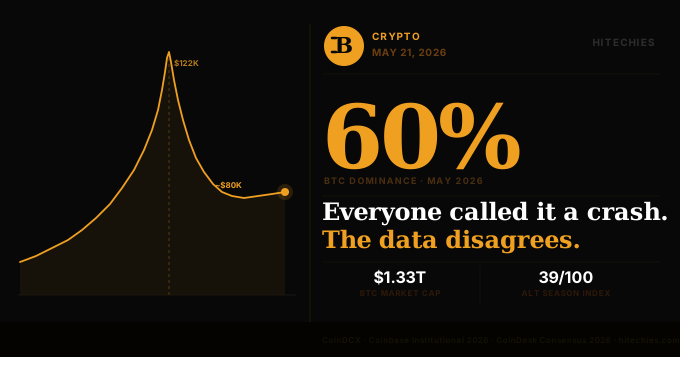
Bitcoin surged to an all-time high of $122,000 earlier in this cycle. The subsequent retracement to the $68,000–$80,000 range triggered the standard media coverage: crash narratives, "crypto winter" speculation, comparisons to the 2022 drawdown. What that coverage missed, because it focused on the price rather than the underlying market structure, is that the institutional positioning that defines this cycle — primarily through spot Bitcoin ETFs — remained intact throughout the drawdown. The buyer base did not rotate out. The ETFs continued to accumulate. The holders who drove the price to $122,000 did not sell. They held.
Bitcoin and crypto market — May 20, 2026
$1.33T
Bitcoin market capitalisation — Ethereum at $233B is the closest competitor, at less than a fifth of BTC's market cap
60%
BTC market dominance as of May 2026 — up from 58.15% the prior day, "Bitcoin Season" on every major index
39/100
CMC Altcoin Season Index — no sustained shift toward altcoin leadership. Low-cap alts are driven by exchange listings and meme cycles, not broad capital rotation
$122K
All-time high this cycle before the corrective retracement — post-halving supply dynamics and ETF inflows drove the surge
Why this correction is structurally different from 2022
The 2022 crypto drawdown was driven by a specific and interconnected set of structural failures. The Luna/Terra collapse triggered a cascade that exposed the fragility of DeFi protocols built on algorithmic stability mechanisms. Three Arrows Capital's insolvency cascaded through the lending market. Celsius, Voyager, and FTX collapsed in sequence, each revealing a different category of mismanaged risk — leveraged positions, misappropriated customer funds, inadequate risk controls. The drawdown was not a simple price correction; it was a structural reckoning with an industry that had grown faster than its risk management infrastructure.
The 2026 retracement from $122,000 to the current $80,000 range has none of those characteristics. There is no systemic contagion visible in the data. No major exchange has announced insolvency. The DeFi protocols that survived 2022 are running on more conservative parameters. The institutional players who came in through spot Bitcoin ETFs — regulated investment vehicles with required disclosures, proper custody arrangements, and no leverage against their Bitcoin holdings — did not produce the cascading liquidations that defined the 2022 collapse.
The Coinbase Institutional 2026 Crypto Market Outlook characterized the setup entering this year as resembling "1996 more than 1999" — a metaphor for a market in which the infrastructure is being built and the genuine use cases are emerging, rather than a market at the peak of a speculative bubble. That framing suggests that the retracement from $122,000 is a corrective pause within a structural uptrend rather than the beginning of a multi-year bear market. The acknowledgment that "the uncertainty band remains wide" is appropriately honest — no one can guarantee that characterization. But the structural evidence supports it more than it supports the bear case.
"The current crypto bull run thesis is shaping up to be selective rather than broad-based, with Bitcoin continuing to lead market structure while altcoins rotate through short-lived, narrative-driven rallies."
— CoinDCX Crypto Bull Run Outlook, May 2026
What the Altcoin Season Index at 39 is actually telling you
The CMC Altcoin Season Index sitting at 39 out of 100 is routinely misread as a negative signal for the broader crypto market. The logic goes: if altcoins aren't performing, the market isn't healthy. This reading confuses the symptom with the diagnosis. The Altcoin Season Index is not a health metric — it is a capital rotation metric. It measures whether institutional and retail capital has rotated from Bitcoin into alternative assets. When the index is low, it means that rotation has not yet occurred, not that it will not occur.
In the previous cycle, the Altcoin Season Index surged to near-maximum readings in early 2021 before the broader market peak. That surge was driven by a combination of retail speculation, leverage, and narrative momentum around DeFi and NFT use cases that, in many cases, did not survive contact with sustained market scrutiny. The current low reading, with institutional capital anchored in Bitcoin and not yet rotating into altcoins, is consistent with a market that is earlier in its cycle — not a market at its peak.
The low-cap altcoin activity that is visible in the data — driven by exchange listings, meme cycles, and speculative volume spikes — is diverging significantly from the broader market. This divergence is characteristic of the early-to-mid phase of a Bitcoin-led cycle, where retail speculation in lower-quality assets coexists with institutional accumulation of the primary asset. The two populations are operating on different investment theses in the same market.
The two narratives building the next structural leg
Tom Lee's characterization at Consensus 2026 — that tokenization and AI agentic finance are the main narratives driving the next bull cycle — deserves elaboration, because both represent structural demand mechanisms that are genuinely new in this cycle and were not present in 2021.
Real-world asset tokenization is the process of representing physical or financial assets — real estate, government bonds, private credit, infrastructure — on blockchain infrastructure as digital tokens. The appeal is transparency, programmability, and accessibility: assets that previously required high minimum investments and complex intermediary arrangements can, in theory, be traded in fractional units by any holder of the relevant token. Regulatory progress in 2025 enabled new institutional frameworks for digital asset treasuries, spot ETFs, and compliant tokenization structures that did not exist at scale before. Coinbase Institutional's stochastic model forecasts the stablecoin market cap — the most fundamental infrastructure layer for tokenized asset settlement — reaching approximately $1.2 trillion by end of 2028. Stablecoins are already the number one use case in the crypto ecosystem by volume. Their growth is the foundation on which tokenization sits.
AI agentic finance is newer and less well understood. It refers to AI systems that can autonomously manage cryptocurrency wallets, execute trades on decentralized exchanges, interact with DeFi protocols, and manage portfolio positions — without requiring human instruction at the transaction level. The infrastructure for this barely existed eighteen months ago. What existed were experimental bots and rudimentary smart contract integrations. What is being built now — on the same model infrastructure that is transforming enterprise software — is considerably more capable: agents that can reason about market conditions, construct multi-step strategies, and execute across multiple protocols simultaneously.
The implications for market structure are significant. If a meaningful fraction of trading volume in the next cycle is executed by AI agents rather than human traders, the behavioral patterns that have historically characterized crypto market cycles — the emotional over-extension, the panic selling, the FOMO-driven entries — may be partially dampened by the more systematic behavior of algorithmic actors. This does not make the market stable. It makes it different in ways that historical pattern analysis cannot fully anticipate.
What changed structurally between the 2021 cycle and this one
- Buyer base: Spot Bitcoin ETFs introduced regulated institutional capital with no leverage and proper custody. The 2021 cycle had no equivalent. ETF inflows remained intact through the $122K → $80K retracement.
- Regulatory clarity: Landmark US and global regulatory advances in 2025 enabled digital asset treasuries and broader institutional participation. The legal ambiguity that suppressed institutional capital in 2021 has partially resolved.
- DeFi maturity: Post-2022 DeFi protocols are running on more conservative collateralization ratios and more robust liquidation mechanisms. The systemic fragility that enabled the 2022 cascade is structurally reduced.
- Stablecoin infrastructure: Total stablecoin market cap is on a trajectory toward $1.2T by 2028. The settlement layer for crypto activity has grown substantially since 2021.
- New demand narratives: RWA tokenization and AI agentic finance represent structural demand that the 2021 cycle did not have. These are not speculative narratives — they are being built on real infrastructure by funded teams.
DeFi's maturation and the derivatives layer
Coinbase Institutional's 2026 outlook contains a detailed analysis of the DeFi derivatives landscape that is worth examining, because it describes a transition that will affect market liquidity and volatility dynamics in ways that most retail participants have not yet incorporated into their analysis. Perpetual futures — the synthetic instruments that allow traders to take leveraged positions on crypto assets without holding the underlying — are moving from isolated leverage tools into core DeFi primitives integrated with lending, collateral, and hedging protocols.
This integration means that a DeFi user can, increasingly, use a perpetual futures position as collateral for a loan, hedge an existing yield farming position, or construct multi-leg strategies that would previously have required multiple separate platforms and manual execution. The composability of these instruments is genuinely new. It is also, potentially, a new source of systemic fragility if the integration creates cascading liquidation pathways that the 2022 cycle's isolated protocol failures did not exhibit. Monitoring the open interest and liquidation levels in composable DeFi derivatives protocols will be one of the important leading indicators for stress in this market structure.
The prediction market segment deserves separate attention. Volumes are expected to broaden significantly in 2026, driven partly by US tax changes that may create incentives to use derivative-anchored prediction instruments rather than direct positions. Coinbase Institutional forecasts that prediction market aggregators could emerge as a dominant interface layer, consolidating significant weekly volumes that are currently fragmented across multiple platforms. This is a niche that has not historically attracted much attention from mainstream crypto analysis, but the volume projections and the structural incentives around it suggest it will become more visible.
What this means for how you should be positioned
The framework that emerges from the structural data is not a price prediction. It is a positioning logic. The investors who understand the current cycle as a Bitcoin-led, institutionally-anchored market with genuine new demand drivers — rather than a replica of 2021's speculative excess — will make different decisions about timing, asset allocation, and risk management than investors applying the 2021 template.
Specifically: the low Altcoin Season Index suggests that broad altcoin rotation has not yet occurred, and that the early-cycle dynamic of Bitcoin leading is consistent with historical patterns before broader rotation. The intact ETF inflows suggest that institutional demand is not exhausted. The stablecoin market cap trajectory suggests that the settlement infrastructure for the next phase of crypto activity is growing. The two new demand narratives — tokenization and AI agentic finance — suggest that the structural demand for crypto infrastructure extends beyond purely speculative use cases for the first time in the asset class's history.
None of this guarantees any particular price outcome. The wide uncertainty band that Coinbase Institutional flagged is real — the Bitcoin price range of $70,000 to $110,000 through much of 2026 is consistent with both the bull case and a more muted outcome. What the structural data does argue against is the bear case built on pattern-matching to 2022, because the structural conditions that drove the 2022 collapse are not present in the current market. That is not a reason for complacency. It is a reason to analyze what is actually happening rather than what happened last time.
This article is for informational and analytical purposes only. Nothing in this article constitutes financial advice, investment recommendations, or trading guidance. Cryptocurrency markets are highly volatile. Always conduct your own research and consult a qualified financial advisor before making investment decisions.
Sources: CoinDesk, Tom Lee at Consensus 2026, May 2026 · CoinDCX, Crypto Bull Run Outlook May 2026 · Coinbase Institutional, 2026 Crypto Market Outlook · Fortune, Bitcoin price tracker May 1–18 2026 · CMC Altcoin Season Index, May 20 2026 · Intellectia AI, Bitcoin Price Analysis May 2026