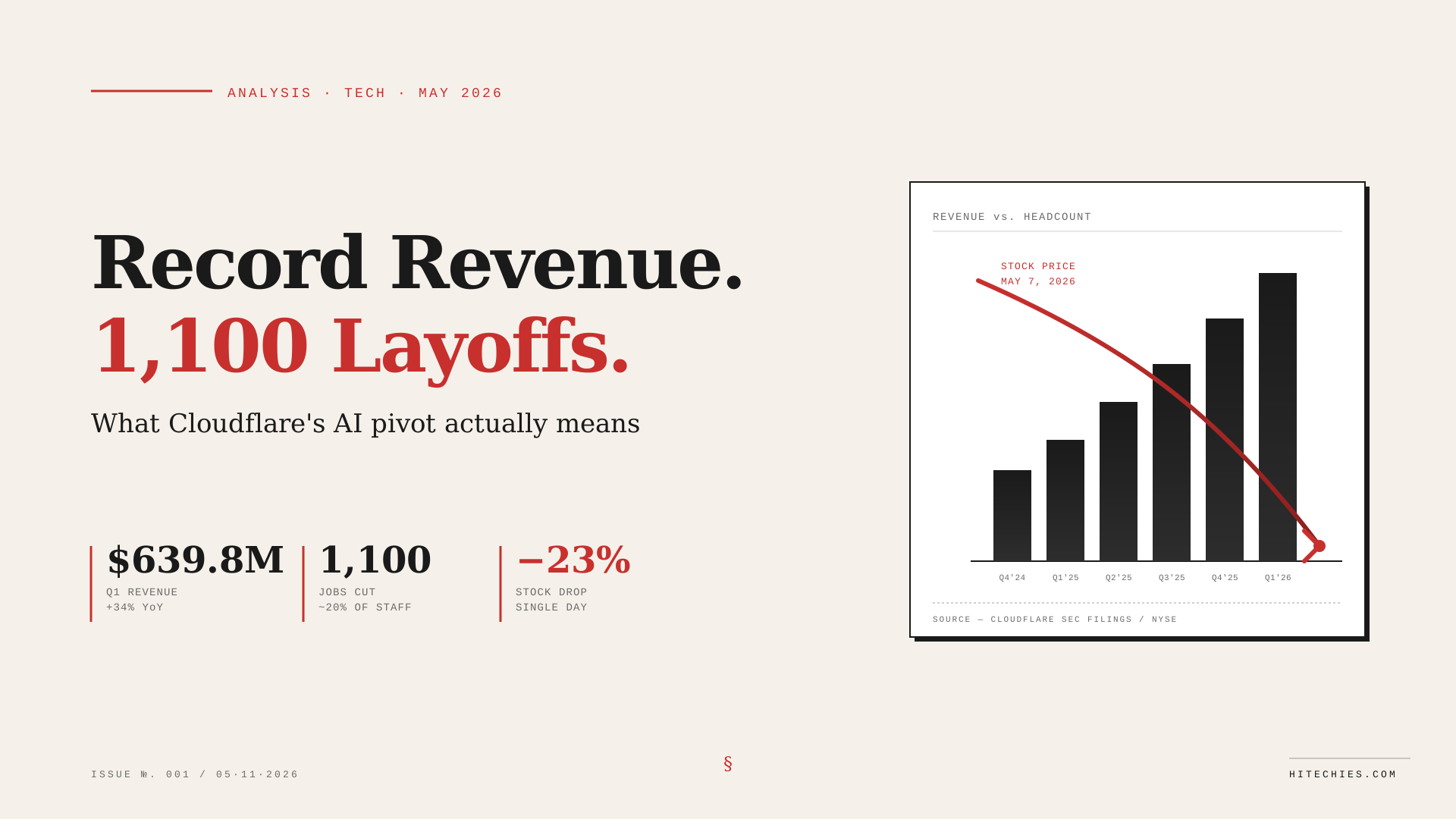
+34% YoY
~20% of workforce
stock drop
CEO Matthew Prince didn't hide from it. On the earnings call, he announced the cuts directly, called the decision "the right one," and pointed to a single statistic: internal AI usage at Cloudflare had grown 600% in three months. The company's blog post framed it as a shift to an "agentic AI-first operating model." Work that used to need people, the argument went, no longer did.
The severance is real. US employees keep full base pay through the end of 2026, healthcare through December, and equity vesting extended to August 15. By tech industry standards, that's generous. By the standards of the people receiving the emails, eight months is eight months.
What makes this story worth a closer look isn't the layoff itself — it's that Cloudflare said the quiet part out loud, and the market punished them for it.
The 600% Number
Prince repeated the figure several times. Almost no one in the press has asked the obvious question: 600% of what?
If most non-technical teams were barely using AI three months ago, multiplying by six isn't transformation — it's onboarding. A company-wide Copilot rollout would do it. He did offer some context: 97% of R&D staff were already using AI coding tools, and Cloudflare runs most of its AI workloads on its own GPU infrastructure via Workers AI, which keeps costs lower than competitors paying API rates. That's a genuine operational edge.
But the headline number is presented without any data on what it actually produced. There's no breakdown of output quality, no comparison of work completed per employee before and after, no measure of how much AI-generated work needed human revision to be usable. The number sounds like evidence. It functions as a claim.
Who got cut and who didn't tells a clearer story. Quota-carrying salespeople were almost entirely spared. The cuts landed on what CFO Thomas Seifert called "support ratios" — operations, HR, finance, and internal marketing roles behind customer-facing teams. Prince was direct about it: the productivity gains came from "the people directly talking to customers and directly creating code." Everyone behind them was up for review.
What "Not a Cost-Cutting Exercise" Actually Means
The accounting tells a different story.
The founders' letter explicitly stated the layoffs were not a cost-cutting exercise.
Cloudflare will book $140–$150 million in one-time restructuring charges, roughly equal to a quarter of free cash flow. But that's the upfront cost. Cutting 1,100 roles at Cloudflare's salary levels removes well over $100 million in annual compensation from the operating model — every year, compounding. Gross margins fell to 71% from 76% as infrastructure costs climbed. Removing payroll is one of the few levers left to pull on margins without slowing customer-facing growth.
This isn't an accusation of dishonesty. It's a description of what the math does, regardless of what the language around it says. When Prince told an analyst on the call that "just because you're fit doesn't mean you can't get fitter," he was answering a question about why the cuts had to happen during a strong quarter. The answer is the one any public company gives in that position: because shareholders reward it.
The Detail Hacker News Caught
In September 2025, Cloudflare hired 1,111 interns in a program titled "Help Build the Future." Eight months later, the layoff announcement appeared on the company blog under the title "Building for the Future."
The numbers are nearly identical. The framing is nearly identical. The direction is opposite.
Interns and full-time employees aren't the same headcount, and the intern program was almost certainly a pipeline initiative rather than positions that subsequently got eliminated. But the symmetry is hard to ignore. Some of the roles being cut today were being filled less than a year ago. Either the AI productivity shift happened faster than Cloudflare's own planning anticipated, or the operating model was still being worked out while hiring continued. Neither is flattering to a narrative of careful structural transformation.
Prince said in the founders' letter that the company doesn't want to do this again for the foreseeable future. That's worth holding them to.
Why the Market Sold Off
A 23% single-day drop on the back of a 34% revenue beat is unusual. Investors don't punish companies that report record numbers unless something else has shaken their confidence in what comes next.
The structural concern was visible in the call itself. Seifert told analysts: "Those ratios are going to change significantly, which frees up dollars. Within the same spend envelope, you can deploy more quota-carrying AE capacity toward our market opportunity."
In plain terms: the people being let go were subsidizing additional salespeople. That's a legitimate business decision. It's also a description of capital reallocation, not AI replacing human work. The same outcome would have been available without AI as the rationale.
There's a broader pattern here. "Efficiency" became "lean" became "AI-enabled" depending on which year a company needed to justify the same underlying decision. What changes is the framing. The dynamic — companies optimizing margins when they have the leverage to do it — stays consistent. In 2026, AI offers the most defensible framing of the last decade.
The Counterargument
There is a reasonable version of this story that doesn't require cynicism.
Support functions — scheduling, internal reporting, tier-one customer queries, administrative coordination — are exactly where agentic AI is most capable right now. Companies across the industry report real time savings in these areas. If Cloudflare's leadership genuinely looked at internal data and concluded that work previously requiring 1,100 people now requires fewer, that's a defensible call, even if the framing is more palatable than "we cut costs."
The harder question is whether that good-faith assessment is replicable at the scale the industry is now running it.
According to Layoffs.fyi, 128,270 tech workers have been cut globally in 2026 across 286 events — over 1,000 per day. Challenger, Gray & Christmas tracked AI as a cited factor in roughly 27,600 US job cuts through Q1 2026: about 13% of all announced cuts, up from around 5% in 2024. Bloomberg data referenced by The Dupree Report suggests roughly half of AI-attributed layoffs result in the same roles being rehired offshore, pointing to a labor-pricing story running alongside the automation one.
Three separate dynamics are collapsing into one narrative: real AI displacement of specific tasks, capital reallocation from salaries to GPU clusters, and what one analyst called "shareholder theater" — saying AI on an earnings call because it lands better than saying you overhired. Cloudflare likely has all three operating at once, in proportions no outsider can verify.
Meta cut roughly 8,000 and framed it as capital reallocation for AI infrastructure. Oracle laid off thousands to fund AI data centers. Atlassian cut 1,600 citing AI restructuring. Cloudflare's distinction wasn't doing something different — it was naming the mechanism. Whether that reflects more honesty or simply a different communications strategy is something Q3 margins will eventually clarify.
Where the Value Goes
The question missing from most of the coverage is the straightforward one. If AI is generating the productivity these companies claim, who captures the gains?
Revenue grows. Margins improve. Stock options vest for the people still inside the building and for the executives who made the call. Glassdoor's tech sector confidence index fell 6.8 percentage points year-over-year in early 2026, the steepest drop of any industry it tracks. Median time-to-hire for senior Bay Area engineers stretched from 38 days in Q3 2025 to 67 days in Q1 2026. Tech wages are flat versus 2025 outside specialized AI roles.
Prince said he expects Cloudflare to have more employees in 2027 than at any point in 2026. That's plausible. They'll be different roles — people who manage AI systems, not the operational layer those systems now handle. The 1,100 who got the email on May 7th aren't candidates for those positions without retraining the company isn't offering.
The standard industry argument is that AI raises productivity, productivity drives growth, growth creates new jobs, net positive in the long run. That may turn out to be true. But for anyone currently looking for work, the long run isn't where the rent is due.