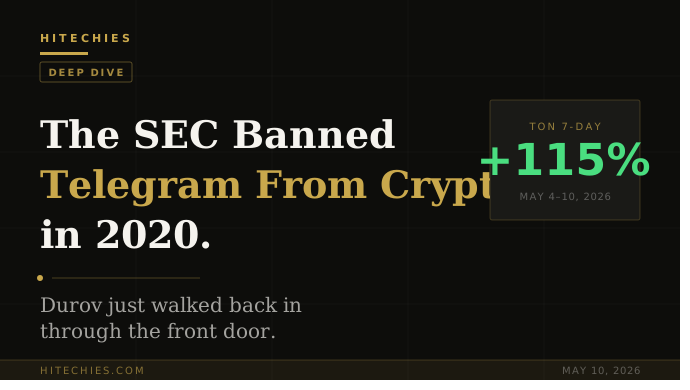
Let me tell you a story about the longest revenge arc in crypto. One that started with the biggest ICO in history, ran through a brutal SEC enforcement case, survived because a community of developers refused to let it die, and ended last week with a billionaire walking back into his own blockchain six years after regulators forced him out.
The ending the SEC did not write. And the question nobody is asking loudly enough while the price is still going up.
2018: The billion-dollar blockchain Telegram built for a billion people
In 2018, Pavel Durov and his brother Nikolai had a vision that was genuinely ahead of its time. Build a blockchain fast enough and cheap enough to power real payments inside Telegram. Not a speculative token. Not a DeFi playground for yield farmers. An actual financial layer for the hundreds of millions of people who already used the app every day. Give the unbanked a way in. Make micropayments feel like sending a message.
The fundraise was extraordinary. $1.7 billion from some of the biggest venture firms and private investors in the world. The Telegram Open Network was going to be the infrastructure that Web3 had been promising since 2015 but had never actually built. The token was called Gram. The ambition was enormous.
Then the SEC showed up.
The regulator ruled that the Gram token sale had been an unregistered securities offering. A federal judge in New York backed them up with a worldwide injunction. Telegram fought the case for months, then capitulated. They paid $18.5 million in fines, returned $1.22 billion to investors, and in May 2020, Durov published a note announcing the project was over.
The project was dead. Or so it appeared.
The five years nobody tells you about
Here is the part of this story that almost never gets told properly — because the narrative jumps straight from "SEC kills Telegram blockchain" to "TON doubles after Durov announcement" without explaining what happened in between.
When Telegram exited in 2020, a group of independent developers picked up the open-source code and refused to let it die. They renamed it The Open Network, launched it under the TON Foundation banner, and kept building. No Telegram. No Durov. No corporate backing. A genuine community project rising from the ashes of a regulatory casualty.
But here is what was also happening during those five years of "independence." Telegram was quietly making TON the backbone of its entire commercial operation. By early 2026, the exclusivity deal was generating roughly $300 million a year for Telegram — so much that a significant drop in TON's price was showing up as a net loss on Telegram's balance sheet. Reported TON holders grew from 2.9 million to 32 million in a single year. The network processed 1.5 billion transactions in Q1 2026 alone.
The Foundation ran the chain. Telegram ran the money that made the chain matter. Those two things were never truly separate.
May 4, 2026: One post that broke the crypto internet
Durov posted on X without fanfare. No press conference. No white paper. Just a clean statement: Telegram would replace the TON Foundation. Telegram would become the largest validator. Fees had been cut sixfold to $0.0005 per transaction. New developer tools and a rebuilt ton.org were coming within two to three weeks.
The ton.org domain updated in real time to read: "ton.org is now controlled by MTONGA. Expect changes soon."
MTONGA. Make TON Great Again. The acronym is as pointed as it sounds.
The market responded immediately and explosively. TON jumped 36% in the first 24 hours. By May 8 it had surged to an intraday high of $2.90 — more than double its pre-announcement low of $1.30. Trading volume exploded 650%. DEX volume for the week hit $152.9 million, up 1,054% week over week. App fees reached $1.48 million in a single day. Meme coins went parabolic — $DOGS up 100%, $UTYA up 140%. The ecosystem's combined meme coin market cap hit $156 million.
"Decentralisation is just a word we use to feel superior until someone offers us a 75% pump and 6x lower fees."
— Coinpedia analysis, May 6, 2026
The part that should bother you more than it does
Last month, Arbitrum's security council executed an emergency freeze on $71 million in exploited funds. The crypto community responded as though democracy itself had been suspended. "Governance crisis." "Code is law violation." "This is what centralisation looks like."
Fast forward to May 4. A company with 950 million monthly active users announces it is replacing the independent foundation running a blockchain used by 32 million people and installing itself as the single largest validator. The same community threw a party. Token up 100%. Maximum bullish.
The difference between those two reactions tells you everything about how crypto actually works versus how it says it works. The stated principle is decentralisation. The revealed preference is price appreciation.
To be fair — Durov's counterargument is not absurd. He said Telegram becoming the largest validator actually strengthens decentralisation by creating conditions for other major entities to join. BNB Chain runs at ~30% Binance concentration. Solana has similar dynamics among top validators. A 25% Telegram stake puts TON in the middle of the industry pack.
But "we're no more centralised than the competition" is not the same as "decentralisation is a feature." And TON spent years marketing itself as The Open Network. That story becomes harder to tell every week. The more honest framing, which Telegram is slowly moving toward, is: we are building a corporate blockchain optimised for consumer utility at scale. That is a legitimate product. It might be the right product. But it is a different product than what the name implies.
The real numbers — and the gap that remains
TON's on-chain metrics are genuinely impressive. 1.5 billion transactions in Q1 2026. $1.2 billion in total value locked. $500 million USDT supply on-chain. Staking APR at 18.8% — officially the highest among the 50 largest cryptocurrencies. Telegram Wallet hit $1 billion in perpetual trading volume in May. Re-entered the top 20 by market cap globally.
But compare it to where TON needs to be for the thesis to pay out at the scale the price implies. On the same day TON recorded $1.48 million in app fees, Solana recorded $6.37 million. Solana holds $15.4 billion in stablecoins; TON holds $752.5 million. TRON holds $89.6 billion in assets. Even Sui — the natural early-stage comparison — shows a more developed DeFi ecosystem relative to its market cap.
TON's moat is distribution, not ecosystem depth. The 950 million Telegram users are real. The on-chain activity from those users remains a fraction of what a fully activated user base could generate. The infrastructure is now technically capable. The question is whether the product integrations that convert passive users into active on-chain participants will materialise at the speed the current valuation is pricing in.
May 24, 2026: Approximately 36.58 million TON tokens — worth roughly $93.65 million at current prices, or 1.36% of float — are scheduled to unlock. A meaningful supply event hitting the market within two weeks of an already overextended rally.
June 2026: Validators vote on cutting block rewards significantly. As the largest validator, Telegram holds the decisive vote. How they use it will be the first real test of whether governance power gets exercised in the network's interest or Telegram's own.
Price scenarios: what analysts are actually saying
Stars revenue-sharing rollout drives sustained demand. June vote executed cleanly. Developer tools ship on time. On-chain activity compounds into real fee revenue.
Market consolidates waiting for June Foundation audit and Stars rollout data. Utility grows steadily but price stays range-bound until a concrete revenue milestone lands.
Governance crisis after Telegram uses validator weight self-interestedly. Major protocols exit on centralisation concerns. May 24 unlock accelerates sell pressure into a weakening narrative.
The IPO angle everyone is missing
Telegram's revenue grew 65% year-over-year in H1 2025 to $870 million. But Telegram has debt and has been discussing an IPO. When a significant percentage of your balance sheet is denominated in a volatile cryptocurrency that swings your company between profit and loss — that is a serious problem for institutional investors doing due diligence on a public listing.
By taking direct control of TON's governance, Telegram gains the operational tools to drive the network's development in ways that support the token's long-term value: faster shipping, better developer tooling, deeper product integration, more institutional credibility. The Financial Times reported earlier this year that Telegram's balance sheet was already materially tied to TON's price performance. This takeover aligns those incentives explicitly. Whether you call that a conflict of interest or a virtuous cycle depends on whether you hold the token.
The ending the SEC didn't write
The SEC won in 2020. Cleanly, legally, unambiguously won. Telegram paid, retreated, and formally exited the space. By any conventional measure, that should have been the end of Telegram's blockchain ambitions.
Instead, a community kept the project alive. They built it without the founder, without corporate backing, without the $1.7 billion war chest. They integrated it so deeply into Telegram's commercial infrastructure over five years that Durov's return became almost structurally inevitable — like gravity. The legal separation the SEC imposed kept Telegram at arm's length formally. Operationally, the distance was always narrower than it appeared.
The founder who was forced to return investor money for a token that never launched is now running the blockchain that grew from its ashes. Earning staking rewards from it. Building what he describes as the universal crypto interface for a billion users on top of it. All without revisiting the regulatory questions that stopped him the first time.
Whether that is a story about the resilience of open-source communities, or the inevitable pull of corporate capital toward infrastructure it finds useful, or just the way technology moves around the edges of regulation — probably all three at once.
What is certain is that the June governance vote will tell you more about what TON actually is than any price chart. The May 24 token unlock will test whether the market's conviction is real or borrowed. And whether the next 12 months produce the on-chain activity to justify an $8 billion market cap will answer the most important question of all: whether this is a real consumer blockchain finding its moment, or another story crypto tells itself while the insiders figure out their timelines.
The green candles are very pretty. Just ask the question before they make everyone too comfortable to bother.