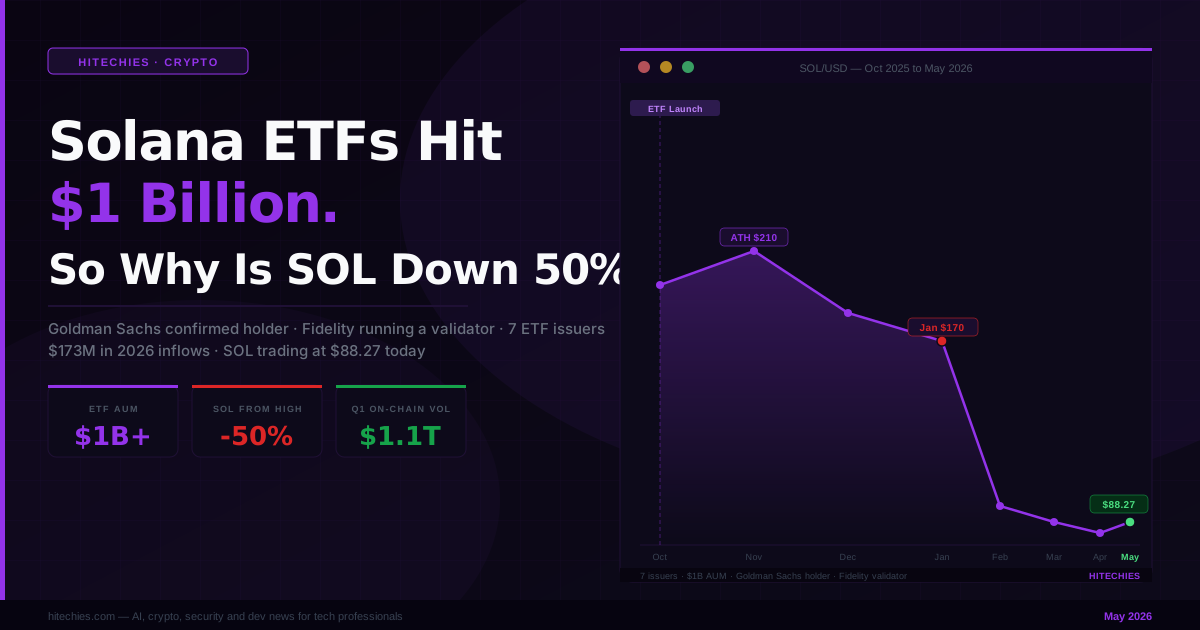
The Solana ETF story has a plot twist nobody predicted when the SEC approved spot products last October. The approval came through. The institutions showed up. Goldman Sachs confirmed SOL exposure in ETF filings. $1 billion in AUM got absorbed in six months. And the token is trading at $88.08 — down roughly 50% from the January 2026 high of around $170, and down more than 30% year-to-date.
That's not what the Bitcoin ETF narrative taught people to expect. Bitcoin hit new all-time highs in the months following ETF approval. Ethereum at least held its ground. Solana launched a regulated institutional product, watched $1 billion flow in, and the price went the other direction. Understanding why requires looking at what's actually happening with the supply side — and it has nothing to do with ETF demand being weak.
The Solana ETF landscape — who launched, what they offer, and who holds them
Live since Oct 28 2025Seven asset managers cleared the SEC process simultaneously on October 28, 2025. The lineup covers the full spectrum of institutional distribution — from retail-accessible giants like Fidelity to specialist crypto managers like Bitwise and 21Shares.
| Issuer | Ticker | Exchange | Staking | Notable |
|---|---|---|---|---|
| Bitwise | BSOL | NYSE Arca | ✓ 7%+ target | Market leader — $620M AUM, 62% share |
| Fidelity | FSOL | Cboe BZX | ✓ Staking | Runs its own Solana validator node |
| VanEck | VSOL | Cboe BZX | ✓ Staking | $1.13M inflow on Apr 23 alone |
| 21Shares | SOL | Cboe BZX | — | First to complete exchange registration |
| Franklin Templeton | EZSO | NYSE Arca | ✓ Staking | Major traditional finance distributor |
| Grayscale | GSOL | NYSE | — | Converted from trust structure |
| Canary Capital | CSOL | Nasdaq | ✓ Staking | Crypto-native issuer |
Fidelity went a step further than any other issuer: it launched its own Solana validator node. That's not an ETF decision — it's an infrastructure decision. It means Fidelity is participating in network consensus, earning staking rewards directly, and making a multi-year commitment to the ecosystem that doesn't show up in AUM figures. When the world's largest mutual fund company runs a validator, the "Solana is institutional-grade" thesis becomes hard to dismiss.
The paradox — $1B in, price down 50%. Here's exactly why.
The real storyThis is the question everyone in crypto is asking right now and most of the takes are wrong. It's not weak demand. Solana ETFs pulled in $173 million in net inflows in 2026 alone, including $35.17 million in a single week. That's not nothing. The problem is what's hitting the market from the other side.
Venture capital firms that funded Solana's development at seed and early-stage prices well below $10 per token have been receiving liquid token allocations as their lockup periods expired throughout 2025 and 2026. Many of those holders are sitting on 10× to 50× returns even at the current depressed price. Every ETF-driven rally gets met with unlock-driven selling. The ETF demand is real. The supply headwind is also real. And right now the supply is winning.
What makes this particularly frustrating for SOL holders is the fundamental picture is genuinely strong. The network hit $1.1 trillion in economic activity during Q1 2026 — a 6,558% jump from the prior quarter according to Artemis. Solana-based DEXs are posting billions in monthly volume. The Firedancer validator client is already running on mainnet with 100,000 TPS capacity. The metrics are moving up and to the right. The price is not. That's not a contradiction — it's a supply-demand imbalance playing out in slow motion.
Alpenglow — the upgrade that actually matters for long-term holders
SIMD-0326 · Q3 2026While the ETF price story has dominated 2026 headlines, the more technically significant development is Alpenglow — Solana's most ambitious consensus overhaul since launch. The upgrade, voted on by validators in 2025 and targeting mainnet in Q3 2026, aims to slash block finality from roughly 12 seconds to 150 milliseconds.
That's not a marginal improvement. 150ms finality makes Solana competitive with traditional payment rails on latency. It matters for real-time applications, institutional trading infrastructure, and the AI agent payment use cases that are already starting to emerge — like the Google Cloud partnership announced May 5, 2026, enabling AI agents to autonomously pay for services using stablecoins on Solana.
The Alpenglow technical specification (SIMD-0326) also targets reduced validator costs, which matters for network decentralisation and the long-term sustainability of the staking yield that makes the ETF carry trade attractive. Lower validator costs mean more validators can participate profitably, which strengthens the network's security assumptions and makes the 7% staking yield more structurally durable.
Bull case vs bear case — what you actually need to believe
Not financial adviceSOL is trading at $88.08 as of May 8, 2026. Here is what each side of the trade requires you to believe, stated plainly.
The honest read is that both cases have more going for them than either side usually admits. The institutional infrastructure is genuinely there — Goldman, Fidelity running validators, J.P. Morgan building on the network. The supply headwind is also genuinely there and won't resolve until Q3. Sitting in the $82–$90 consolidation zone until one of those forces wins is the most likely near-term outcome.
What the Solana ETF story actually tells us about crypto in 2026
The bigger pictureBeyond the SOL price, the Solana ETF story reveals something important about where the crypto market is in 2026. The regulatory battle is effectively over for the major Layer 1s. Bitcoin, Ethereum, and Solana all have spot ETFs in the United States. Canada launched four spot Solana ETFs on the Toronto Stock Exchange in April 2025. Europe has had regulated SOL products for years — ASOL alone manages $1.447 billion in AUM.
The question has shifted from "will institutions be allowed to invest?" to "will institutional inflows be enough to overcome the tokenomics that were designed before institutions existed?" That's a different and more interesting problem. Venture unlocks, foundation holdings, early-team allocations — all of these represent supply that was priced at a fraction of current levels and whose holders have every incentive to sell into ETF-driven demand.
The $1 billion AUM milestone matters not because of what it means for SOL price today, but because of what it demonstrates about the infrastructure. Seven regulated products from major asset managers. Goldman Sachs as a confirmed holder. Fidelity running a validator. These are not temporary positions. They're foundations. When the unlock headwind fades, the institutional infrastructure will still be there — and the supply-demand arithmetic looks very different.
Track crypto portfolio performance with our free tools → DeFi APY Calculator, Impermanent Loss Calculator, Satoshi Converter — all free, all browser-based.
Open Crypto ToolsRelated reading