Vibe Coding Is Fun Until Someone Gets Breached EU AI Act Is Live: What Every Tech Startup Must Do Now Why Bitcoin Is Down 37% From Its All-Time High — A Critical Analysis GPT-5.5 vs Claude Opus 4 — We Put Both Through Hell So You Don't Have To 10 Free Developer Tools That Don't Suck (and Actually Respect Your Time) $300 Billion in One Quarter — But Strip Out Four Companies and the Story Changes Completely TypeScript Hit Number One on GitHub. Now Comes the Hard Part. Rust Is Now in Half of All Enterprise Codebases — and the Language War Is the Wrong Thing to Watch The $10.5 Trillion Problem: Why AI Is Making Cybersecurity Simultaneously Better and Worse Ransomware Is Now a Franchise Business — And It's Growing Faster Than the Companies It Attacks
AI

EU AI Act Is Live: What Every Tech Startup Must Do Now

The EU AI Act majority rules apply August 2026 — three months away. Here's how to classify your AI features, understand your obligations as a provider or deployer, and build compliance evidence into your product before the deadline hits.

EU AI Act Is Live: What Every Tech Startup Must Do Now
EU AI Act Is Live: What Every Tech Startup Must Do Now — Hitechies
The EU AI Act is already live. Banned practices have applied since February 2025. General-purpose AI model rules since August 2025. The majority of rules kick in August 2026 — three months away. If you're shipping AI features in Europe and haven't classified them yet, this is the article to read.

The EU AI Act is not a distant policy debate. It entered into force on 1 August 2024, and obligations have been rolling in ever since. For tech startups, the message is direct: classify every AI feature, document the decision, and build compliance evidence into product development before August 2026 arrives.

This article covers what's already live, what changes in August 2026, how to classify your use case, and what a practical compliance sprint actually looks like — without the legal jargon.

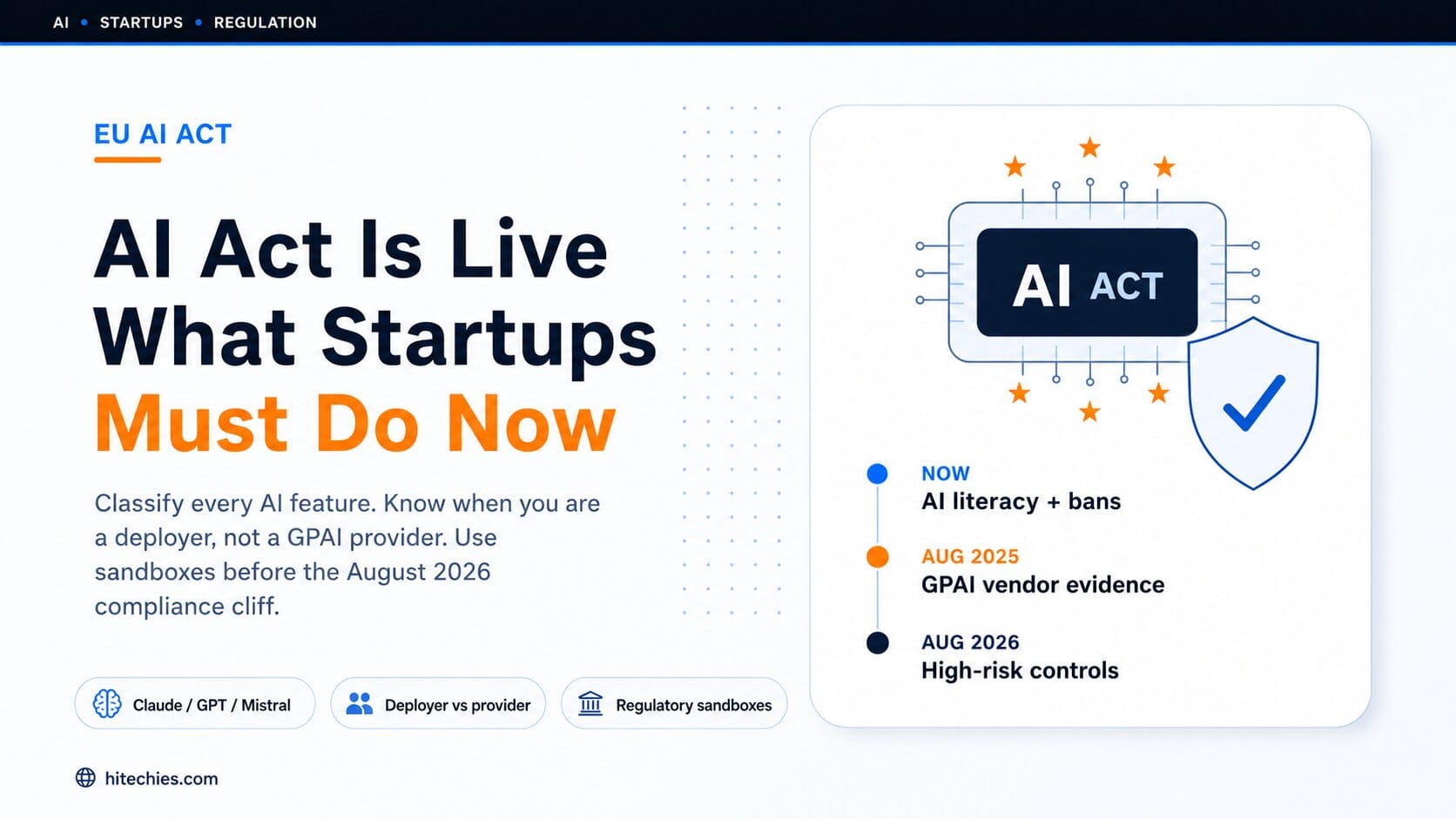
EU AI Act — Key implementation timeline
The AI Act is already live — the next major startup deadline is August 2026
1 Aug 2024
AI Act enters into force
2 Feb 2025
Banned practices + AI literacy apply
2 Aug 2025
GPAI model rules — live now
!
2 Aug 2026
⚠ Majority of rules — your deadline
2 Aug 2027
Product high-risk in regulated products
Sources: European Commission AI Act overview; EU AI Act Service Desk timeline; Regulation (EU) 2024/1689.

The risk-based model — four categories, very different obligations

Classification first

The AI Act does not regulate all AI the same way. It uses a risk-based model with four categories. Which category your product falls into determines everything — the documentation you need, the controls you must build, and the fines you face if you get it wrong.

AI Act risk categories — compliance burden by tier
Practical rule: map the product use case first, then assign obligations by role
Unacceptable risk
Banned since Feb 2025
High risk
Strict controls, conformity, logging, oversight
Transparency risk
Disclose chatbots, deepfakes, AI-generated public text
Minimal / no risk
Most systems — no mandatory AI Act obligations
Sources: European Commission AI Act overview and FAQ; Regulation (EU) 2024/1689.
The startup mistake to avoid Classification depends on intended use, not the underlying model. A startup using Claude or GPT for internal support drafting has very different obligations from one shipping an AI hiring assistant or medical triage tool under its own brand. Classify by what your feature does to real people, not by which API you called.

Are you a provider or a deployer? The distinction that changes everything

Your role in the chain

Most founders don't need to become general-purpose AI model providers just because they call a third-party LLM API. The key distinction is this:

You are a provider if... You wrap a foundation model into a product feature and sell or offer that feature under your own brand. You become the provider of that AI system — even if the underlying model is Claude, GPT, Mistral, or Gemini.
You are a deployer if... You use an AI system internally under your own authority — for example, using an LLM to draft support replies that your staff review before sending. You have lighter obligations, but you still need to document the use.

OpenAI, Anthropic, Google, Mistral, and Microsoft handle GPAI model-provider obligations for their underlying models. Your obligations attach to your own use case, customer interface, data, and role — not to the model underneath.

The practical test If you ship an AI support agent, content generator, hiring assistant, medical triage tool, or credit-risk feature to customers under your product name — you are likely a provider of an AI system. If you only use an LLM internally for staff productivity — you are closer to a deployer. Both roles have obligations. They're just different ones.

If your SaaS uses Claude, GPT, or another LLM — your obligations by use case

Quick reference
Use case Likely posture What to do
Internal support drafting
Staff use LLM, human reviews before sending
Deployer Add to AI inventory. Train staff. Document human review. Control personal data inputs. Keep vendor documentation.
Customer-facing SaaS chatbot
Answers product questions under your brand
Transparency Tell users they're interacting with AI. Log failures. Document intended purpose. Define human escalation. Test for hallucinations.
AI content generator
Marketing copy, product descriptions, email drafts
Transparency Label AI interaction. Keep output provenance. Add review workflow for regulated claims. Disclose AI-generated public-interest text.
CV ranking / hiring filter
LLM ranks applicants or filters candidates
High risk Full high-risk treatment: risk management, data governance, logs, human oversight, technical documentation, applicant information duties.
Clinical triage or eligibility
Medical diagnostic support, eligibility decisions
High risk Do not ship on a generic checklist. Assess medical-device status, high-risk AI status, clinical safety, human oversight, incident reporting.

What is already live — obligations in force right now

No grace period

The AI Act's bans on unacceptable-risk practices became enforceable on 2 February 2025. These are not future obligations — they are live law right now.

Banned since February 2025 Harmful AI-based manipulation of people. Exploitation of vulnerabilities based on age, disability, or social/economic situation. Social scoring by public or private entities. Certain individual criminal-offence risk predictions. Untargeted scraping of facial images for recognition databases. Emotion recognition in workplaces and educational institutions. Biometric categorisation to infer protected characteristics. Real-time remote biometric identification for law enforcement in public spaces except under narrow judicial authorisation.

The same February 2025 milestone brought AI literacy obligations into application. Organisations need appropriate AI understanding among staff and relevant people who operate or use AI systems. This means your product, engineering, and customer-facing teams need working knowledge of what your AI features do and how they can fail.

Rules for providers of general-purpose AI models became applicable on 2 August 2025, including transparency and copyright-related obligations. For startups using third-party models, the vendor's position under the GPAI Code of Practice becomes procurement evidence — ask whether your model provider has signed it, which chapters, and what documentation they provide to downstream customers.

Mistral-specific note worth knowing Mistral AI is a full signatory of the GPAI Code of Practice, alongside Anthropic, Google, Microsoft, and OpenAI. xAI is a partial signatory to the Safety and Security chapter only. For any model vendor, ask: what is the model's AI Act classification, what documentation is available, what incident-notification duties flow back to you, and what limits apply to high-risk repurposing.

What changes in August 2026 — the cliff most startups are heading toward

⚠ 3 months away

On 2 August 2026, the majority of AI Act rules come into force. This includes rules for high-risk AI systems listed in Annex III, transparency rules under Article 50, national and EU-level enforcement, and the requirement that member states have at least one AI regulatory sandbox operational.

High-risk AI systems cover use cases that affect health, safety, or fundamental rights — including AI used in critical infrastructure, education, employment, access to essential private or public services, law enforcement, migration and border control, justice, and democratic processes. Whether your system is high-risk depends on its intended purpose, function, specific use, and deployment model.

For startups building high-risk AI systems, compliance has to move upstream into product design. High-risk providers must prepare conformity evidence, risk management documentation, data governance, technical documentation, logging, human oversight controls, accuracy and robustness testing, cybersecurity measures, and post-market monitoring — before the system is placed on the market.

One genuine advantage: regulatory sandboxes The Regulation requires each member state to have at least one AI regulatory sandbox operational by August 2026. These are controlled environments for developing, training, testing, and validating novel AI systems before market launch. Importantly, no administrative fines should be imposed for AI Act infringements if participants follow the sandbox plan, observe its terms, and act in good faith on guidance received. If your product is borderline high-risk or novel, a sandbox application may be worth preparing now.

The fines are real — but the bigger risk is market access

Penalty structure

The AI Act's penalty structure is severe. For SMEs and startups, each fine is capped at the lower of the relevant percentage or fixed amount — but that does not remove the need to demonstrate compliance when authorities ask.

AI Act fines — fixed caps and % of global revenue
SME/startup caps use the lower of the fixed amount or percentage
Prohibited practices
Article 5
€35m or 7% turnover
Operator / transparency violations
Articles 99–101
€15m or 3% turnover
GPAI provider violations
via Commission
€15m or 3% turnover
Incorrect or misleading information
to authorities
€7.5m or 1% turnover
Source: Regulation (EU) 2024/1689, Articles 99 and 101. Even small teams need evidence of classification, controls, logs, and oversight before regulators ask.
The larger commercial risk isn't the fine The real risk is losing enterprise, public-sector, healthcare, finance, education, or HR customers because you can't produce documentation, controls, or contractual evidence fast enough during procurement. A single large customer requiring AI Act compliance evidence before signing — and you having nothing to show — costs more than most fines would.

A practical AI Act backlog for startups — six moves before August 2026

Action plan

Treat the AI Act as an operating system for responsible AI delivery. The work belongs in the product backlog, security backlog, data backlog, and vendor-management process — not in a static PDF that no one reads.

A 6-step operating plan for tech startups before August 2026
Turn the AI Act into a product and governance backlog
1
Inventory
List AI features, vendors, data, owners
2
Classify
Prohibited, high-risk, transparency, GPAI, minimal
3
Assign roles
Provider, deployer, importer, distributor
4
Build evidence
Risk file, logs, data governance, oversight
5
Vendor pack
GPAI docs, copyright, model cards, SLAs
6
Review loop
Incidents, drift, audits, EU guidance updates
Sources: European Commission AI Act overview and FAQ; AI Act Service Desk timeline; GPAI Code of Practice page.
1
Build the AI inventory
Create a single source of truth for all AI use — in-house models, third-party APIs, open-source models, embedded AI in SaaS tools, automation workflows, data inputs, model outputs, user groups, affected persons, deployment geography, owner, vendor, and release status. This is the baseline for determining your role in each use case.
2
Classify every use case by intended purpose
A chatbot that answers product questions triggers transparency duties. A model that ranks job candidates, influences credit access, or supports medical eligibility may be high-risk. Every AI system needs a classification card: intended purpose, model vendor, your role, risk category, user notice, human escalation route, and incident process.
3
Assign evidence owners
Every AI system needs a named owner responsible for classification, data governance, model testing, documentation, human oversight, monitoring, incident response, and customer evidence. High-risk systems need detailed documentation before they go to market — not after.
4
Collect vendor documentation early
If your product depends on a GPAI model, request vendor documentation now. Ask whether the model provider has signed the GPAI Code of Practice, which chapters, how they demonstrate compliance, what downstream documentation they provide, and what incident-notification duties flow back to you.
5
Make transparency a product feature
Users interacting with AI must be told. Providers of generative AI must ensure output is identifiable. Certain deepfakes and AI-generated public-interest text need clear disclosure. Implement these in the user interface and content pipeline — not manually at launch.
6
Plan for monitoring and incidents before first regulated customer
Logs, drift checks, complaint handling, model-change reviews, customer notifications, and vendor escalation paths should be designed before the first enterprise or regulated customer signs. Post-market monitoring is an obligation, not an afterthought.

What startups should do this month — the two-week sprint

Immediate actions

The most useful immediate move is a focused two-week sprint.

Week 1: Create the AI inventory. Classify each system. Identify any obviously prohibited or high-risk use cases. Freeze any risky launch until the classification is documented and signed off.

Week 2: Assign evidence owners. Request GPAI and vendor documentation. Add transparency requirements to the product backlog. Draft a board-level AI risk register.

Beyond the sprint, four moves matter most:

Create a customer-facing AI compliance pack. Include the AI inventory summary, risk classification rationale, model and vendor list, data governance summary, human oversight approach, logging and monitoring controls, transparency disclosures, and incident-response process.
Watch official guidance. The Commission's AI Act Service Desk, AI Office guidance, GPAI Code of Practice, transparency-code work, harmonised standards, and national competent-authority updates will shape how evidence is assessed in practice.
Identify whether a sandbox application is worthwhile. If your AI system is novel, borderline high-risk, or intended for employment, healthcare, education, finance, public services, or critical infrastructure — prepare a sandbox dossier now.
Treat this as a product and engineering problem, not a legal one. The evidence needs to be in your systems, logs, and user interface — not in a document your lawyers wrote and nobody else has read.
Bottom line The EU AI Act is already live for banned practices, AI literacy, and GPAI obligations. The next major compliance cliff for most startups is 2 August 2026. Startups that can show a clean inventory, a defensible classification, vendor evidence, transparency controls, logs, human oversight, and an incident process will be easier to sell, fund, audit, and scale in Europe. Startups that can't will find out the hard way during procurement.
This article is for general information only and does not replace legal advice for a specific AI system, product, or market entry decision. Consult qualified legal counsel before making compliance decisions.

Compare AI models before you build → See how GPT-5.5, Claude Opus 4, and Gemini handle the same prompt — free, no account needed.

Open AI Benchmark

Marshall Manoharan

Marshall Manoharan

Digital Transformation Specialist. AI Ethics certified, he writes about how startups can adopt AI responsibly and stay ahead of EU regulation.