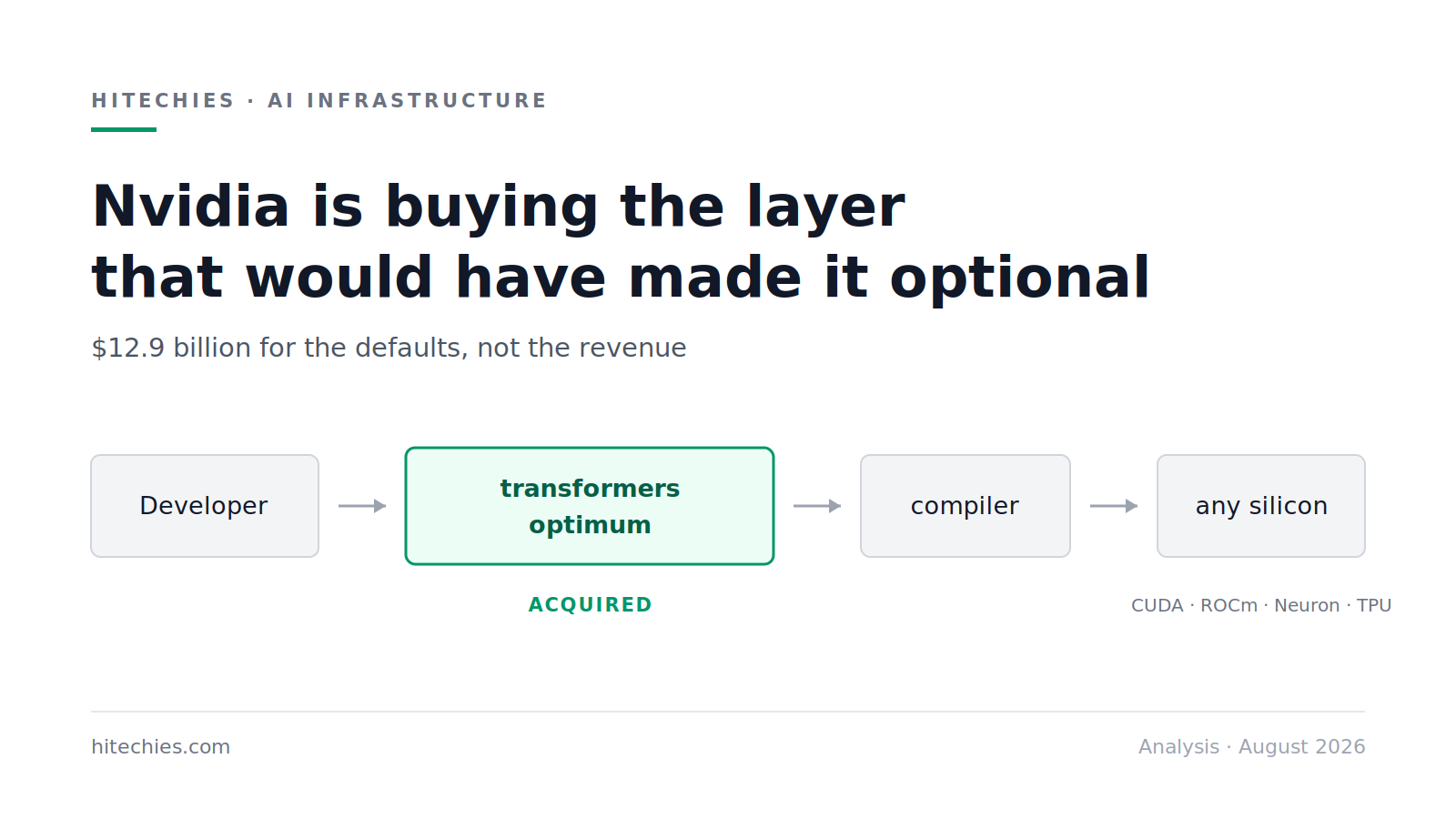
Hugging Face maintains a package called optimum. Its job is to take a model and make it run properly on whatever accelerator you own: AWS Neuron, so Trainium and Inferentia. Intel. ONNX Runtime. AMD.
It is not the most important piece of hardware-portability infrastructure in the industry. It isn't close. PyTorch's compiler stack matters more, Triton matters more, and MLIR, XLA, ONNX Runtime, vLLM and AWS's own Neuron SDK are all pushing in the same direction.
But every one of those is either open-governance or owned by Nvidia's competitors. PyTorch sits under the Linux Foundation. Triton and MLIR have no owner to negotiate with. Neuron belongs to Amazon.
Hugging Face is the only node in that entire diagram with a cap table.
That's the acquisition. Hugging Face is not the threat. It is bought because it's the acquirable fraction of a threat that is otherwise structurally unbuyable, and because it sits at the exact layer where the industry's defaults get set.
Everyone is covering the price. The interesting question is what Nvidia thinks it's defending, and for once you can answer it fairly precisely, because the threat is made of code you can go read.
What the moat is actually made of
Nvidia's protection has never been raw FLOPs. Competitors get close on paper regularly, and have for years. The protection is that the software above the chip assumes Nvidia, and has for fifteen years.
Concretely, that's four things.
Kernels. cuBLAS and cuDNN handle the matrix and convolution primitives. Above them sit the hand-written fused kernels that make modern transformers viable at all. FlashAttention is the one that matters most. It restructures attention to avoid materializing the full N×N score matrix in high-bandwidth memory, turning a memory-bound disaster into something that tiles through SRAM. Nothing about that algorithm is Nvidia-specific. The implementation, tuned first for Ampere and then Hopper, entirely is.
The compiler chain. CUDA C++ goes through NVCC to PTX, Nvidia's intermediate representation, then to SASS, the machine code for a given architecture. PTX is a moat in its own right: stable, documented, and the funnel everything passes through. Teams chasing the last few percent write it directly.
Day-one support. A new architecture drops, say a new attention variant or a new MoE routing scheme, and it runs on CUDA immediately, because the kernels exist or get written within days by people who own the hardware. On Neuron or ROCm, that work happens again, later. The lag is rarely dramatic. Six weeks, then four, then it mostly works.
Defaults. This is the one nobody writes about, and it's the one Nvidia is buying.
Why now, and not in 2023
Nvidia already held a stake in Hugging Face from the 2023 round that valued it at $4.5 billion. It looked at this company, at a fifth of today's price, and passed.
What changed isn't Hugging Face's revenue. It's that hardware abstraction became technically tractable, for a reason that has nothing to do with Hugging Face.
The op set stopped churning. Five years ago portability was hopeless, because architectures mutated constantly and any abstraction layer was chasing a moving target. Today essentially everything in production is a transformer variant, and the operations that matter have narrowed to a short, stable list: GEMM, attention, RMSNorm, SwiGLU or a close relative, rotary embeddings, and for mixture-of-experts, a routing step and an all-to-all.
That's a small enough surface for one team to support properly across four backends. Convergence is what made portability viable at all. It's also what made Nvidia's problem urgent, because the same narrowing that lets a startup ship a model quickly is what lets Trainium be a genuine substitute rather than a science project.
The choke point is a config line
When you load a model with transformers, you're not just fetching weights. You're inheriting decisions: which dtype, which attention implementation, which quantization backend. The attn_implementation argument alone dispatches between eager, PyTorch's SDPA, and FlashAttention-2. Unless you override it, the library chooses.
Multiply by Hugging Face's download volume and the framing changes. Some small fraction of developers deliberately choose a backend. The rest accept what from_pretrained hands them, in a call they think of as "loading a model."
Whoever sets those defaults isn't maintaining a library. They're steering a very large amount of downstream compute demand without anyone ever consciously deciding "I choose Nvidia."
None of this is new. Browser search defaults, OS browser defaults and cloud SDK defaults have all been worth billions, and AI infrastructure is not special. That lever is a line in a config dict, and right now it belongs to a neutral party.
The stack that was dissolving the moat
Read the layers bottom-up.
Triton is the important one, and it isn't Hugging Face's. It's a Python-embedded language for writing GPU kernels, and PyTorch's torch.compile pipeline, where Dynamo captures the graph and Inductor lowers it, emits Triton rather than CUDA C++. The consequence is structural: a growing share of performance-critical kernels are no longer written in CUDA by anyone. They're generated from a vendor-neutral IR, and Triton has non-Nvidia backends. Every kernel that migrates from hand-written CUDA to generated Triton is a brick out of the wall, and this is happening inside PyTorch, which Nvidia cannot buy.
safetensors made weights memory-mappable, zero-copy and framework-neutral, replacing pickle-based checkpoints. Boring and load-bearing.
transformers and accelerate standardized how models are defined and sharded, so the definition stops encoding hardware assumptions.
optimum compiles that neutral definition for a specific backend; optimum-neuron wraps AWS's compiler and hands you the same call shape as the CUDA path.
TGI and vLLM closed the serving gap that used to make non-Nvidia deployment painful in production rather than merely in benchmarks.
Nvidia is buying two of those six. That's the honest accounting, and it's why this is a hedge rather than a solution.
Portable correctness is not portable performance
Here's the strongest argument against reading this as an existential threat, and it deserves stating properly.
Making a model run on alternative silicon is a solved-ish problem. Making it run at 95% of what the hardware can theoretically do is not, and the gap between those two states is where the entire economics live. Memory hierarchy, tensor core geometry, fabric topology, supported precisions and compiler maturity all differ enormously, and an abstraction layer that hides those differences from the developer does not thereby eliminate them.
At hyperscale, a 15% throughput difference is a nine-figure line item. Portability that costs 15% is not portability, it's a rounding error away from just buying Nvidia.
So the abstraction layer's real work is not compatibility. It is closing that performance gap, generation after generation, on hardware the maintainers don't own. That's slow, unglamorous work.
It also cuts the other way, which is the part the bear case misses: if performance portability is the hard part, then the layer where performance defaults and tuning decisions get made is worth more, not less. You don't need to stop portability. You need it to keep costing 15%.
Where the performance frontier moved
The trend that should worry Nvidia most is visible in any inference benchmark from the last two years.
The big throughput wins have stopped coming from hardware exploitation and started coming from scheduling. Continuous batching, replacing static batches with a rolling admission queue. PagedAttention, managing the KV cache in fixed blocks like virtual memory instead of contiguous allocations. Prefix caching. Speculative decoding, where a small draft model proposes tokens a large model verifies in parallel.
Every one of those is an algorithm. None is hardware-specific. They deliver multiples, not percentages, and they run on anything.
The share of total inference performance attributable to being on Nvidia specifically shrinks every year, not because Nvidia's chips got worse, but because the largest remaining wins are portable by construction.
What abstraction still can't hide
One part of the moat is genuinely hard to route around, and it's where Nvidia's real advantage now lives.
Collectives. Multi-GPU and multi-node work depends on all-reduce, all-gather and all-to-all, and on Nvidia those run through NCCL over NVLink and NVSwitch, tuned over a decade. AMD's RCCL and AWS's Neuron collectives over EFA exist and work, but this is system-level engineering: topology, congestion, fabric behavior under load. It is not a kernel you regenerate from a neutral IR. FSDP and DeepSpeed sit directly on top.
Mixture-of-experts makes it worse for the challengers, since MoE routing turns every layer into an all-to-all exchange, loading weight onto exactly the interconnect advantage Nvidia spent a decade building.
It's also worth resisting the tidy claim that competitors only lack software. They lack memory bandwidth, packaging, fabric maturity and volume manufacturing too, in varying combinations. Software is the gap that closes fastest, which is why it's the one worth defending, not the only one that exists.
Quantization is the live front
Nvidia's newest advantage isn't core count, it's numerics: FP8 on Hopper, FP4 on Blackwell, hardware and kernels arriving together. Low precision is where inference economics are now decided.
Quantization is also the most hardware-entangled part of the stack: bitsandbytes, GPTQ, AWQ and the FP8 paths all need per-architecture kernels. And Hugging Face is where those competing methods get normalized behind one interface.
The strategic shape matters more than the detail. Nvidia's preferred sequence is: ship a new numeric format, have the ecosystem build around it, convert a hardware lead into software lock-in. The abstraction layer's effect is to replace that with: ship a format, watch competitors implement an equivalent, watch the abstraction hide the difference. Then Nvidia has to win the next generation on merit, and the one after that, forever. A durable moat becomes a treadmill, and treadmills don't support seventy-percent margins.
What ownership buys, and what it doesn't
To be clear about what follows: this is incentive analysis, not a prediction, and nobody has evidence Nvidia intends any of it.
Ownership doesn't require sabotage, and sabotage would be self-defeating. Hugging Face's value is its neutrality, and visibly crippling non-Nvidia support would push AWS, AMD and Google to fund somewhere else within a quarter. Nvidia's rational strategy is to keep the platform genuinely neutral while ensuring the Nvidia path is simply the best-maintained one.
That's a subtle difference and it's the whole game. Nothing gets deleted. Everything stays open source. What shifts is merge latency and roadmap order: the CUDA path works on day one because the generic kernels cover it, while the Neuron path needs tracing support and a compiler update, and that pull request waits on maintainers whose priorities are set elsewhere. Meanwhile defaults keep resolving to the FlashAttention path on CUDA and something more conservative elsewhere, which is defensible on stability grounds and always has been.
Six weeks of lag, preserved indefinitely, with no rule broken and nothing to point at. Nobody has to conspire. That is simply what ownership does to priorities, and it is enough.
The move may create what it's meant to prevent
Here's the part that makes this genuinely interesting rather than merely clever.
Hugging Face's usefulness as a portability layer depended on it being nobody's. The moment it becomes Nvidia's, every organization with a stake in alternative silicon acquires a sharp new reason to fund an independent one. Unlike Hugging Face, they have the resources and the motive to coordinate.
AWS, Google, Meta, Microsoft and AMD all have chips they need a software path for. A neutral consortium layer has been unnecessary while a functioning neutral layer already existed. Buying it removes that argument overnight.
So the plausible outcome isn't "Nvidia controls the abstraction layer." It's "the abstraction layer fragments, and the successor is built by a coalition explicitly organized around not being Nvidia." Nvidia would have bought the Schelling point and destroyed the property that made it one. Call it the coordination-equilibrium version of observing a particle.
Which may still be the right trade. Fragmentation buys years, and years are what this is about. But it's a different bet than the tidy one, and it's the reason the smart response to this deal is to watch what Amazon and AMD announce next, not what Nvidia does.
What the price does and doesn't tell you
Nvidia is reportedly paying about eighty-six times revenue for a business it already had a stake in and passed on at a fifth of the price three years ago.
That's consistent with the thesis. It is not proof of it, and I'd resist anyone who says otherwise, including the first draft of this piece. A number that size can also be paying for enterprise relationships, developer mindshare, hosted inference revenue, talent, dataset gravity, or simple denial. Keeping the asset away from a competitor is worth real money on its own.
What the price does establish is that something changed between 2023 and now, and it wasn't Hugging Face's fundamentals. Everything above is an argument about what.
The thing actually being contested
Strip out the deal and the disagreement underneath is about which sentence describes the next decade.
Nvidia needs developers to keep experiencing the stack as AI runs on CUDA runs on Nvidia. Everyone else needs it to become AI runs on a framework, and the accelerator underneath is a purchasing decision.
If the second sentence wins, Nvidia doesn't necessarily lose its lead. Its chips may stay the fastest for years. What it loses is more valuable than the lead: the customer's inability to leave.
That's what $12.9 billion is bidding on, and it's why the interesting question was never whether the deal is signed.
The deal was reported by The Information and has not been confirmed by either company; Business Insider reported no signed agreement as of Thursday. Figures for the purchase price and Hugging Face's revenue trace to a single outlet and remain unverified.
The tell: if this closes, watch time-to-support for new architectures on non-CUDA backends over two quarters, and commit velocity on optimum-neuron and optimum-amd. Then watch whether AWS, AMD and Google announce anything that looks like a shared alternative. The second signal matters more than the first.