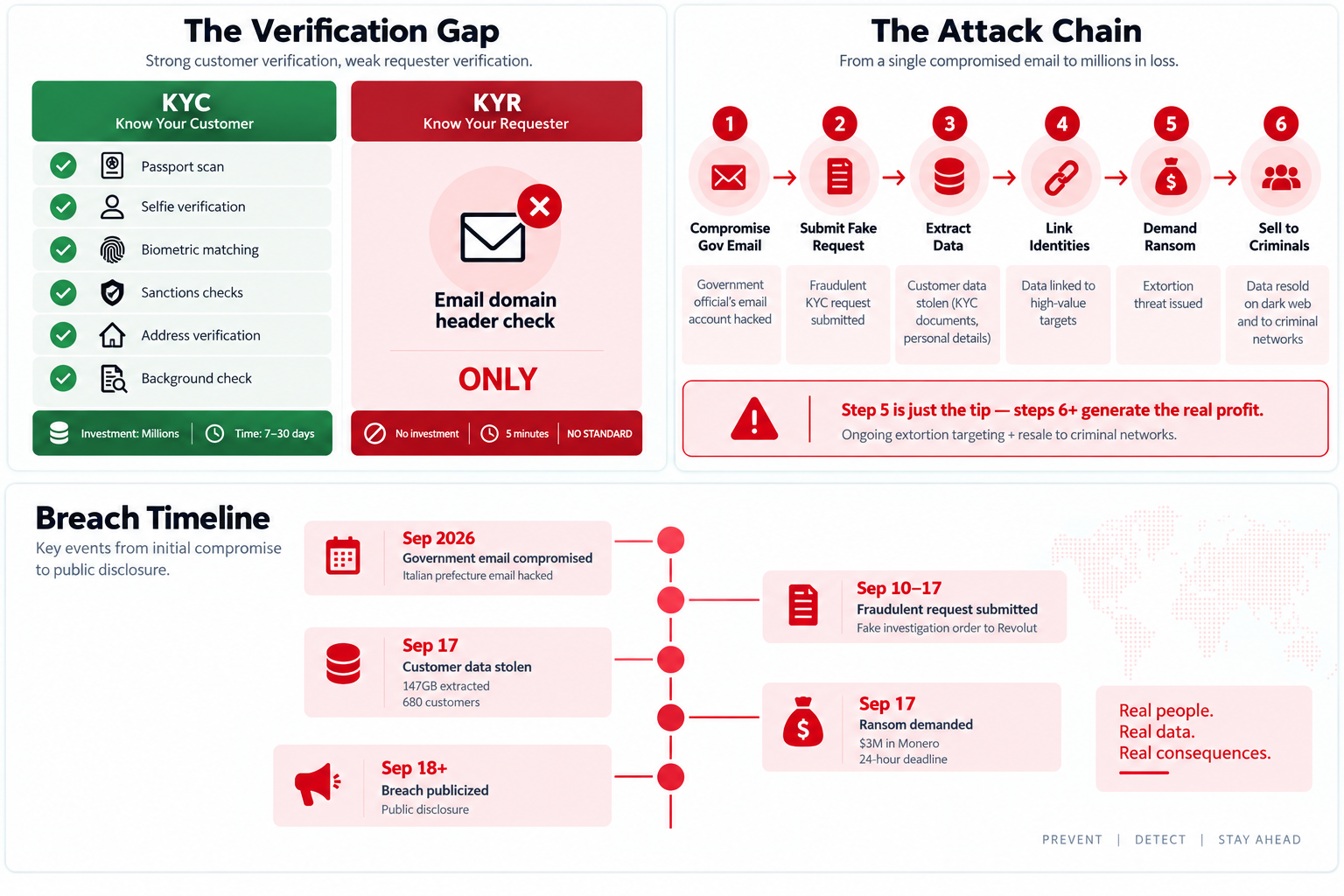
Revolut spent millions building one of the tightest Know Your Customer systems in fintech. They scan passports. They verify selfies. They cross-reference against sanctions lists. They do this for every customer, every time.
It took an email header to bypass all of it.
On September 17, a criminal group calling themselves "iamnotavillain" released a ransom demand: 6,000 Monero, roughly $3 million, due in 24 hours. They had stolen data on 680 European customers. Passports. Driver's licenses. Selfies. Account numbers. Complete transaction histories, including Bitcoin movements. The breach worked because someone sent Revolut a request that looked like it came from Italian law enforcement. It came from a real government email account—just one that had been compromised. Revolut treated email authentication as sufficient proof. And their customers are still paying the price.
The scandal here isn't that Revolut got hacked. It's that we built a financial system that trusts government email headers more than it trusts government itself.
Who Actually Got Harmed Here?
Start with the 680 customers whose data is now in criminal hands. Their passports are compromised—identity documents are expensive to forge, but this saves the work. Their selfies combined with their identities enable deepfake attacks and account takeovers at other institutions. Their IBANs, account opening dates, and withdrawal records create a detailed map of their financial behavior. Their Bitcoin transaction histories, especially damaging, have permanently linked their verified real-world identities to every pseudonymous wallet they've ever touched. This data doesn't expire. A customer's transaction history from September 2026 will enable extortion in 2030. It will fuel phishing in 2035.
But the victims extend beyond Revolut's customers.
Fintech founders are now trapped in an impossible bind. The Financial Conduct Authority expects companies to respond to government data requests within 24–48 hours. Move too slow and face regulatory enforcement. But verify too hard and regulators will accuse you of obstructing law enforcement. There's no middle ground. There's no standard. There's no authentication mechanism that's both fast enough and secure enough to satisfy anyone.
Revolut's executives are in the worst position of all. They followed the rules. They complied with what appeared to be a legitimate government request. They disclosed customer data based on procedures that every other fintech follows. And now customers are suing, regulators are investigating, and their IPO—which was supposed to happen this year—is in limbo. This is the cost of operating in a system with no verification standard.
The Regulatory Trap: Speed vs. Security
Here's what nobody in compliance circles will say out loud: regulators created this disaster. Specifically, they created it by obsessing over speed while ignoring verification.
In 2019, the FCA started issuing guidance requiring rapid response to law enforcement data requests. The expectation: 24–48 hour turnaround for urgent requests. This was framed as necessary for fighting crime. Fast data disclosure saves lives in kidnapping cases, terrorism investigations, human trafficking situations. The intent is legitimate.
But the FCA never, in any guidance, ever required companies to verify that the person requesting data was actually law enforcement. They assumed government email headers were sufficient. Or they didn't think about it at all.
Meanwhile, European data protection law (GDPR) says that any personal data disclosure requires a lawful basis. The assumption: if a government agency with authority requests it, the lawful basis is satisfied. The regulation doesn't require verification of that authority. It assumes the authority is real.
Law enforcement agencies, for their part, have spent decades operating under the assumption that email is a secure channel. It isn't. Email servers at municipal, regional, and national levels routinely lack multi-factor authentication. Passwords leak. Credentials get sold. A police captain's email account compromises a building's worth of investigation tools.
The result is a regulatory system that optimizes for one thing—speed of compliance—and ignores two others: verification and security. Companies responded rationally by building systems optimized for speed. Revolut responded rationally by treating authenticated email headers as sufficient proof.
The system failed because the system is broken.
The Verification Vacuum Nobody Wants to Acknowledge
There is no standard for "Know Your Requester" (KYR) in the financial services industry. Full stop.
We have KYC standards. We have AML/CFT standards. We have transaction monitoring standards. We have data protection standards. But there is no mandated, auditable, repeatable standard for verifying that the person requesting customer data on behalf of government is actually an authorized representative of that government, acting within their scope of authority, for a legally valid purpose.
This isn't a Revolut oversight. It's an industry-wide blind spot.
When a company receives a data request that appears to come from law enforcement, they have no reliable way to verify it. They can:
- Check the email domain. (Revolut did this. It wasn't enough. Domains are spoofed or compromised routinely.)
- Call a known number. (Some fintechs do this. But what number? Many police departments don't publish dedicated data request lines. And if the attacker has email credentials, they might also control the phone system.)
- Require digital signatures. (No law enforcement agency in Europe uses PKI-signed government requests. This isn't an option yet.)
- Ask for case numbers, investigation references, or judicial authorization. (This might actually help. But what if the requester doesn't have a case number yet? What if it's an intelligence operation? There's no time for deep verification when someone claims lives are at stake.)
The honest answer is: there's no good way to verify. So companies punt. They treat the appearance of authority as sufficient. And when that appearance is faked—when a compromised government email gets used to extract sensitive data—the company gets blamed for being gullible, while the system that incentivized this gullibility remains untouched.
Why This Breaks the Entire Ecosystem
This isn't an isolated incident. It's a pattern waiting to happen across the industry.
Every major fintech holds the same data Revolut held: passport scans, selfies, bank account details, transaction histories. Wise. N26. Kraken. Coinbase. They all have KYC data on millions of customers. And if one criminal group figured out that compromised government emails work as a key to access that data, others will too.
More specifically: the attackers now know exactly which fintechs hold the highest-value targets. A company serving crypto users holds data linked to Bitcoin holdings and wallet addresses. That data is worth orders of magnitude more than a traditional bank's customer data. You can use it for targeted extortion ("we know which wallets hold your Bitcoin"), wallet theft ("we can use your identity to intercept your recovery codes"), or portfolio construction ("we know who the real whales are").
The $3 million ransom Revolut received? That's not the real payday. The real payday comes from selling access to criminals who will extort customers individually. Or from selling to competitors' security researchers. Or from using the data to craft perfectly targeted phishing campaigns. The ransom demand is the noise. The data extraction is the goal.
And now we're in a multi-level tragedy:
- Revolut's customers face identity theft, extortion, and account takeover risk
- Other fintechs face the same targeting (the attack pattern is public now)
- Legitimate law enforcement faces a trust crisis (their own channels are compromised)
- Regulators have to choose between demanding faster compliance (which enables more fake requests) or demanding better verification (which they never defined)
- The entire fintech sector becomes a high-value target for credential theft
What Needs to Exist—and Doesn't
If the system is broken, the question is: who fixes it?
Regulators won't. The FCA and ECB have shown no appetite for defining a KYR standard. They created the obligation for speed; they're not going to create the infrastructure for verification. Compliance exists in the space between "too much regulation is bad" and "not enough regulation is bad," and nobody wants to move either boundary.
Tech companies won't self-regulate. Banks have no incentive to build better government-verification infrastructure. It would slow down compliance. It would create liability if a request that should have gone through got blocked by over-verification.
Which means nobody's building the actual solution.
This standard would need to be mandated across the EU and UK. It would need teeth—audits, penalties for non-compliance, liability shields for companies that follow it correctly.
It would also need to be fast. The entire point of the current system is speed in emergencies. A KYR standard that added 48 hours to every request would just push the problem elsewhere.
The technology to do this exists. Banking systems use PKI and digital signatures all the time. The infrastructure isn't the problem. The problem is that nobody has written the spec, nobody has mandated it, and nobody has invested in building it across agencies.
The Compliance Theater We're Still Performing
Revolut's compliance failure illustrates something brutal about how financial regulation actually works: we measure inputs, not outcomes. We measure that you have a process, not whether the process works.
Revolut had a process for responding to government data requests. It was documented. It was followed. It was audited. By every metric that regulators care about, it was compliant. And it failed catastrophically.
But regulators won't fine Revolut for having the wrong process. They'll fine Revolut for not having patched the process after industry events revealed its vulnerability. They'll fine them for failing to implement controls that—until now—nobody required.
This is how compliance theater works. We build elaborate systems to track what we're supposed to do. We get very good at documenting that we did it. And then we act shocked when the underlying system is fundamentally broken.
Revolut will pay fines—likely £10–50 million under GDPR and FCA enforcement. They'll implement "enhanced verification" for government data requests. They'll add a new layer to their compliance stack. And in two years, when another fintech gets breached the same way, regulators will act surprised and fine the next company too.
Meanwhile, the actual problem—the verification vacuum—remains unfixed.
Where This Heads
If nothing changes, here's what happens:
Months 1-3: Regulators conduct investigations into Revolut. Fintechs audit their own government data request procedures. Nothing meaningful changes.
Months 4-6: Three more fintechs get breached the same way. Each one is a variation—different government email compromised, different data exfiltrated, different ransom demand. Patterns emerge in security research.
Months 7-12: Class action lawsuits against fintechs for inadequate verification procedures. Regulators issue guidance (non-binding, of course) suggesting "enhanced scrutiny" of government requests. Some companies implement callback verification. Most don't.
Year 2: Credential theft becomes a targeted attack vector. Criminal groups specialize in compromising government email accounts specifically to sell access to fintechs. It becomes a market.
Year 3+: Regulators finally issue binding guidance. It requires verification that looks like: out-of-band confirmation, case reference validation, digital signatures. It adds 24–48 hours to every request. There's uproar from law enforcement about delays. There's a compromise: emergency requests get expedited processing if the requesting agency has PKI certification (most don't yet). It takes three more years to implement.
This is the trajectory we're on unless something changes. And the thing is: this is all knowable. We can see it coming. We know the system is broken. We're just waiting for the regulatory machine to grind slowly enough that by the time it produces answers, everyone's moved on.
The Real Cost
The customers affected by this breach will spend years managing the fallout. They'll monitor credit reports. They'll watch for account takeovers. They'll get targeted by phishing campaigns. Some will lose money. Some will be victims of identity fraud.
They'll also never fully trust Revolut again. Or any fintech. The message is clear: these companies will comply with anything that looks like authority, without verification. Your data is only as secure as the email system of whatever government agency might request it.
Revolut will survive this. They'll pay fines, implement new controls, and move forward. It'll hurt the IPO timeline. It might change the valuation. But they'll survive because they're big enough to absorb the cost.
Smaller fintechs won't be as lucky. One breach could bankrupt them. Or force them into the arms of a larger acquirer—exactly the kind of consolidation that kills innovation.
And the system—the actual financial infrastructure—remains broken. Because we've built compliance as theater. We measure that you followed the procedure, not whether the procedure actually works. We create obligations without creating verification mechanisms. We blame companies for gaming a system we designed to be gameable.
Revolut didn't fail because they're incompetent. They failed because the system they operate in has no verification standard for the most critical data requests they receive.
What Needs to Happen Now
This one's simple. Regulators need to mandate an actual verification standard for government data requests. Not suggestions. Not best practices. Requirements. With audit, with teeth, with liability shields for companies that follow them.
The standard should include:
- Digital authentication. Government agencies that request customer data must use PKI-signed requests or equivalent cryptographic proof of authority. No email headers. No passwords. Real cryptographic verification.
- Out-of-band confirmation. For sensitive disclosures, fintechs should be able to call back to independently verified government numbers to confirm the request.
- Case reference validation. Requests must reference real investigation numbers that can be spot-checked against case databases.
- Temporal validity. Requests expire. They can't be forwarded indefinitely or reused for different purposes.
- Audit logging. Every data disclosure is logged with the requester's identity, the legal basis, and the data requested. This enables post-breach discovery.
- Safe harbor. Companies that follow the standard and still get breached aren't liable to customers for the breach itself (they're liable for negligence, but not for the mere fact that they complied with a fraudulent request using proper verification).
Will this slow down emergency requests? Yes, a bit. But not as much as people think. If agencies are using real digital credentials, verification can happen in minutes. It's the current email-based system that's slow because it requires manual review.
Will this cost money to implement? Yes. Both for government to build their side of the infrastructure, and for fintechs to implement verification systems. But we're already spending that money—on fines, on remediation, on lawsuits, on breach notifications. We're just spending it badly, after the fact, instead of before.
The question isn't whether we can afford a real verification system. The question is how much longer we can afford not to have one.
Final Word
Revolut's compliance team didn't fail. The fintech industry didn't fail. The system failed. And it will keep failing until someone has the authority and will to build verification standards that actually work.
Until then, every customer of every fintech holding sensitive data is betting that their data stays secure based on the assumption that government email servers are trustworthy. We've now proven they're not. The next breach is just a question of timing.
The real scandal isn't that Revolut got breached. It's that we're shocked when a system with no verification standard gets bypassed by someone who knows how to fake the appearance of authority.
We built this. We can fix it. We're just choosing not to yet.