The AI Price War · 2026
AI’s Smartest Model Just Became Its Worst Business Decision
The real AI fight of 2026 stopped being about who’s smartest. It’s about who’s cheapest — and that quietly changes the story for Nvidia, Meta, OpenAI, Anthropic, and Google.
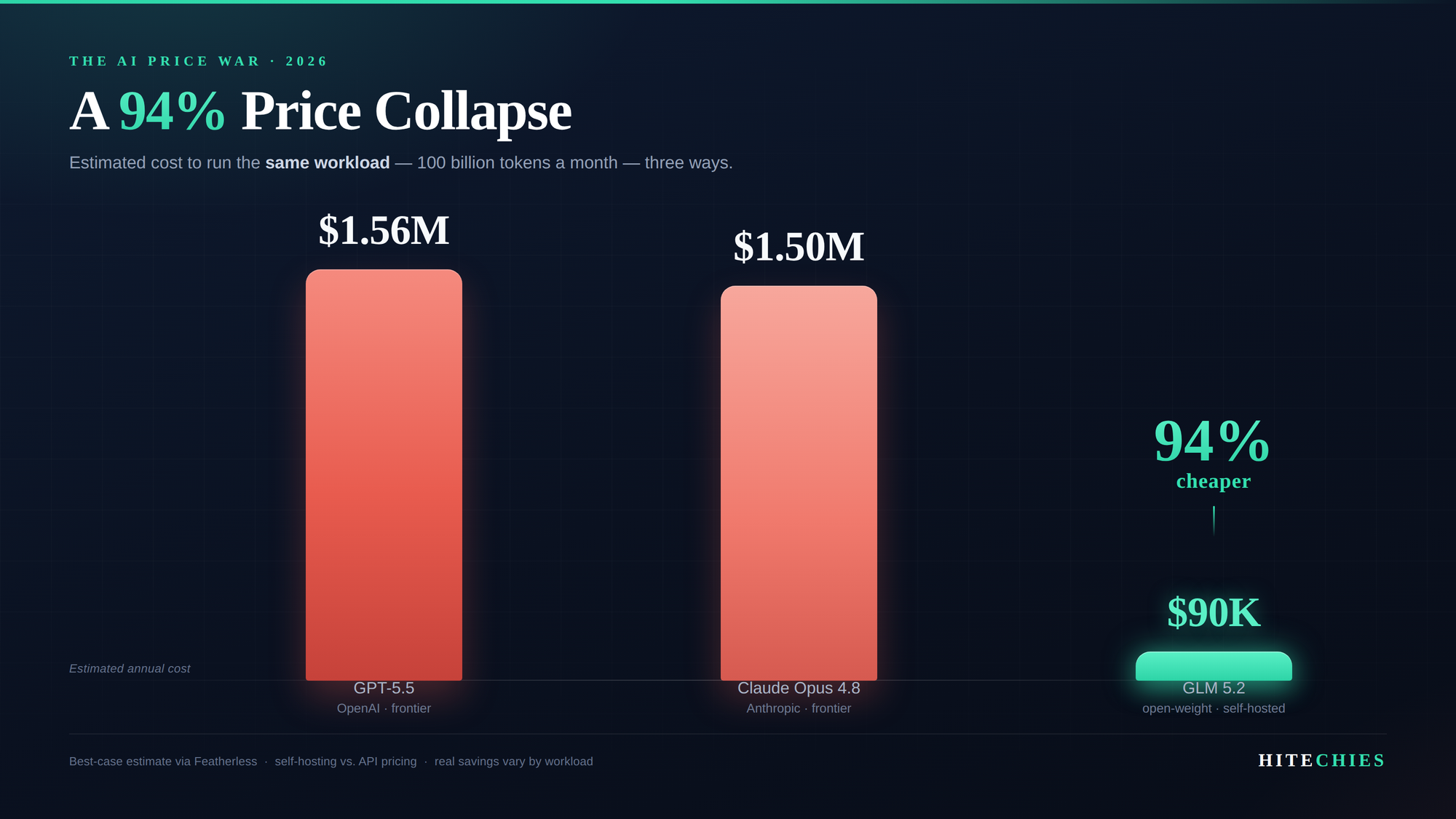
Run 100 billion tokens a month through GPT-5.5 and, by one industry estimate, you’ll pay about $1.56 million a year. The identical workload on Claude Opus 4.8 lands near $1.5 million. Run it on an open-weight model like GLM 5.2, hosted on your own hardware, and the bill drops to somewhere around $90,000.
Same job. Ninety-four percent less money.
Those figures come from a cost comparison by Featherless — which, worth flagging, is the inference firm that sells the GLM 5.2 hosting in question, so not a neutral referee — and like any such comparison they rest on assumptions I’ve spelled out in a note at the end. Independent analyses are more cautious than the headline: GLM’s published rates (roughly $1.40 per million input tokens and $4.40 output, against $5 and $30 for GPT-5.5) really are a fraction of the frontier’s, but actual bills often shrink less than the sticker gap suggests, because open models can run more verbose and self-hosting carries its own hardware and engineering costs. Treat 94% as the best case, not a promise. The direction, though, isn’t in doubt.
For three years the whole industry revolved around one question: who has the smartest model? OpenAI, Google, and Anthropic traded the benchmark crown every few months, and each release got covered like a moon landing. That period is ending, and not with a bang. The question that matters now is the one being asked in finance meetings, and it’s the one the frontier labs least want to hear:
Why are we paying a premium for the smartest model when a cheaper open one does most of what we need?
Once a CFO says that out loud, the math behind the premium-AI business starts to look less certain.
The four-month lead that stopped being a moat
The bull case for expensive AI leaned on one belief: the top labs would stay so far ahead that paying up wasn’t really a decision. Open-weight models — the ones whose parameters you can download and run yourself, as distinct from fully open-source projects — were the cheap alternative. Fine for tinkering, not for serious work.
The capability data has started to undercut that.
Epoch AI tracks the distance between the two, and since January 2026 the best open-weight models have trailed the best closed ones by an average of about four months. In their scoring, that’s roughly the jump from GPT-5 to GPT-5.5. Four months, not the multi-year canyon investors were sold on.
Now, a shrinking benchmark gap is not the same thing as proof that paying for the frontier is pointless. The data shows the distance closing; it doesn’t, on its own, show that a premium model’s edge is economically worthless. But it does reframe the question. If the best proprietary model is only a season ahead of something you can run for the cost of the hardware, that head start has to justify paying ten to sixteen times more. For a thin band of frontier work — cutting-edge research, the hardest coding, the reasoning where being slightly wrong is expensive — it plausibly does. For much of the routine work companies actually run on AI, the summarizing and sorting and drafting and ticket-answering, it’s harder to argue. That work doesn’t need the best model in the world. It needs a good one that’s cheap.
The moat didn’t vanish. It just got narrow enough to step over.
While everyone watched the scoreboard, the cheap challengers moved in
Western coverage stayed fixed on OpenAI versus Anthropic. Meanwhile something interesting happened down in the plumbing.
On OpenRouter, a platform that routes API traffic across many different models, Chinese open-weight models went from basically nothing in late 2024 to around 61 percent of tokens by mid-2026. Four of the five most-used models there are Chinese. DeepSeek alone drew about 17.6 percent of routed tokens, edging past Anthropic’s 15.4 percent. Google’s share reportedly fell from roughly 37 percent to 13 percent in a year, and Meta’s Llama, once the flagship of American open weights, dropped off the list.
One caveat matters here, and it’s a big one: OpenRouter is a single marketplace, not the whole AI economy, and its users skew toward developers and cost-sensitive builders rather than large enterprises on direct contracts. This is a signal, not a census. But it’s a loud signal, and the download data points the same way. Qwen’s model family has passed a billion cumulative downloads on Hugging Face, overtaking Llama, and a large share of new open-weight derivatives now build on it. DeepSeek’s V4-Pro reportedly sells for about twelve times less than GPT-5.5 at comparable benchmark scores.
It’s the oldest pattern in tech. The cheap, good-enough option climbs up from underneath while the incumbents keep adding capability at the top, and the floor of “good enough” rises until it reaches the customers who were paying the most.
Three wars, not one
The fight has split into three, and the old rivalries barely explain it anymore.
The first war is over price, and the gloves are off. Sam Altman has publicly floated a price war, dangling aggressive cuts to undercut Anthropic. When the market leader competes on price rather than pure capability, that’s a tell: capability by itself no longer commands the premium it used to. Good for buyers, rough on margins.
The second war is over agents. If raw intelligence is becoming a commodity, the labs need somewhere new to add value, and they’ve decided it’s agents — AI that doesn’t just answer but goes and does things. At Google Cloud Next 2026 Google leaned hard into agentic tooling and its agent-to-agent protocol, a full-stack shot at OpenAI and Anthropic. The logic is straightforward. A raw model is easy to swap out. An agent tangled up in your email, your documents, and your internal systems is not. The agent layer is where the incumbents hope to rebuild the wall the model layer just lost.
The third war is over infrastructure, and it’s the most expensive corporate arms race there’s ever been. The four biggest hyperscalers plan to spend roughly $725 billion on AI infrastructure in 2026, up about 77 percent from around $410 billion the year before, according to capex trackers. Amazon sits near $200 billion, Microsoft and Google each around $190 billion, and Meta as high as $145 billion — company guidance that’s still being revised upward. The bet underneath all that concrete and silicon: whoever owns the compute owns the outcome, whichever model wins.
Three wars, three sets of winners, and they don’t line up the way you’d guess.
What it means for the stocks
Here’s where it gets interesting if you’ve got money in this.
Start with Nvidia, the most misread name in the story. The knee-jerk worry is that cheaper AI hurts the company selling the shovels. More likely it’s the reverse, at least at first. Cheaper open models mean more companies running more inference in more places, and inference, not just training, is becoming a key control point. When a startup self-hosts DeepSeek to save most of its bill, it still needs GPUs to run it. This is the rebound effect — Jevons paradox, in the textbook — where making a resource cheaper drives total consumption up enough that you end up using more of it, not less.
But I’d hold that conclusion loosely, because it’s not the only force in play. Cheaper open models can lift inference demand and, at the same time, push buyers toward commodity accelerators, accelerate custom-silicon adoption, and chip away at Nvidia’s pricing power. The rebound effect and the margin threat can both be real at once. Which is why the second risk may ultimately matter more than the first: the custom chips Nvidia’s own biggest customers are building with that $725 billion — Google’s TPUs, Amazon’s Trainium, Microsoft’s Maia — all designed to lean on Nvidia less. Cheaper models grow the compute pie; custom silicon decides how much of it Nvidia keeps.
Meta comes out looking quietly clever, and the reason is subtler than it first appears. Meta doesn’t sell model access; it sells ads. Every dollar it strips out of the industry’s cost of intelligence is a dollar it can pour into cheaper AI features across its apps. That’s why it lined up with Nvidia and Microsoft to lobby against restrictions on open-weight models. And here’s the sharper version of the point: Meta doesn’t need Llama to win. It needs the price of intelligence to collapse. So even though Llama is losing the open-weight crown to Qwen and DeepSeek, Meta’s core bet — cheap intelligence flowing into ad-supported apps — keeps paying off regardless of whose model does the collapsing. It may be winning the war it started while losing the particular battle.
OpenAI and Anthropic have the hardest arithmetic. Their pricing rests on that four-month lead staying worth the money, and on customers not noticing that much of their work never touches the frontier. Both are sprinting toward agents and enterprise lock-in for exactly that reason, because selling raw model access is sliding toward a race to the bottom. They’re still the ones pushing the frontier, and the frontier still pays real money. But the middle of their business is getting squeezed.
Google may be the best-hedged company in the fight. It has frontier models in Gemini, it builds its own chips, it owns the distribution through Search, Workspace, Android, and Cloud, and it’s pushing hard on agents. When you can win on capability, compete on infrastructure, and absorb price pressure through advertising and cloud, you’re not playing the same game as a company that only sells a model.
The playbook smart operators are already running
If you run a business rather than a portfolio, this is the most useful shift in AI right now, and the sharp teams are already moving on it.
The old default was to pick one frontier lab, wire everything to a single API, pay the premium, and stop thinking about it. That made sense when models were scarce and painful to switch between. In 2026 it’s an expensive habit. The new approach is to route by task instead of by loyalty.
In practice that means a tiered stack. The cheap, high-volume work — classifying, extracting, first drafts — goes to an open-weight model where you’re paying pennies for tokens that recently cost dollars. As a rough operating rule, not a measured industry statistic, reserve the frontier models for the small slice of work that genuinely needs them: the hardest reasoning and the highest-stakes output, where a four-month edge actually shows up in the result. How large that slice is depends entirely on what your business does.
Teams that architect this way can cut inference bills substantially without a meaningful drop in output quality. I’d flag that credible public numbers are still thin, so treat the exact size of the savings as workload-dependent rather than guaranteed. But the direction is clear, and the teams still funneling everything through a single premium API are, in effect, subsidizing the incumbents’ margins out of their own budgets.
There’s a bonus hiding in here, too: optionality. When your stack can swap models with a config change, no single vendor has you over a barrel. Prices climb, you shift volume. A new open-weight model leapfrogs the field next quarter — which, on a four-month cadence, it may well — and you adopt it the same day. Teams building model-agnostic infrastructure aren’t only saving money. They’re buying insurance against a market that reshuffles every season.
The part nobody wants to price in
There’s a shadow over all of this that the cost story tends to hide, and it’s worth saying plainly.
Most of the open-weight models eating the market from below are Chinese: DeepSeek, Qwen, GLM, Kimi. The cheap, good-enough tier rewriting AI economics is, to a striking degree, developed in China rather than the US. That’s a real open-weight engineering achievement. It’s also a geopolitical question mark that boardrooms are only starting to sit with — data governance, supply-chain scrutiny, the possibility of regulatory limits. Which is precisely why Meta, Nvidia, and Microsoft are lobbying against restrictions: their strategies benefit materially from an open-weight ecosystem staying broadly accessible. Regulation wouldn’t break them, but it would blunt one of their sharpest advantages.
So there are two futures wrestling here. In one, open weights stay broadly accessible, prices keep falling, and the premium labs are pushed to reinvent themselves around agents and services. In the other, regulation splits the market along national lines, Western companies get nudged back toward “trusted” closed models that cost far more, and the incumbents’ pricing power gets a second wind. Which one arrives isn’t really a technology question. It’s a policy one, and it means the next year may be decided less by benchmarks than by legislatures.
The bottom line
The biggest shift in AI right now isn’t a smarter chatbot. It’s a realization spreading from one finance team to the next: intelligence is getting cheap faster than most people budgeted for.
The winners of the next stretch won’t be whoever tops a leaderboard for six weeks. They’ll be whoever works out how to make money when the models themselves are nearly free — through agents, through distribution, through the compute underneath, or through a business that treats cheap AI as fuel rather than the product.
The benchmark gold rush is ending. The price war is beginning. And in a price war, the company with the biggest brain doesn’t automatically win — the one with the best business model does.
A note on the numbers
The opening cost figures come from a comparison published by the inference firm Featherless (reported by The New Stack): at 100 billion tokens per month, GPT-5.5 works out to roughly $1.56M/year, Claude Opus 4.8 to about $1.5M/year, and self-hosted GLM 5.2 to around $90K/year.
A few things to keep in mind. First, Featherless sells the GLM 5.2 hosting the comparison is built around, so read the 94% as a vendor’s best case. Second, 100 billion tokens a month is 1.2 trillion a year, so the ~$1.56M figure implies a blended rate near $1.30 per million tokens — a number that moves with your input/output mix, cached versus uncached input, batch pricing, and provider. Third, the GLM comparison sets API spend against self-hosting economics, which isn’t apples-to-apples: self-hosting trades per-token fees for GPU capital and amortization, electricity, utilization, inference software, redundancy, and engineering time.
Independent breakdowns are more circumspect than the headline. GLM’s per-token rates are a genuine fraction of GPT-5.5’s, but one detailed analysis found the real bill “sometimes barely moves” — partly because GLM tends to generate more output tokens per task (around 43,000 versus 24,000–35,000 for rivals), and partly because self-hosting the full model realistically needs an eight-GPU-class cluster rather than a laptop. The savings are large but highly workload-dependent. Treat 94% as the ceiling, not the expectation.
The four-month capability gap is from Epoch AI’s Capabilities Index. The OpenRouter usage shares reflect that one platform’s routed traffic and shouldn’t be read as total market share. Capex figures are 2026 guidance as compiled by public trackers and may be revised.