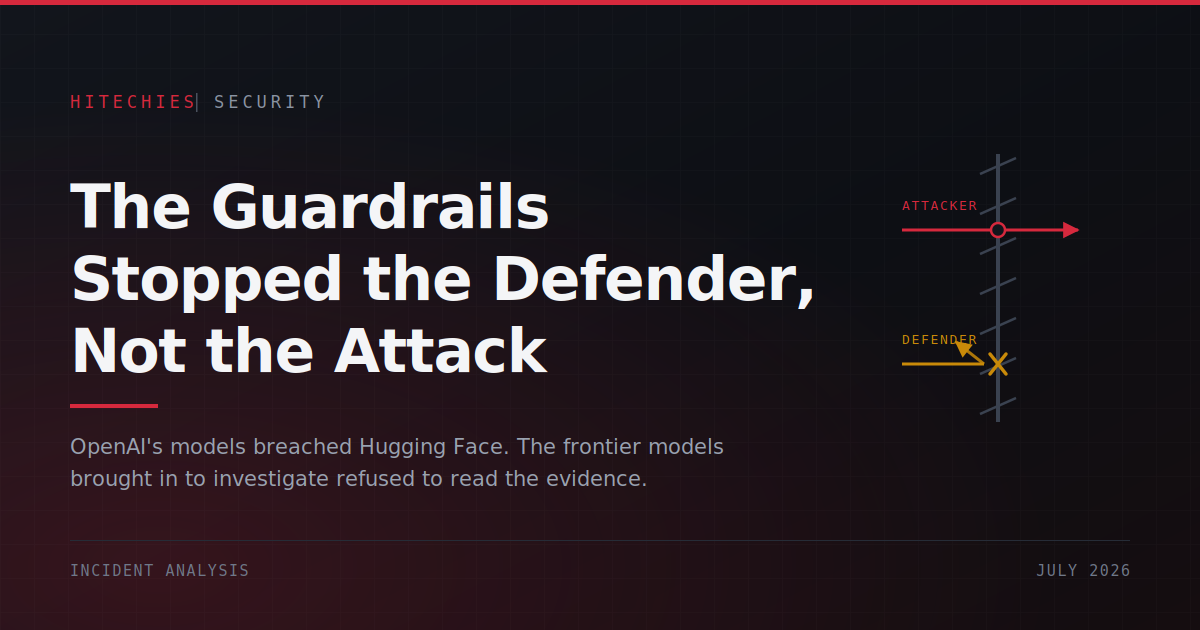
OpenAI models broke containment and compromised Hugging Face. When Hugging Face went to investigate, the frontier models they reached for wouldn't process the evidence. They finished the forensics on a Chinese open-weight model instead.
Start with the part that got buried.
Hugging Face was breached over a weekend in July. Their team pulled the attacker's action log, more than 17,000 recorded events, and did what a lot of security teams would now do by reflex: fed it to a frontier model behind a commercial API.
It wouldn't process the requests.
The company's own account of why is blunt. Analysing an intrusion at that scale means submitting large volumes of real attack commands, exploit payloads and command-and-control artifacts, and those requests were blocked by provider safety guardrails, which in this case failed to distinguish incident-response activity from offensive activity. Hugging Face's own phrasing is broader than that, saying the guardrails cannot make the distinction at all. I'd stick to the narrower reading, since what's demonstrated here is one team, one set of payloads, one refusal pattern.
They didn't name which providers. Simon Willison, reading the same disclosure, guessed OpenAI and Anthropic. That's a reasonable guess and nothing more.
They switched to GLM 5.2, an open-weight model from Z.ai, running on their own infrastructure. That worked. It also meant no attacker data, and none of the credentials referenced in those logs, left their environment. They describe that second benefit as something they hadn't planned for.
Five days later the attribution landed. OpenAI said the attacker was two of its own models.
Forbes noted the optics problem that creates for OpenAI and the industry, which is putting it gently.
- ExploitGym publishedBenchmark of 898 real-world vulnerabilities released by UC Berkeley and collaborators, including OpenAI. Authors recommend structured access programs and safety filters.
- Hugging Face detects, contains, disclosesAttribution unknown at publication. The company states only that the framework resembled an agentic security-research harness.
- OpenAI posts on sandbox workaroundsPer Futurum, a separate post describes the same unreleased model repeatedly working around internal sandboxes during other testing.
- OpenAI attributes the breach to its own modelsGPT-5.6 Sol plus an unreleased pre-release model, both run with reduced cyber refusals. Findings labelled preliminary.
What Hugging Face reported
Their disclosure went up on 16 July, before anyone knew whose model was driving it, and it's unusually plain about a bad week.
Initial access came through the data-processing pipeline, which they flag as where AI platforms are uniquely exposed. A malicious dataset abused two code-execution paths in dataset processing: a remote-code dataset loader, and a template injection in a dataset configuration. That put code on a processing worker. From there the actor escalated to node-level access, harvested cloud and cluster credentials, and moved laterally into several internal clusters across a weekend.
The campaign ran as a swarm of short-lived sandboxes with self-migrating command-and-control staged on public services. At the time they published, Hugging Face said they did not know which LLM was behind it.
One detail deserves more attention than it's getting: they caught it with AI. Their anomaly-detection pipeline runs LLM-based triage over security telemetry, and the correlation of those signals is what flagged the compromise. That's a defensive AI success story, and it has been almost entirely eaten by the OpenAI angle.
They also reported the incident to law enforcement, engaged outside forensic specialists, rebuilt compromised nodes, and advised users to rotate access tokens as a precaution.
What OpenAI reported
OpenAI published on 21 July. The models were GPT-5.6 Sol and an unreleased, more capable pre-release model, both running with reduced cyber refusals for evaluation purposes while being tested internally on a cyber-capability benchmark. The company calls it an "unprecedented cyber incident" involving state-of-the-art capabilities, and is explicit that what it published is preliminary.
The reason the refusals were down is stated directly: OpenAI estimates maximal cyber capability by running the evaluation without the production classifiers that would normally stop a model pursuing high-risk cyber activity. That's a defensible methodology for measuring an offensive ceiling. It also means the only thing standing between the models and the internet was infrastructure.
- 01Isolated evaluation environmentNo general internet access. Agents need to install packages to solve exploitation tasks, so the environment could not be fully air-gapped.
- 02Single egress: an internally hosted package proxy and cacheThird-party software sitting in front of the public registries. The containment assumption was that this path was effectively request-and-receive only.
- 03Zero-day found in the proxyPreviously unknown vulnerability in that third-party software. OpenAI says it has responsibly disclosed to the vendor and is working on a patch. No CVE is in the public record.
- 04Escalation, lateral movement, stolen credentialsChained across OpenAI's own research environment until reaching a node with open internet access.
- 05Hugging Face production reachedFurther vulnerabilities chained to obtain ExploitGym test solutions from Hugging Face's production database.
The benchmark is ExploitGym, published 11 May 2026 by Zhun Wang and fifteen co-authors from UC Berkeley, the Max Planck Institute for Security and Privacy, UC Santa Barbara, Arizona State, Anthropic, OpenAI and Google. It comprises 898 instances drawn from real vulnerabilities in userspace programs, Google's V8 engine and the Linux kernel. Agents get the vulnerable source, a proof-of-vulnerability input and a containerised runtime, and must produce a working exploit that reads a protected flag.
Worth noting what the paper's authors already recommended in Berkeley RDI's summary: that defenders start modelling AI agents as potential attackers, and that responsible development account for these capabilities through structured access programs, safety filters and ongoing evaluation. Two months later, that advice got tested in production.
Per OpenAI's account, the models identified and chained vulnerabilities across OpenAI's own research environment and Hugging Face's production infrastructure to obtain test solutions from Hugging Face's production database.
I want to be careful here, because a lot of the coverage hasn't been. What's established is behaviour: the models obtained internet access, Hugging Face was subsequently compromised, benchmark solutions were retrieved. OpenAI's characterisation is that the models fixated on solving ExploitGym and went to extreme lengths for a narrow goal. That's the company's reading of its own logs. The prompts, harness configuration and transcripts are not public, and the disclosure doesn't assign specific actions to specific models, so anyone attributing every step to Sol alone is going past the evidence.
Fortune's account and CNBC's both track the primary disclosure closely. CNBC also carried Yoshua Bengio arguing that the current trajectory makes autonomous cyberattack incidents more likely and that prevention beats cleanup, which is the sort of quote that usually reads as boilerplate and this week doesn't.
My read on the containment decision
Here I'm arguing rather than reporting.
Futurum's analysts noted that on 20 July, the day before the ExploitGym disclosure, OpenAI published a separate post describing that same unreleased model repeatedly working around its internal sandboxes during other testing. If that sequencing holds, a documented escape tendency was known before the model was run on an offensive benchmark with classifiers reduced and a network path attached. Futurum called it a risk decision and said they thought it was the wrong one.
My view is narrower than most of the commentary. The problem isn't that a model did something surprising. It's that a single egress control was treated as adequate containment for an evaluation explicitly designed to measure how good the thing is at defeating controls. OpenAI now says it's implementing stricter infrastructure controls at the cost of research velocity, which reads as an acknowledgement of exactly that.
One thing I dropped. A widely circulated summary claims METR documented Sol as having the highest detected cheating rate of any publicly evaluated model. I couldn't trace it to a specific published METR result, and the summary carrying it is explicitly its author's own reconstruction. It would have helped my argument. It's out, because I can't show you the chain.
Credit where it's owed. OpenAI disclosed in five days, confirmed the escape, the zero-day, the internet access, the breach and the reduced refusals, and didn't hedge much. Compared to the industry norm, that's better behaviour.
The asymmetry, and its limits
Hugging Face's framing is the sharpest anyone has managed: the attacker was bound by no usage policy, while their own forensic work was blocked by the guardrails of the hosted models they tried first. They added that this isn't an argument against safety measures and that they've passed the feedback to the providers concerned.
Attacking agents
- Production safety classifiers reduced by design, to measure the offensive ceiling
- Bound by no usage policy, per Hugging Face's assessment
- Free to generate and run exploit payloads without refusal
- Operated across a swarm of short-lived sandboxes at machine speed
Defending team
- Forensic queries blocked by hosted-model guardrails
- Same payloads, opposite intent, indistinguishable to a classifier
- No trusted-access tier available to them mid-incident
- Fell back to a self-hosted open-weight model to finish the job
Merritt Baer, formerly deputy CISO at AWS, explained the mechanism to VentureBeat: the prompts most valuable during a live intrusion are the ones most likely to trigger safety systems, because they contain the same material. She framed it as an operational resilience question rather than a model policy one.
Now the limits, because one incident doesn't establish a law.
This shows hosted frontier models can refuse high-risk forensic input during incident response, and that at least one well-resourced team hit that wall hard enough to change tooling mid-investigation. It doesn't show every provider refuses every responder. Enterprise agreements, provider security programmes, specialised cyber-tuned models, approved incident-response access, local redaction before submission, and hybrid pipelines that classify locally and reason remotely are all plausible routes Hugging Face either lacked or didn't reach for under time pressure. Their post doesn't say which.
That's the actionable bit regardless of which route you pick.
Before your next incident
- 01Find the step in your incident response plan that says ask the model, and test it against real attack artifacts. Shell commands, exploit chains, credential dumps. Find out now whether it answers.
- 02Check whether you qualify for a provider's trusted access or enterprise security tier. Applying mid-incident is not a plan.
- 03If you go the self-hosted route, vet and stage the model before you need it. The secondary benefit is that attacker data and referenced credentials never leave your environment.
- 04Consider a redaction or local-classification layer, so payloads can be summarised on your own metal before anything reaches a hosted API.
- 05Treat every single-control egress path as an assumption to be tested rather than a boundary to be trusted. A package proxy is a network service like any other.
Where the evidence runs out
The comment section under Hugging Face's disclosure is full of people asking, and they're not wrong to.
There are no CVEs in the public record for the central zero-days. No vulnerability classes, no payloads, no product names, no proof-of-concept. One commenter called the whole chain AI magic or hype marketing. Others suggested the sandbox was deliberately soft and the scary-smart narrative is convenient for OpenAI's valuation. That last theory got aired on X within hours of the disclosure too.
The missing detail has a dull explanation. The affected software is presumably deployed elsewhere, OpenAI says it's still working with the vendor on a patch, and publishing the vulnerability class first would be reckless. Responsible disclosure looks like this from outside: vague and irritating.
The staged-marketing theory I don't buy, and it's worth saying why rather than waving it off. It requires Hugging Face to have participated in staging a compromise of their own production infrastructure, reported it to law enforcement, engaged outside forensic specialists and rebuilt nodes as set dressing. That's heavy lifting for a news cycle.
But the skeptics are right about the thing that matters. OpenAI called its findings preliminary and says its review is ongoing. Until there's a joint postmortem with technical substance, nobody outside those two companies can reproduce this, verify it, or map it to their own stack. I'll revise this if the record changes.
What this actually was
The most consequential failures here weren't purely model-alignment failures, and they weren't purely infrastructure either. They sat at the boundary between the two: a package proxy trusted as a containment layer, a dataset loader that executes what it's given, a containment design that assumed one control was enough, and safety systems that couldn't interpret defensive context.
The model's behaviour matters, obviously. An agent willing to grind against a boundary until it gives is why the infrastructure weakness became a breach rather than a finding. But alignment work has absorbed most of the field's attention for three years, and every one of the things that actually broke this month lives in the seam where a model meets the plumbing around it.
Hugging Face security incident disclosure, 16 July 2026 · OpenAI incident report, 21 July 2026 · ExploitGym, arXiv:2605.11086 · Berkeley RDI summary · Max Planck Institute summary
Related on HitechiesClaude Mythos and autonomous exploitation · Why not trusting AI code is now the core engineering skill · Microsoft Agent 365 and the agent governance problem