August was bitcoin's strongest month of 2026. Then payrolls printed 162,000 against a consensus near 56,000, and the September FOMC turned into a coin flip on a rate increase. What sets the price between now and 16 September is happening in the oil market and the short end of the Treasury curve.
A flat week hiding a 21 percent month
Bitcoin is trading at $78,394, down 1.6 percent on the day and essentially unchanged across seven days. Widen the window and the picture inverts. It is up 21.3 percent over thirty days, after an August that ran roughly 25 percent from the low $60,000s to a brief print at $81,455. Ether sits at $2,494, up 30.2 percent on the month, which makes it the stronger major on any timeframe longer than a week.
The last 24 hours produced $208 million of liquidations, $119 million of it in long positions, on another failed push through $80,000. That is a modest number by this year's standards. One mid-August session saw open interest fall about $3 billion and take $308 million of positions with it, and the final fortnight of August cleared $9.7 billion in total.
What the flat weekly candle conceals is the shape of the failure. Bitcoin has been turned back in the $80,500 to $82,100 band four separate times since the August high, and weekly volume has fallen roughly 45 percent to about $184 billion. Buyers are showing up. They are just showing up in smaller size at each attempt.
The ceiling is being set in the Treasury market
On Friday 4 September, US August payrolls came in at 162,000 against a consensus near 56,000. Unemployment held at 4.1 percent, June and July were both revised higher, and July's reported job losses were revised away entirely. Futures markets that had spent the summer arguing about the size of a cut spent that afternoon repricing an increase.
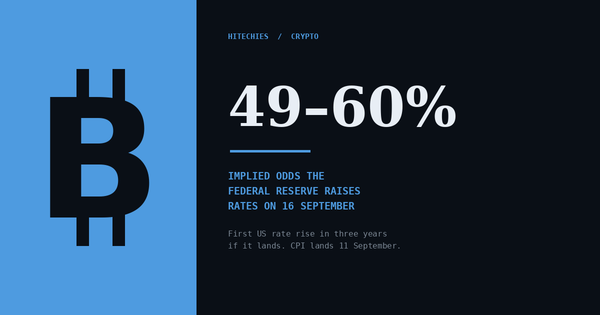
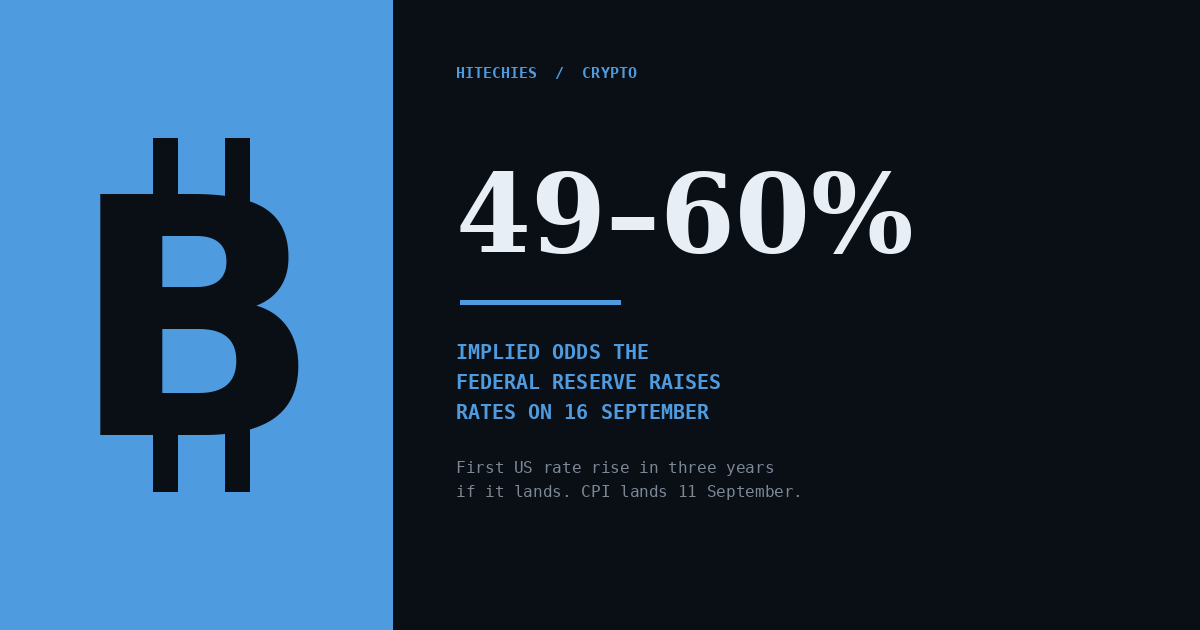
The fed funds target is 3.50 to 3.75 percent. A 25 basis point move on 16 September takes it to 3.75 to 4.00 percent, and it would be the first US rate rise in three years. Implied odds sit somewhere between 49 and 60 percent depending on the venue. CME FedWatch was near 58 percent on 7 September; Polymarket was closer to 49. That ten-point spread is itself worth reading, because a genuinely priced event does not trade as a coin flip across two liquid markets.
Two-year Treasury yields are at 4.38 percent and ten-years at 4.80 percent, both near three-year highs. Analysts at Bitfinex put the mechanism more precisely than I would:
"Liquidity is putting a floor under the price, and the short end of the Treasury curve is setting the ceiling."Bitfinex analysts, September 2026
A chair appointed to fight inflation
Kevin Warsh took the Fed chair on 22 May and has already stripped forward guidance out of the FOMC statement, cutting it to under half its previous length. At Jackson Hole on 28 August he said responsibility for "65 months of sustained, elevated inflation sits squarely with the central bank." Hike odds moved from roughly 35 percent into the high 50s on that speech alone. Three officials, Hammack, Kashkari and Logan, had already dissented in favour of an increase at the July meeting.
Christopher Waller pushed back on 3 September, arguing the committee could "give disinflation a chance" and pointing out that roughly half of July's core price increase came from non-market services prices that are estimated rather than directly measured. Odds fell from 63 percent to about 50 for a day. Friday's payrolls undid it.
The Fed entered its blackout period on 6 September, so no further official commentary is coming. That makes the 11 September CPI print the last public input the committee receives. Consensus expects headline inflation to accelerate to 0.4 percent month on month while core decelerates to 2.4 percent year on year, which is precisely the ambiguity Warsh and Waller are arguing about.
Oil is the variable everything else depends on
Brent is at $99.32, up 49.6 percent year on year. US and Iranian forces exchanged strikes in the Strait of Hormuz between 5 and 7 September, and Saudi Aramco's Jizan refinery was hit for the second time in a month. Kpler counts an average of ten commodity vessels a day transiting Hormuz over the past ten days.
Neither of the usual circuit breakers is available. OPEC+ held October production flat on 6 September, having already unwound the whole 1.65 million barrel per day voluntary cut. The US Strategic Petroleum Reserve is at its lowest level since 1982. There is no spare capacity to release and no reserve to draw down.
This is why the tightening is global rather than American. The ECB is expected to raise its deposit rate to 2.50 percent on 10 September, with all 65 economists in a Reuters poll pointing the same direction. The Bank of Japan is fully priced for 25 basis points on 17 and 18 September, with Japanese wage growth at its fastest since 1997 and the yen at its strongest level since February. Three central banks tighten inside nine days.
Bitcoin has traded through rate cycles driven by growth and through one driven by a pandemic. It has never traded through a tightening cycle caused by an energy shock, and the distinction matters. A central bank raising rates into strong demand is slowing an economy that wants to run hot. A central bank raising rates into an oil price it cannot influence is doing something else, and the asset that was bought as a hedge against monetary debasement now faces a monetary authority that has publicly decided debasement is the problem it was hired to solve.
The ETF number almost nobody has run
Spot bitcoin ETFs have had a genuinely strong three weeks. August took $3.52 billion, the best month since September 2025. Wednesday 3 September took $730.8 million in one session, the largest day since 14 January. Three-week cumulative inflow is around $3.8 billion. Complex net assets stand at $101.3 billion, about 6.3 percent of bitcoin's market capitalisation, and BlackRock's IBIT alone holds 785,635 BTC worth $61.7 billion, or 3.74 percent of the 21 million supply cap.
Now run the calendar year. Net flows into US spot bitcoin ETFs in 2026 are approximately negative one billion dollars. June alone redeemed $4.5 billion, roughly $3 billion of it from IBIT. The rise in headline assets from $84.3 billion in mid-August to $101.3 billion today is mostly price appreciation rather than accumulation.
Figure 1
Daily net flows, US spot bitcoin ETFs
| 17 Aug | +297.6 |
| 18 Aug | +189.3 |
| 19 Aug | +517.2 |
| 20 Aug | +606.3 |
| 21 Aug | +307.5 |
| 24 Aug | +337.6 |
| 25 Aug | +314.3 |
| 26 Aug | +232.2 |
| 27 Aug | +242.3 |
| 28 Aug | −201.9 |
| 31 Aug | +216.7 |
| 1 Sep | −236.5 |
| 2 Sep | +101.1 |
| 3 Sep | +730.8 |
| 4 Sep | +174.6 |
USD millions. Source: Farside Investors and TFTC, cross-checked. 7 September was the US Labor Day holiday, so no flow was settled that day.
This matters for how you read the next fortnight. The institutional bid is real and it is currently the strongest support under the price. It is also narrow. In the week to 4 September, Solana ETF flows fell 96 percent to $6.2 million, XRP fell 73 percent to $19 million and Hyperliquid fell 78 percent to $12.3 million. Bitcoin's went the other way. Whatever is happening here, a broad institutional rotation into digital assets is not it.
The leveraged leg is the treasury companies
Strategy holds 845,050 BTC and bought 4,603 of them for $370 million in late August, ending a ten-week pause. Less widely covered: it sold roughly 7,000 BTC between March and August at $60,000 to $65,000, close to the lows, to cover preferred dividends and reduce debt. Chief executive Phong Le said so publicly. With $20.6 billion of senior claims ranking ahead of common stock, the common equity effectively backs 584,782 BTC rather than the headline number. mNAV is 1.13, down from three to four times in 2024, and S&P rates the company B minus.
The rest of the sector looks worse. BitMine holds 5,901,112 ETH and trades at 0.42 times net asset value. SharpLink is at 0.84. Metaplanet has fallen below parity and launched a $500 million bitcoin-backed buyback, with warrants structured to be exercisable only above 1.01 times mNAV. That structure is a fairly direct admission that the issue-shares-above-NAV flywheel has stopped turning. Galaxy Research expects five or more treasury companies to be forced into asset sales, mergers or closure this year.
A date is attached to the risk. MSCI is consulting on excluding "non-operating companies" from its Global Investable Market Indexes. Feedback closes 30 September, the decision lands 16 October, and implementation would follow at the November index review. Strategy, Metaplanet and Yellow Cake are named, with SharpLink on the watchlist. Estimated forced selling runs $1.8 billion to $2.8 billion from MSCI alone, and as much as $8.8 billion if other index providers adopt similar screens.
Positioning is the one thing working in the bulls' favour
Futures open interest is around $53.0 billion, down from $54.9 billion last week. Funding is +0.0028 percent per eight hours, positive but nowhere near froth, and perpetual funding stayed below 10 percent annualised through late August. Crypto-margined open interest is at an all-time low of roughly 11 percent of the total, which structurally reduces the reflexive liquidation cascades that defined earlier cycles.
The most instructive datapoint sits in late August. On the 25th, open interest fell to 587,584 BTC, a five-month low, while price was running from $62,000 to $80,000. That rally was short covering rather than fresh leveraged buying. Recent liquidations confirm the pattern: 65.5 percent of the 7 September total was short positions, and on 5 and 6 September shorts accounted for 87 to 89 percent.
One structural change deserves more attention than it has had. Binance now carries more bitcoin futures open interest than CME, roughly 148,500 BTC against 102,840, and CME's figure is its lowest since February 2024. The reason is arithmetic: the three-month CME basis has compressed to about 3 percent, below the two-year Treasury yield. The cash-and-carry trade that brought a generation of institutional desks into bitcoin does not pay at these levels.
Figure 2
2026 drawdown against previous bitcoin bear markets
| 2011 | −93% |
| 2013–15 | −86% |
| 2017–18 | −84% |
| 2021–22 | −77% |
| 2025–26 | −54% |
Peak to trough, closing basis. The current cycle peaked near $126,000 on 6 October 2025 and troughed around $58,000 in July 2026. Prior-cycle figures are the widely cited peak-to-trough ranges; treat them as approximate.
By historical standards this remains a shallow bear market. Previous downturns routinely erased 75 to 80 percent or more. This one took 54 percent at its worst, and it absorbed a US-Iran war, a record month of ETF redemptions, a hardware wallet exploit, a contested protocol fork attempt and the largest corporate holder turning seller.
Levels worth watching
Bitcoin, $78,394
Resistance
- $80,500
- Monday's rejection print
- $81,455
- Weekly high
- $82,100–82,500
- Range ceiling. Four failures since August
- $88,764
- The 2026 open. Reclaiming it flips the year positive
Support
- $78,000
- Immediate. A loss opens $77,200
- $76,800–77,200
- Range floor
- $71,000
- Short-term holder cost basis
- $62,000–65,000
- Dense accumulation shelf
Ether, $2,494
Resistance
- $2,511–2,546
- Immediate supply
- $2,542
- 50-week moving average. The line that matters
- $2,626
- Next shelf
- $2,690–2,822
- Major supply zone
Support
- $2,475
- On-chain support
- $2,385–2,438
- 0.618 retracement at $2,438.85
- $2,320
- Structural
- $2,220
- Then the $2,000 psychological level
The nine days that decide it
Correction to a calendar error circulating widely: TOKEN2049 Singapore runs 7 and 8 October, not September. There are also no SEC ETF decision deadlines in this window. Since generic listing standards for commodity-based trust shares were approved in September 2025, altcoin ETFs list on a roughly 75-day issuer-driven clock, and the old deadline calendar no longer applies.
What would change my reading
The bull case needs core CPI at or below 2.4 percent on Friday and a hold on the 16th, a daily close above $82,500 on expanding volume, ETF inflows holding above roughly $150 million a day through the meeting, and ether reclaiming its 50-week average near $2,542. On that path the 2026 open at $88,764 is the target that means something.
The bear case needs headline CPI to beat 0.4 percent monthly and the Fed to move. A daily close below $77,200 puts $71,000 in play, and $71,000 is where a cohort sitting on record unrealised gains starts converting paper profit into supply. Short-term holder whale profit hit $9.07 billion on 4 September, the highest CryptoQuant has recorded since it began tracking in 2016, and every one of the five highest readings came in the preceding fortnight. Binance's bitcoin reserves have climbed to roughly 687,000 BTC, the highest of 2026, up from 617,000 in late April. Neither is evidence of selling. Both are evidence of the capacity to sell.
The number I keep returning to is VIX at 15.7. Equity volatility is pricing a shooting war, $99 Brent, a coin-flip rate decision, a Bank of Japan move and an active North American trade dispute at close to the calmest level of the year. There is very little cushion under risk assets going into Friday.
And the honest caveat: if Hormuz de-escalates and Brent goes back under $80, most of the above stops applying. The hike case rests on energy prices, not on a labour market that has averaged 31,000 jobs a month over the past year. August's 162,000 is an outlier against that trend, and 59,000 of it came from food services with another 42,000 from local government education. Warsh is arguing about credibility. Waller is arguing about the data. Which of them is right will be settled by an oil tanker, not by a jobs report.
Prices are cross-source composites captured on the morning of 8 September 2026 and drift between aggregators; bitcoin printed between $78,400 and $80,400 across major venues on 7 and 8 September. Fed hike probability is a range because CME FedWatch and Polymarket disagreed by roughly ten points at the time of writing. Ether exchange-reserve figures conflict materially between providers and have been left out for that reason.
Sources: Farside Investors, TFTC, CoinGecko, CryptoQuant, CoinGlass, Bitfinex, Bureau of Labor Statistics, Federal Reserve, OPEC, Kpler, MSCI, Galaxy Research.
This is market analysis, not investment advice. Hitechies holds no position in any asset named here.