The first papal encyclical ever written about artificial intelligence — and Silicon Valley should not look away.
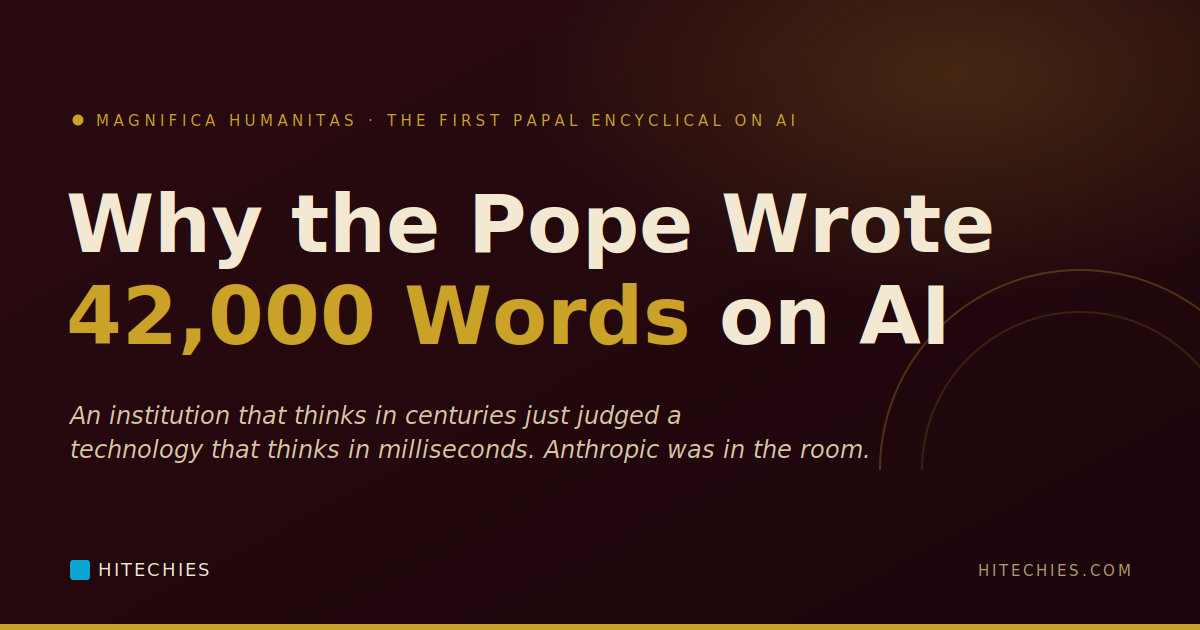
An institution that measures time in centuries just issued a formal verdict on a technology that measures time in milliseconds. On May 25, Pope Leo XIV released Magnifica Humanitas — "Magnificent Humanity" — the first encyclical in the Catholic Church's history written specifically about artificial intelligence. It runs roughly 42,300 words, carries the weight of formal Church teaching across 1.4 billion members, and lands at the exact moment the AI industry is moving faster, and with less external friction, than at any point in its history.
You can dismiss it as a religious document outside your lane. That would be a mistake. Encyclicals don't stay inside church walls — they shape policy debates, frame public opinion, and give politicians moral cover for positions they already wanted to take. The last time a Pope Leo wrote a document like this, it reshaped how the entire West thought about industrial labor for a century.
I What it actually says
The encyclical is built on one sharp premise that cuts against a lot of tech-industry self-image: technology is never neutral. Leo XIV is explicit that AI is not inherently evil and not "a force antagonistic to humanity" — but he argues it always carries the characteristics of the people who design it, finance it, regulate it, and use it. There is no clean, value-free tool. The tool is shaped by whoever holds it.
From that premise, the document builds its central image: humanity faces a choice between "constructing Babel and rebuilding Jerusalem." Babel is power for its own sake — remote, prideful, indifferent to the people underneath it. Jerusalem is a community built to human scale. The whole encyclical argues for the second over the first, and warns that AI makes the first dangerously easy.
The specific concerns are familiar to anyone following the policy debate: job insecurity, manipulation of information, privacy, ideological bias baked into systems, autonomous weapons, the environmental cost of energy-hungry infrastructure, deepfakes corroding public discourse. But Leo XIV names a deeper danger underneath the practical ones — that people begin to see themselves and each other as products, valued for output rather than dignity. On the military side he goes further than expected, discouraging an AI arms race, warning against political deepfakes, and arguing that traditional just-war theory has become outdated in an age of autonomous systems. The phrase the press seized on: AI "must be disarmed," and must never be allowed to "dominate humanity."
Humanity faces a choice between constructing Babel and rebuilding Jerusalem — between remote, prideful power and community built to human scale.
II The 1891 parallel that explains everything
To understand why this document exists, look at the date on it. Leo XIV signed Magnifica Humanitas on May 15 — the 135th anniversary of Rerum Novarum, the landmark 1891 encyclical by his namesake, Leo XIII. That isn't a coincidence. It's the entire thesis.
Rerum Novarum was the Church's answer to the Industrial Revolution. As factories remade society, Leo XIII insisted that capital must serve labor — that the new machinery could not be allowed to grind up the human person. It became the foundation of modern Catholic social teaching and shaped labor debates across the West for generations. Leo XIV is making a deliberate, almost architectural claim: AI is the "new thing" of our time the way industrialization was the new thing of 1891, and the same principle applies. The structure is borrowed on purpose, because the Church is positioning AI as a civilizational shift on that scale — and staking out its moral ground early, exactly as it did then. We've reached for the same comparison ourselves in why every software company is now an AI company; the Pope just made it with 135 years of institutional weight behind it.
III The tech angle nobody's covering
Here's the detail that turns this from a religion story into a tech story, and it's been strangely underplayed: Anthropic was in the room.
An AI founder, at the Vatican
When Magnifica Humanitas was presented, the session included Christopher Olah, a co-founder of Anthropic. He reportedly singled out the duty to the global poor, the need to rethink what human flourishing means, and the responsibility of AI developers to exercise discernment. One of the people building frontier AI stood at the Vatican as the Church issued its first encyclical on the technology he's helping create.
That's not a scheduling accident. It signals the leading labs are taking the moral-legitimacy fight seriously — they'd rather be inside the conversation about AI's limits than outside it. Anthropic has leaned on safety framing harder than any rival, a positioning we examined in its $900 billion valuation. A co-founder at the Vatican is that strategy made literal.
IV Where it collides with Silicon Valley
The friction is obvious once you line up the two value systems. The encyclical's core move — humans can never be replaced by machines, and people must be valued for dignity rather than productivity — runs straight into an industry whose entire pitch is automating human labor and measuring everything by output. While Leo XIV warns against building a new Babel "that sacrifices the most vulnerable," the valuations being assigned to AI companies are premised, in large part, on exactly the labor displacement he's cautioning against.
This isn't a fringe critic the industry can wave off. It's a formally reasoned, 42,000-word position from an institution with 1.4 billion members and a 2,000-year habit of outlasting the powers it critiques. The document bans nothing and writes no regulation. What it does is hand every politician, regulator, labor organizer, and worried parent a ready-made moral vocabulary for the unease they already felt — a lens that changes what feels acceptable. The energy footprint it flags connects to the backlash we covered in rising public opposition to AI data centers, and its call for limits gives unexpected company to the rulemaking we tracked in the EU AI Act and startup compliance.
V Why a religious document matters for AI policy
The honest tech-reader question is: so what? The Pope can't fine OpenAI or rewrite the EU AI Act. True — but that's not how this kind of document exerts force. Rerum Novarum didn't pass a single labor law; it shaped the moral common sense that made labor laws thinkable, for decades. Magnifica Humanitas is built to do the same job for AI: move the baseline of what the public considers acceptable, and give the people who write the actual rules a shared language to point at. Pressure is upstream of policy, and this is a large, deliberate push on the upstream. The same compute build-out it implicitly indicts is the one we mapped in the AI compute war nobody warned you about.
VI What happens next
VII FAQ
What is Magnifica Humanitas?
Pope Leo XIV's first encyclical and the first papal encyclical ever devoted to AI. Titled "On Safeguarding the Human Person in the Time of Artificial Intelligence," it runs about 42,300 words and was published May 25, 2026.
What does it argue?
That technology is never neutral and algorithms must serve the human person. It warns against job displacement, misinformation, autonomous weapons and treating people as products, framing a choice between "constructing Babel and rebuilding Jerusalem."
Why does it matter for AI policy?
Encyclicals shape public moral consensus. Its 1891 predecessor influenced labor law for generations without passing any law. Analysts treat this as a moral intervention that amplifies pressure on AI governance.
The real surprise isn't that the Pope wrote about AI. It's the precision of the move — anchored to 1891, framing algorithms the way the Church once framed factory capital, with a frontier AI founder standing in the room. The Church did this once to an entire industrial age. It clearly intends to do it again.
SOURCES — Vatican News, Magnifica Humanitas · National Catholic Register, full text · Word on Fire & Rome Reports, chapter overviews · Time & The Atlantic, coverage and the Vatican presentation.