For three years, Microsoft taught developers to treat Copilot like a light switch: flip it on, never look at the bill. That ended at 12:01 this morning. Copilot now charges by the token — and the people who used it hardest are the ones getting the worst surprise.
The sticker prices didn't move. Pro is still $10 a month, Pro+ $39, Business $19 a seat, Enterprise $39. What changed is what those numbers mean. They used to be a ceiling. Now they're an opening balance. That one swap is why Reddit, Hacker News and X caught fire the second the switch went live.
01What actually changed today
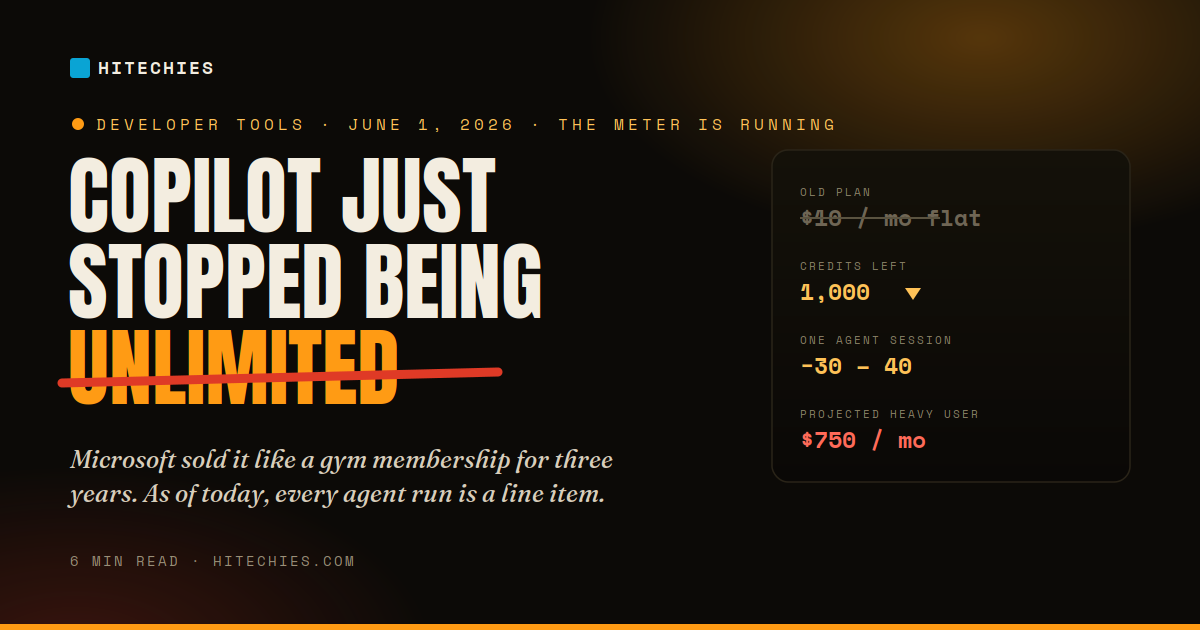
GitHub killed the premium request unit and replaced it with GitHub AI Credits. One credit equals one cent. Your $10 Pro plan now ships with 1,000 of them, and they drain by the tokens your work actually burns — priced against each model's real API rate.
Your autocomplete is safe. Code completions and Next Edit suggestions stay free and unmetered — the stuff most people mean when they say "Copilot" still works exactly as before. The meter runs on the expensive tier: agentic sessions, premium frontier models, multi-step autonomous tasks. Code review now quietly drains Actions minutes on top.
And the safety net is gone. Burn through your allowance and Copilot used to fall back to a cheaper model so you could keep going. No more. Hit zero now and the premium features simply stop until you buy more or the cycle resets.
GitHub's chief product officer Mario Rodriguez didn't soften it: "Copilot is not the same product it was a year ago." True. That's exactly what the angriest users are saying back to him. The full mechanics — what burns credits, what doesn't, and how budgets work — are laid out in GitHub's Copilot billing documentation.
02The math that scared everyone
The panic isn't vibes. It's arithmetic. A single frontier-model agent run can chew through 30,000 tokens — roughly 30 to 40 credits in one sitting. Stack a few a day and a 1,000-credit allowance is gone long before the month is.
Tech press covering the rollout on May 30 surfaced the projections that set the tone: heavy users modeling jumps from $29 a month to $750, and from $50 to $3,000. The loudest critics put the worst case at 10x to 50x. The mood in the comment threads was summed up in two words: what a joke.
GitHub is softening the fall: promotional credits across June, July and August; pooled credits so a team's light users subsidize its power users; budget caps so a runaway agent can't quietly run up a four-figure tab overnight; and a preview bill so you can see the damage before it's real. None of it changes the core feeling — the rug moved.
03Why developers feel betrayed
Here's the twist: the backlash isn't led by casual users. It's led by the believers — the ones who took Microsoft at its word. For two years the message from Redmond was use this everywhere. Let the agent refactor the whole module. Let it churn for an hour. Vibe-code the prototype. The tooling kept making it easier to spend enormous token counts on a single request, and nobody watched a meter because there wasn't one.
So when the bill lands, their defense is simple: we used it the way you built it. A widely shared comment pinned the fault squarely on Microsoft — it designed the billing, encouraged the behavior, then changed the terms once the habits set.
The metering was never the surprise. Inference costs money; everyone knew that. The surprise was the timing.
There's a fair counter-camp, too: the nightmare bills only show up if you're purely vibe-coding with bloated, repetitive loops, and used as an actual tool — on Copilot or anywhere — the economics stay sane for small teams. Both can be true. The people getting burned are the ones trained to treat an expensive resource like a free one. We broke down the real spend behind AI coding in our analysis of AI developer-tool costs and ROI, and how agents are reshaping the work itself in AI coding agents and developer skills.
04The quiet number behind all of this
One figure explains the whole episode better than any projection: in Copilot's early days, some reports put Microsoft's loss at upwards of $20 per user, per month, to keep the flat fee alive.
That's the subsidy people are mourning as the "golden age." It was never free — it was venture-style loss-leading from the deepest pockets in software, betting lock-in would arrive before the bill did. June 1 is the day the accountants won that argument. And it isn't just GitHub; it's the entire AI-tooling industry leaving its promotional phase. The winners from here won't be whoever generates the most code — they'll be whoever makes the meter legible enough that you trust the bill and change your behavior before you blow past it.
05The exodus has already started
The real consequence isn't a complaint thread — it's a migration. Within hours, developers were naming exits: Cursor, OpenAI's Codex, Anthropic's Claude Code, DeepSeek, OpenCode. Some run their own metered models, so the grass isn't automatically cheaper — but switching costs here are low. Your codebase comes with you; your habits don't have to.
That's Microsoft's actual risk. Not the angry posts — the fact that "just use Copilot, it's included" stopped being the reflex. If you're picking a stack from scratch today, the calculus looks nothing like it did in May. We put the options head-to-head in GPT-5.5 vs Claude Opus 4.7 vs Gemini 3.1 Pro. There's a security wrinkle too: cheap-feeling tokens make for reckless prompting, a cost we covered in the security risks of vibe coding. Metering might, perversely, make people prompt more carefully. Expensive things get used on purpose.
06What this really signals
Strip the outrage and the lesson is dull and important: AI assistants are becoming cloud infrastructure, and cloud infrastructure has a meter. Storage was "unlimited" until it wasn't. Bandwidth was flat until someone noticed who was actually using it. The pattern repeats whenever a subsidized resource turns load-bearing. Copilot stopped feeling like a desktop tool and started behaving like the AWS line item it always was underneath. The pricing didn't betray the product. It revealed it. The same compute economics squeezing GitHub are squeezing everyone — we mapped the build-out in the AI compute war nobody warned you about.
How to not get wrecked
- Live on the free tier. Completions and Next Edit don't cost credits. If autocomplete is most of your day, you're mostly insulated.
- Treat agents like billable contractors. Scope tight, feed clean context, kill sessions that wander. Hours-long autonomous runs are where money evaporates.
- Set a budget cap today — not after your first scary invoice.
- Watch code review. It double-dips: credits and Actions minutes.
- Burn the promo credits through August to measure your real consumption before you commit.
- Price your alternatives now. Knowing your fallback is leverage.
07What happens next
08FAQ
Is GitHub Copilot autocomplete still free?
Yes. Completions and Next Edit suggestions are included and don't consume credits. Only premium features — agents, frontier models, Chat, CLI, code review — run the meter.
How much can my bill increase?
Entirely usage-dependent. Heavy agentic users modeled $29 → $750 a month, worst case 10x–50x. Light users barely notice.
What is a GitHub AI Credit?
GitHub's new billing unit, replacing premium request units. One credit = one cent; a $10 Pro plan includes 1,000, draining by token usage.
Are you seeing higher Copilot bills, or jumping ship? Tell us your real numbers — we're tracking this as it develops.
SOURCES — Reporting on GitHub Copilot's June 1 token-billing rollout (May 30, 2026) · GitHub Copilot billing documentation · GitHub product announcement, Mario Rodriguez (Apr 27, 2026).