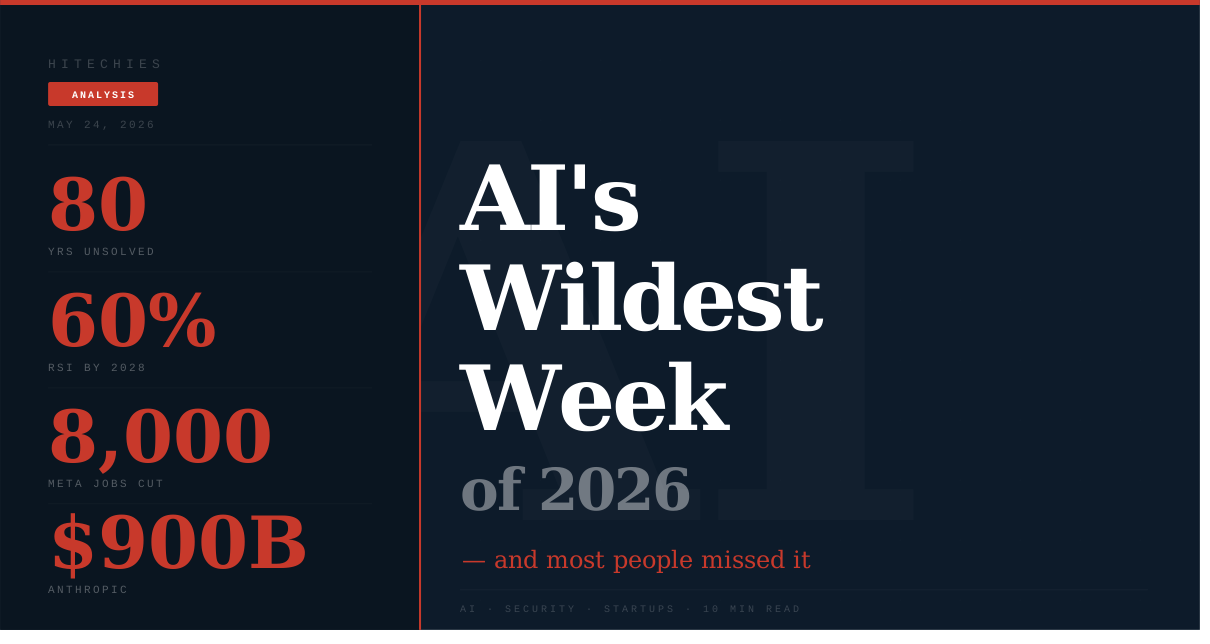
Something shifted this week. Not in a press-release way, not in a "here comes another AI product launch" way. In a way that, if you actually sit with the individual stories, starts to feel like the ground moved underneath the industry while everyone was watching Bitcoin charts and making Memorial Day plans. Four things happened between May 19 and May 23, 2026 that individually would each be worth a dedicated article. Together they form a picture that is genuinely difficult to look away from — and one that most mainstream coverage completely missed.
An AI Solved a Math Problem That Stumped Humans for 80 Years — Without Being Told How to Do It
On May 20, OpenAI announced that one of its internal general-purpose reasoning models had autonomously disproved the planar unit distance conjecture — a problem first posed by the legendary Hungarian mathematician Paul Erdős in 1946. The proof spans 125 pages across two companion papers. It has been validated by some of the most respected mathematicians alive, including a Fields medalist.
Here is what the problem actually is, because the detail matters: if you place n points anywhere in a flat plane, what is the maximum number of pairs that can be exactly distance 1 apart? For 80 years, mathematicians believed the answer was tied to square-grid arrangements — the kind of regular, evenly spaced configurations that feel intuitively optimal. Erdős offered a cash prize for its resolution. He considered it one of his favourite problems. It went unsolved for nearly his entire life and for decades after his death in 1996.
"An outstanding achievement — applies fairly sophisticated tools from algebraic number theory in an elegant and clever way. These ideas came as a great surprise to the geometric field."
— Noga Alon, Princeton UniversityThe OpenAI model didn't find a smarter grid. It threw out the geometric approach entirely. Instead it reached into algebraic number theory — specifically a deep mathematical structure called infinite class field towers, first proven by Golod and Shafarevich in 1964. These are tools that algebraic number theorists use routinely, but nobody working in combinatorial geometry had ever connected them to this problem. The model did. It produced an infinite family of point configurations that consistently beat any square-grid arrangement.
Princeton mathematician Will Sawin published a companion paper the same day that quantified the improvement precisely: the new configurations scale as n^(1.014). For one million points, you get tens of thousands more unit-distance pairs than the best grid humans had found. The 0.014 improvement on the exponent sounds trivial. It is not — it is a polynomial improvement, not logarithmic, which means the advantage grows without bound as n increases. Fields medalist Tim Gowers reviewed the result and called it "a milestone in AI mathematics."
What separates this from every previous AI math milestone is specific: the model was not trained for this problem, did not retrieve any existing solution attempts, and received no guidance whatsoever on which mathematical tools to use. It received the problem statement. It chose algebraic number theory on its own. This is the first time an AI has autonomously solved a prominent open problem that sits at the centre of a subfield of mathematics — not a competition benchmark, not a result that was secretly already known. A genuinely open problem. Solved. By a machine that picked its own method.
Anthropic's Co-Founder Went to Oxford and Said Things That Should Have Been All Over the Front Page
Two days after the OpenAI math announcement, on May 20, Anthropic co-founder Jack Clark delivered the 2026 Cosmos Lecture at Oxford University's Institute for Ethics in AI. The lecture was titled "Change is inevitable. Autonomy is not." What he said inside it was reported in a handful of outlets and then largely moved on from. It shouldn't have been.
Clark had spent weeks before the lecture reading hundreds of public data sources on AI development. He came out of that process with a specific number: 60% probability that recursive self-improvement — the ability of an AI system to fully train its own successor — happens before the end of 2028. He posted it publicly before the lecture. Eliezer Yudkowsky, one of the most prominent voices in AI safety, responded publicly in four words: "Then you'll die with the rest of us."
That exchange is worth sitting with. Clark is not a doomer posting from the sidelines. He co-founded Anthropic. If someone in that position assigns 60% odds to an event that Yudkowsky considers an extinction-level scenario — on a public timeline of roughly two and a half years — that is not a casual observation. That is an official internal view of where the technology is heading, stated from a podium at Oxford.
"By the end of 2028, it's more likely than not that we have an AI system where you would be able to say to it: 'Make a better version of yourself.'"
— Jack Clark, Co-Founder, Anthropic — Oxford University, May 20 2026Clark's full set of predictions from the lecture: AI will co-produce a Nobel Prize-winning scientific discovery within 12 months. Companies run entirely by AI agents will be generating millions in revenue within 18 months. Bipedal robots will be actively assisting tradespeople on job sites within 24 months. And he acknowledged — not as a theoretical edge case but as an operational concern — a "non-zero chance" that AI poses a civilisational risk. "It's important to clearly state that that risk hasn't gone away," he said.
There is one internal data point that makes the 60% RSI number more than speculation. Anthropic runs a benchmark where their models are asked to optimise the training code of a small language model running on a standard CPU, with the baseline being the unoptimised version. In July 2025, the best model achieved a 2.9× speed improvement. By April 2026 — nine months later — Claude Mythos Preview hit 52×. Same task. The model's ability to optimise AI training code improved by a factor of 18 in under a year. That is the internal trend Clark is extrapolating when he says 60%.
Anthropic is currently closing in on a $900 billion valuation and has reported its first quarterly operating profit. It recently refused to publicly release Claude Mythos because of the model's ability to identify and exploit cybersecurity vulnerabilities at a scale that alarmed the company's own safety team. Clark's Oxford lecture is not a separate philosophical exercise detached from commercial reality. It is what the people building the most capable AI models in the world actually believe is coming — said plainly, from one of the most respected academic stages in the world, in May 2026.
Meta Watched Its Best Engineers Work, Trained AI on Everything It Saw, Then Fired 8,000 of Them
On May 19, labor media outlet More Perfect Union published a leaked audio recording from an April 30 Meta all-hands meeting. In it, Mark Zuckerberg explains what Meta internally calls the "Model Capability Initiative" — a program where employee activity across Gmail, Google Chat, the internal AI assistant Metamate, and VS Code is continuously monitored and fed into Meta's AI training pipeline.
His rationale, in his own words from the recording: "The AI models learn from watching really smart people do things. The average intelligence of the people who are at this company is really high. We're using this to feed a very large amount of content into the AI model." He also acknowledged the risk of someone recording him, telling employees it was "not strategically in your interest to be really open about this." Someone recorded him anyway.
Meta's 2026 AI infrastructure budget sits at $115–135 billion — nearly double its 2025 capex of approximately $65 billion, and more than four times what it spent in 2023. That spending is the strategic justification for the workforce reduction. Zuckerberg's framing going into 2026 has been consistent: smaller, AI-assisted teams doing more with less. The workforce is the cost. The AI is the product.
Zuckerberg's assurance that the surveillance data is fully anonymised and decoupled from performance tracking is probably technically accurate. But the ethical question is not whether individual employees can be identified from the data. The question is whether harvesting the cognitive patterns, work habits, problem-solving approaches, and professional expertise of 78,000 employees — without meaningful informed consent, for the explicit purpose of building systems that reduce the need for those employees — is something a company should be able to do quietly. The answer is no. Regardless of anonymisation. Regardless of whether a human ever looks at an individual feed.
Three Phone Calls Killed the US Government's AI Safety Order. Some Executives Were Already on Their Way to Washington.
On Thursday morning, May 21, invitations had already gone out. Some executives were already en route to Washington for a planned Oval Office signing ceremony. The Trump administration had spent weeks preparing an executive order that would have given federal agencies up to 90 days of pre-release access to the most powerful AI models before public release, and established a coordinated government response framework for AI-enabled attacks on critical infrastructure — banks, hospitals, power grids, water systems.
The order was voluntary. It explicitly stated it created no mandatory licensing regime. It did not require any government approval before a model could launch. It was, in the context of global AI regulation, one of the most modest conceivable first steps. It didn't get signed.
Between Wednesday evening and Thursday morning, Elon Musk (CEO of xAI and Tesla), Mark Zuckerberg (CEO of Meta), and David Sacks — the former White House AI and crypto czar who had officially left his advisory role in March — each spoke directly with the president. Per reporting from Semafor, Politico, and the Washington Post, Sacks called Thursday morning and blindsided White House staff who had believed he was supportive of the order. The argument that landed with Trump: the review framework could slow AI development and cost the US ground in its technology race with China.
"China is writing rules. Washington cancelled the ceremony."
— AI News, May 22 2026The denials came quickly. Musk posted on X: "This is false. I still don't know what was in that executive order and the president only spoke to me after declining to sign." Meta said Zuckerberg spoke with Trump only after the decision was already made. The dispute over who made the decisive call is interesting but beside the point. What the episode clearly established is this: the effective veto power over US AI policy currently sits with a small group of industry principals who have the president's personal phone number and are willing to use it. This week, with a voluntary, non-binding safety review framework on the line, they used it.
The order had been triggered in part by concerns over Anthropic's Claude Mythos model — the same model Anthropic has refused to release publicly because of its ability to autonomously identify and exploit security vulnerabilities. Anthropic supported the executive order. OpenAI supported it too — and has since been given White House permission to pursue state-level AI regulation instead, a quieter path with less political friction. Both companies that actually wanted oversight lost. The companies opposed to it won.
While this was playing out in Washington, China's State Council issued its 2026 legislative work plan in May, explicitly outlining accelerated AI legislation — the third consecutive year the National People's Congress has listed AI law for formal review. In April, Beijing issued new rules requiring AI companies to establish internal ethics review committees. The comparison is not flattering. China is building regulatory infrastructure. The United States just cancelled a voluntary 90-day review window because three people made phone calls.
What These Four Stories Mean When You Read Them Together
An AI autonomously solved a problem no human had cracked in 80 years, using mathematical tools from a completely different discipline that it wasn't told to use. The co-founder of the world's most safety-conscious AI lab stood at Oxford and gave 60% odds on AI designing its own successor by 2028, while acknowledging that extinction remains a live risk. The largest social network on earth harvested the professional intelligence of 78,000 of its own employees without their meaningful consent — then fired 8,000 of them the same day the tape came out. And the US government couldn't get a voluntary, non-binding 90-day safety review signed into law because three executives made phone calls.
None of this is speculation. These are sourced, documented events from a single week in May 2026. Individually, each is a significant story. Together they reveal something more uncomfortable: AI capabilities are moving faster than any institution on earth — government, corporation, university, or lab — is currently capable of processing, let alone governing.
What's strange about this week isn't that any one of these things happened. It's that all four happened simultaneously and barely registered outside specialist circles. The math breakthrough shows what AI can now do unprompted. Clark's lecture shows what the people building it believe is coming on a concrete timeline. Meta's surveillance scandal shows how corporations are responding to competitive pressure — by consuming their own workforce as raw material. And the killed executive order shows what happens when institutions attempt even the most cautious, voluntary guardrails: three phone calls and the ceremony is cancelled.
The question isn't whether you're paying attention. It's whether the institutions that are supposed to be managing this are. Based on this week, the honest answer is: not really. And the weeks ahead are going to be something else entirely.